
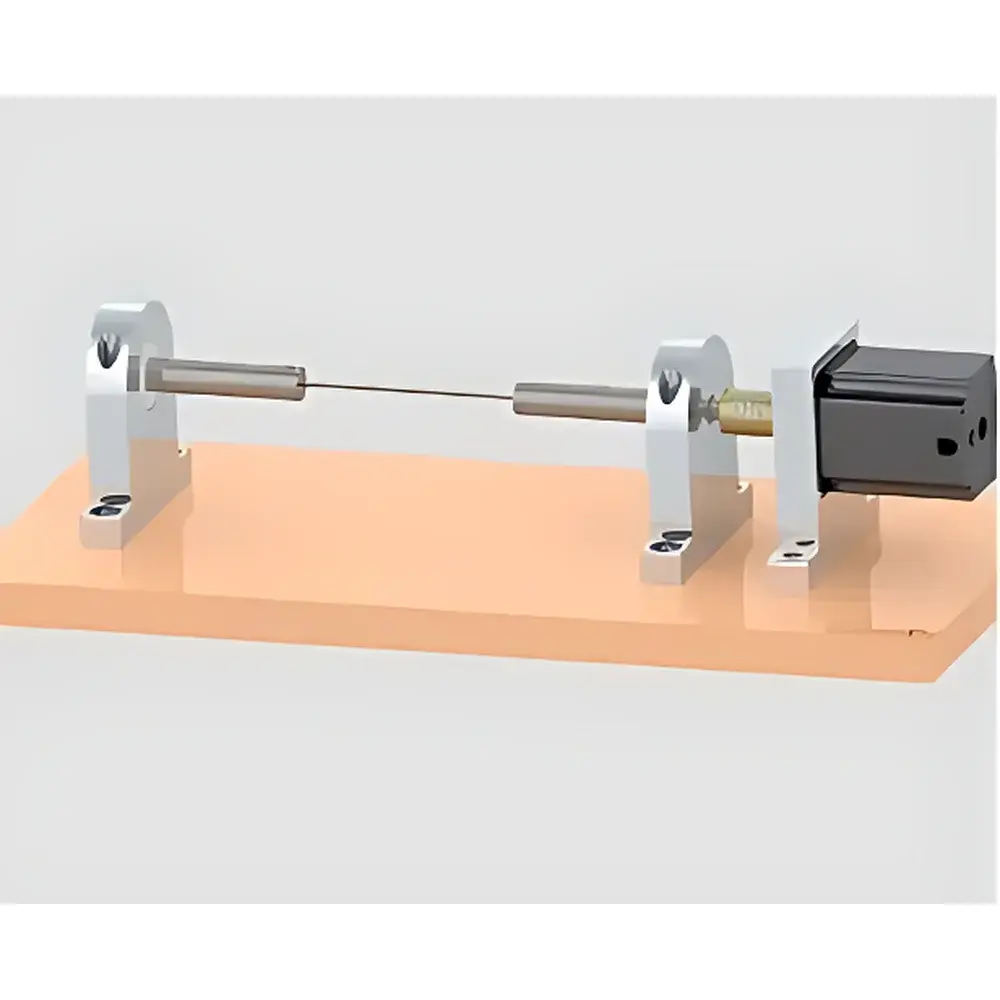
Truelab Fine-Rod Collector for Electrospinning (0–1000 rpm)
| Brand | Truelab |
|---|---|
| Origin | Shanghai, China |
| Manufacturer Type | Authorized Distributor |
| Country of Origin | China |
| Model | Fine-Rod Collector |
| Rotational Speed Range | 0–1000 rpm ±1 rpm |
| Motor | 57-step Hybrid Stepper Motor |
| Rod Material | AISI 304 Stainless Steel |
| Standard Rod Dimensions | Ø2.5 mm × L100 mm (customizable in diameter and length) |
| Base Material | Phenolic Resin (Bakelite) |
| Base Dimensions | 450 mm W × 200 mm D × 20 mm H |
| Overall Dimensions | 450 mm W × 200 mm D × 135 mm H |
| Weight | 10 kg |
Overview
The Truelab Fine-Rod Collector is a precision-engineered rotational collection system designed specifically for electrospinning applications requiring tubular or aligned nanofiber architectures. Unlike conventional flat-plate or drum collectors, this device employs a slender, high-aspect-ratio cylindrical rod that rotates at controlled angular velocities to induce directional fiber deposition via centrifugal alignment and electrostatic field modulation. Its operation is grounded in the principle of rotational field-assisted fiber orientation—where controlled surface velocity (0–1000 rpm ±1 rpm) governs fiber stretching, solvent evaporation kinetics, and inter-fiber spacing during deposition. The collector integrates seamlessly into standard electrospinning setups, serving as a core component for fabricating hollow nanotubes, coaxial scaffolds, and anisotropic biomaterial matrices used in vascular tissue engineering, filtration membranes, and sensor substrates.
Key Features
- High-resolution speed control: Digital stepper motor drive with ±1 rpm repeatability across the full 0–1000 rpm range, enabling precise tuning of fiber alignment density and morphology.
- Corrosion-resistant construction: AISI 304 stainless steel fine rod (standard Ø2.5 mm × 100 mm), certified for compatibility with organic solvents (e.g., DMF, chloroform, HFIP) and aqueous polymer solutions.
- Modular mechanical design: Interchangeable rod assemblies supported by low-outgassing phenolic resin (Bakelite) base—electrically insulating, dimensionally stable, and compliant with Class 1000 cleanroom handling protocols.
- Bidirectional rotation capability: Programmable forward/reverse mode via K11-series controller, facilitating layered deposition strategies and minimizing edge accumulation artifacts.
- Customization-ready architecture: Rod diameter (1.0–6.0 mm), length (50–300 mm), and surface finish (polished, grooved, or conductive-coated) available per ISO 80000-3 dimensional tolerancing standards.
Sample Compatibility & Compliance
The Fine-Rod Collector accommodates a broad spectrum of electrospinnable feedstocks, including but not limited to PCL, PLGA, PAN, collagen, gelatin methacryloyl (GelMA), and cellulose acetate. Its non-magnetic, non-polar base material prevents electromagnetic interference with high-voltage electrospinning power supplies (up to 30 kV). All structural components meet RoHS Directive 2011/65/EU requirements for hazardous substance restriction. While the unit itself is not a medical device, its configuration supports GLP-compliant process documentation when integrated with validated electrospinning platforms operating under ISO 13485–aligned quality systems.
Software & Data Management
The K11-series controller provides analog/digital I/O interfaces compatible with LabVIEW™, MATLAB® Data Acquisition Toolbox, and custom Python-based automation scripts (via RS-232 or USB-to-serial protocols). Real-time speed logging, runtime duration tracking, and direction-switch event timestamps are stored locally in CSV format. Audit-trail functionality—including user ID tagging and parameter change history—is achievable when paired with third-party SCADA environments compliant with FDA 21 CFR Part 11 requirements for electronic records and signatures.
Applications
- Production of hollow nanofibrous tubules for guided nerve regeneration and small-diameter vascular grafts.
- Controlled fabrication of aligned nanofiber bundles for piezoelectric energy harvesters and strain-sensitive biosensors.
- Rapid prototyping of gradient fiber density scaffolds in regenerative medicine research.
- Process development studies on solvent volatility–rotation rate coupling effects in multi-phase electrospinning.
- Teaching laboratory implementation for hands-on instruction in nanomaterial processing physics and rotational fluid dynamics.
FAQ
What is the maximum recommended continuous duty cycle for the stepper motor?
The 57-step hybrid stepper motor is rated for continuous operation at ≤60% of maximum speed (i.e., up to 600 rpm) without forced cooling. Intermittent use up to 1000 rpm is permissible for durations ≤15 minutes per session.
Can the rod be grounded externally for charge dissipation?
Yes—the stainless-steel rod features a dedicated M3 threaded grounding port located at the drive-end flange, compatible with standard 12 AWG grounding cables and DIN 40050-2 compliant clamps.
Is firmware update support available for the K11 controller?
Firmware revisions are distributed biannually via Truelab’s secure customer portal; updates require a valid hardware serial number and are validated against IEC 62443-3-3 security assurance levels.
Does the system comply with CE marking requirements for laboratory equipment?
The collector meets EMC Directive 2014/30/EU and Low Voltage Directive 2014/35/EU; CE marking applies to the complete assembled unit when used with certified power supplies and controllers.
What dimensional tolerances apply to custom rod orders?
Custom rods adhere to ISO 2768-mK general tolerances: ±0.05 mm for diameter, ±0.2 mm for length, with surface roughness Ra ≤0.8 µm unless specified otherwise.



