
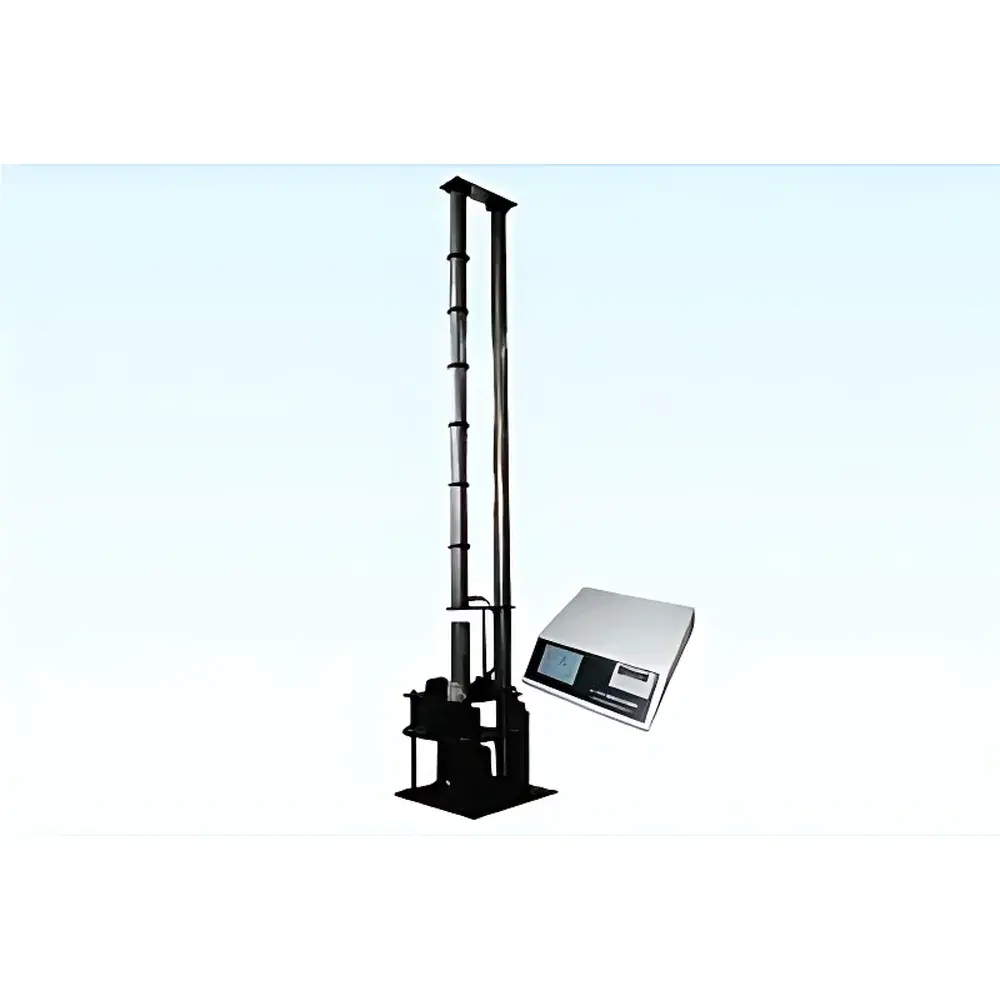
JC-300B Drop Weight Impact Tester
| Key | Origin: Jilin, China |
|---|---|
| Manufacturer Type | Authorized Distributor |
| Country of Origin | China |
| Model | JC-300B |
| Quotation | Available Upon Request |
| Max Impact Energy | 300 J |
| Max Drop Height | 2 m |
| Hammer Displacement Accuracy | ±2 mm |
| Max Combined Hammer Mass | 15 kg |
| Mass Tolerance per Weight | ±5 g |
| Hammer Tip Radii | SR=5, 10, 20, 30, 50 mm |
| Adjustable Hammer Masses | 1–10 kg (1 kg increments), plus 15 kg |
| Lifting Force Limit | ≤20 kgf |
| Impact Center Alignment Tolerance | ≤2 mm |
| Test Chamber Dimensions | 250 mm (H) × 300 mm (W) |
| Ring Clamps for Sheet Specimens | Φ40±1.0 mm, Φ80±2.0 mm, Φ130±2.5 mm |
| V-Notch Fixture for Pipes | 300 mm length, 120° opening angle |
| Recommended Sample Range | Pipes Φ20–Φ200 mm |
| Power Supply | AC 220 V |
| Overall Dimensions | 600×600×3100 mm |
Overview
The JC-300B Drop Weight Impact Tester is an engineered mechanical testing system designed for standardized evaluation of impact resistance in rigid thermoplastic materials—particularly pipes and flat sheets—under controlled free-fall conditions. Based on the fundamental principle of gravitational potential energy conversion into kinetic energy upon release, the instrument delivers precise, repeatable impact loads to specimens mounted in standardized fixtures. Its operation conforms to key international and national standards including GB/T 14153–1993 (General Method for Drop-Weight Impact Testing of Rigid Plastics), GB/T 14152–2001 (Test Method for Resistance to External Impact of Thermoplastic Pipes), and GB 11548–1989 (Impact Resistance Testing of Rigid Plastic Sheets). The tester employs a vertically guided hammer assembly with calibrated mass and drop height to generate defined impact energies up to 300 J, enabling compliance-driven quality assurance in manufacturing, R&D, and incoming material inspection environments.
Key Features
- Modular mechanical architecture with rigid steel frame, precision-machined guide columns, and low-friction hammer guidance for minimal lateral deviation during descent.
- Electromechanically actuated release and capture mechanism ensures consistent timing and eliminates operator-induced variability.
- Integrated color touchscreen controller with Chinese-language interface provides step-by-step procedural guidance, real-time status feedback, and intuitive parameter entry for test setup (e.g., drop height, hammer mass, dwell time).
- Dual-purpose fixture system: interchangeable ring clamps (Φ40, Φ80, Φ130 mm) for sheet specimens and adjustable V-groove supports (300 mm length, 120° angle) accommodating pipe diameters from 20 mm to 200 mm.
- Standardized hammer tip geometry options (SR = 5, 10, 20, 30, and 50 mm radii) allow selection per material stiffness and standard requirements—enabling correlation with ISO 6603-2 or ASTM D7192 methodologies where applicable.
- Modular weight set (1–10 kg in 1 kg increments + 15 kg) enables fine-tuned energy calibration without recalibration; individual weights certified to ±5 g tolerance.
- Independent control cabinet connected via shielded cable harness ensures electromagnetic compatibility and simplifies field service access without disassembly of the main structural frame.
Sample Compatibility & Compliance
The JC-300B accommodates flat specimens up to 200 mm × 200 mm and cylindrical pipes within the specified diameter range. All fixtures are manufactured to dimensional tolerances aligned with GB/T 14152–2001 and GB/T 14153–1993 requirements. The system supports both pass/fail assessment and quantitative energy-to-failure determination under standardized impact conditions. While not inherently compliant with ISO/IEC 17025 accreditation requirements out-of-the-box, the instrument’s traceable mass and height calibration points—and its deterministic mechanical behavior—facilitate integration into GLP- or GMP-aligned laboratory quality systems when paired with documented calibration procedures and operator training records. It is routinely deployed in third-party testing labs serving pipe extrusion manufacturers, construction material certifiers, and municipal infrastructure QA departments.
Software & Data Management
The embedded controller stores test parameters (mass, height, tip radius, specimen ID) and outcome classification (pass/fail, visible crack, full fracture) locally. Data export is supported via USB port in CSV format for external analysis or LIMS integration. Although the system does not include network connectivity or audit-trail functionality per FDA 21 CFR Part 11, its deterministic control logic and non-volatile parameter memory support reproducible test execution across shifts. For regulated environments, users may implement supplemental documentation workflows—including manual logbooks or electronic batch records—to satisfy traceability requirements for raw material qualification or production lot release.
Applications
- Verification of impact performance of PVC, PE, PP, and ABS pipes per GB/T 14152–2001 prior to pressure rating certification.
- Evaluation of brittle-to-ductile transition behavior in rigid plastic sheets used in automotive interior panels or packaging substrates.
- Comparative assessment of weathering effects on polymer impact toughness after UV exposure or thermal cycling.
- In-process quality control for extruded profiles where wall thickness variation may influence localized impact resistance.
- Supporting failure analysis investigations by correlating fracture morphology (e.g., radial cracking vs. circumferential splitting) with impact energy and hammer geometry.
FAQ
What standards does the JC-300B directly support?
The system is configured and validated for GB/T 14153–1993, GB/T 14152–2001, and GB 11548–1989. With appropriate fixture adaptation and calibration documentation, it can be operated in alignment with ASTM D7192 (for plastics) or ISO 6603-2 (impact testing of plastics—part 2: instrumented impact testing) principles.
Is calibration certification included with delivery?
A factory-issued calibration report covering hammer mass verification (±5 g), height measurement accuracy (±2 mm), and centering alignment (≤2 mm) is provided. Full ISO/IEC 17025-accredited calibration requires engagement with an external accredited provider.
Can the system be upgraded for instrumented impact measurement?
The base JC-300B is a non-instrumented (pass/fail or energy-threshold) tester. Integration of load cells or high-speed displacement sensors is not supported in the current design due to structural and firmware constraints.
What maintenance intervals are recommended?
Lubrication of guide rails and inspection of release solenoid function are advised every 500 test cycles. Annual verification of hammer tip geometry using optical profilometry is recommended for laboratories performing critical certification testing.



