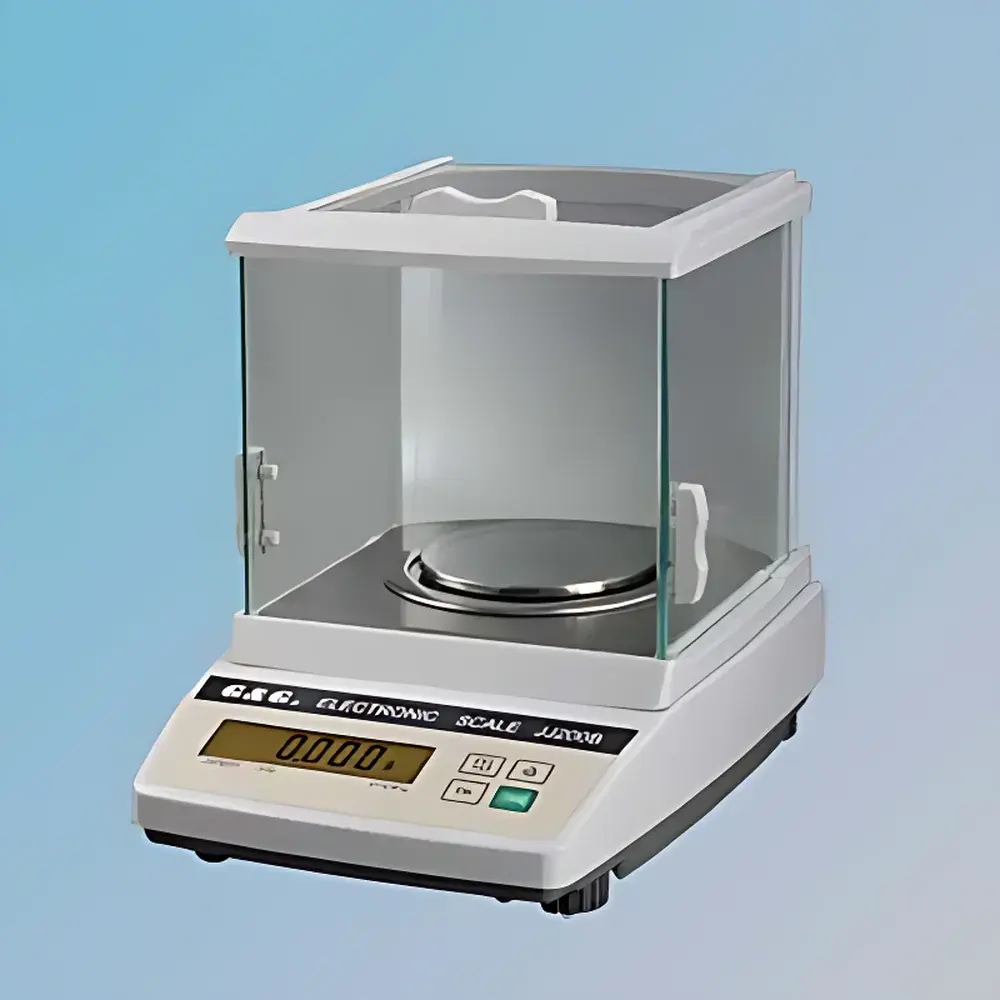
Truelab JJ100B / JJ200B Precision Analytical Balance
| Brand | Truelab |
|---|---|
| Origin | Shanghai, China |
| Model | JJ100B / JJ200B |
| Instrument Type | Analytical Balance |
| Capacity | 110 g / 200 g |
| Readability | 0.001 g (1 mg) |
| Repeatability | ±0.001 g |
| Calibration Method | Manual internal calibration (100 g / 200 g standard weight required) |
| Pan Diameter | Ø105 mm |
| Dimensions (L×W×H) | 325 × 211 × 110 mm |
| Power Supply | AC 220 V ±10%, 50 Hz ±1 Hz |
| Operating Temperature | 0–40 °C |
| Operating Humidity | ≤80 % RH (non-condensing) |
| Interface | RS232 serial port |
| Tare Range | 0–110 g / 0–200 g |
| Verification Scale Interval (e) | 0.01 g (10d) |
| Construction | Aluminum alloy base with EMI-shielded internal housing |
| Features | Stainless steel weighing pan, 7-unit conversion (g, oz, ct, dwt, grain, lb, tl), piece counting (sample size: 1/10/20/50/100), underhook weighing capability, LCD display |
Overview
The Truelab JJ100B and JJ200B are entry-level analytical balances engineered for precision mass measurement in academic teaching labs, QC environments, and routine industrial applications where 1 mg readability meets regulatory and procedural requirements. These balances operate on electromagnetic force compensation (EMFC) principles—utilizing a high-stability strain-gauge load cell paired with a digitally optimized control loop—to deliver consistent, traceable results across their full capacity range. Designed to ASTM E2229-22 and ISO 9001-aligned manufacturing standards, the JJ-series balances provide reliable metrological performance without requiring external vibration isolation tables under typical laboratory conditions. The integrated EMI shielding layer minimizes signal noise from adjacent instrumentation, while the rigid aluminum alloy chassis ensures mechanical stability during repeated loading cycles. Both models support below-balance weighing via a built-in underhook assembly, enabling density determination, magnetic susceptibility testing, or suspended sample analysis per ISO 8655-6 guidelines.
Key Features
- High-reproducibility strain-gauge sensor system with thermal drift compensation algorithm
- Stainless steel weighing pan (Ø105 mm) compatible with common lab solvents and cleaning agents
- Seven-unit conversion capability (g, oz, ct, dwt, grain, lb, tl) for cross-disciplinary workflow integration
- Internal tare function with full-range tare capacity (0–110 g / 0–200 g)
- Dual-mode counting function with programmable sample sizes (1, 10, 20, 50, or 100 pieces)
- RS232 serial interface compliant with NIST-traceable data logging protocols
- Underhook assembly mounted beneath the balance base for density, buoyancy, and magnetic measurements
- Backlit LCD display with 18-mm character height for improved readability under varied ambient lighting
- EMI-shielded internal architecture to maintain signal integrity in electromagnetically noisy environments
Sample Compatibility & Compliance
The JJ100B/JJ200B accommodates solid samples up to 110 g or 200 g respectively, with maximum dimensions constrained by pan diameter (Ø105 mm) and clearance height (~65 mm above pan surface). The stainless steel pan resists corrosion from aqueous solutions, mild acids, and organic solvents commonly used in pharmaceutical formulation and materials science workflows. These balances comply with OIML R76-1 (2021) class II requirements for non-automatic weighing instruments and meet the minimum verification criteria outlined in USP for analytical balance qualification when operated within specified environmental limits (0–40 °C, ≤80 % RH non-condensing). While not certified for GLP/GMP production environments without additional validation documentation, they are suitable for method development, raw material receipt inspection, and educational use per ISO/IEC 17025 clause 6.4.3.
Software & Data Management
Data output is supported exclusively via the RS232 interface using ASCII-based transmission protocol at 9600 baud, 8N1 configuration. The balance transmits stable weight values prefixed with “S” (stable) or “U” (unstable), followed by numeric mass value and unit identifier (e.g., “S 12.345 g”). This format enables direct import into Excel, LabArchives ELN, or custom LIMS platforms without proprietary drivers. No embedded software or firmware update capability is provided; all calibration and configuration parameters are stored in non-volatile memory and retained after power cycling. For audit trail compliance, users must implement external timestamping and user authentication at the host system level, as the device itself does not support FDA 21 CFR Part 11 electronic signature functionality.
Applications
- Weighing reference standards and certified reference materials (CRMs) in calibration laboratories
- Formulation of buffer solutions and reagent stock preparations in life science research
- Quality control checks of tablet mass uniformity per USP
- Gravimetric analysis including ash content, moisture loss on drying (LOD), and residue on ignition (ROI)
- Piece counting of small components (e.g., screws, pills, microfluidic chips) in manufacturing QA
- Density determination of solids using hydrostatic weighing with the underhook accessory
- Teaching fundamental metrology concepts—including repeatability, linearity, and eccentric load error—in undergraduate chemistry labs
FAQ
What is the verification scale interval (e) for the JJ100B and JJ200B?
The verification scale interval e is 0.01 g (10 × d), conforming to OIML R76-1 class II designation for non-automatic instruments.
Does the balance support automatic internal calibration?
No—it requires manual calibration using an external 100 g (JJ100B) or 200 g (JJ200B) Class M2 standard weight.
Can this balance be connected to a computer for automated data capture?
Yes, via RS232 serial interface; no USB or Ethernet connectivity is available.
Is the underhook suitable for density measurement according to ISO 1183-1?
Yes—the mechanical design allows suspension of samples in air and liquid media, supporting density calculations per ISO 1183-1 Annex A.
What environmental conditions must be maintained for optimal performance?
Ambient temperature between 0 °C and 40 °C, relative humidity ≤80 % RH (non-condensing), and minimal air currents or floor vibration.