
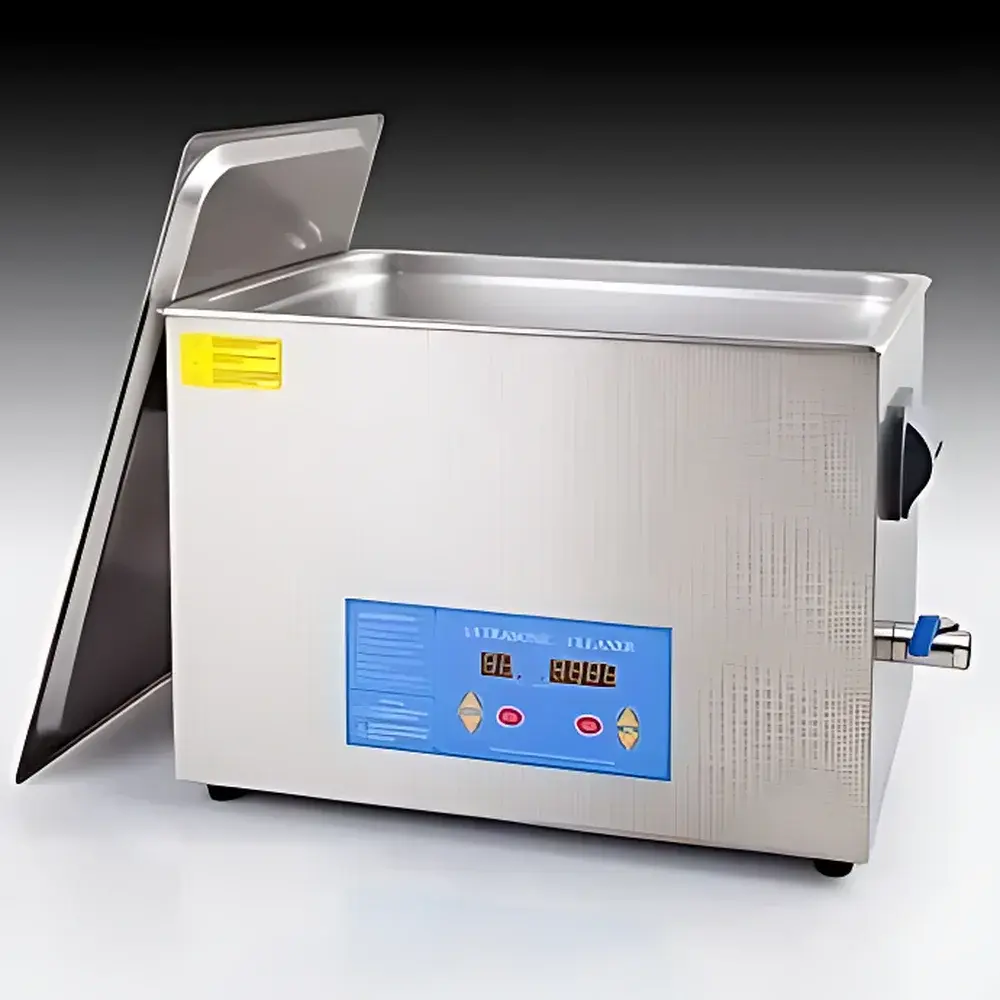
Truelab UC-T34D Desktop Digital Ultrasonic Cleaner
| Brand | Truelab |
|---|---|
| Origin | Shanghai, China |
| Model | UC-T34D |
| Type | General-purpose ultrasonic cleaner |
| Tank Capacity | 34.4 L |
| Ultrasonic Frequency | 40 kHz |
| Ultrasonic Power Output | 500 W (adjustable in fixed-step mode) |
| Heating Range | 0–80 °C (digitally adjustable) |
| Timer Range | 1 min – 99 min 59 sec |
| Sound-dampening Lid | Included |
| Drain Port | Integrated |
| Tank Dimensions (L×W×H) | 530 × 325 × 200 mm |
| Overall Dimensions (L×W×H) | 550 × 330 × 358 mm |
| Net Weight | 14.5 kg |
| Gross Weight | 15.2 kg |
| Construction | Full SUS304 stainless steel tank and housing |
| Control System | Industrial-grade microcontroller with digital LED display |
| Basket | Welded stainless steel mesh rack |
Overview
The Truelab UC-T34D is a benchtop digital ultrasonic cleaner engineered for precision cleaning, degassing, and surface decontamination in research laboratories, quality control environments, and small-scale manufacturing settings. It operates on the principle of acoustic cavitation: a 40 kHz ultrasonic generator drives piezoelectric transducers bonded to the bottom and/or sides of the stainless steel tank, producing high-frequency pressure waves in the cleaning medium. These waves generate transient microscopic vacuum bubbles that collapse violently upon reaching resonance—releasing localized energy sufficient to dislodge particulate contaminants, organic residues, oils, oxides, and biofilms from complex geometries, blind holes, and microstructures without mechanical abrasion. Unlike manual scrubbing or solvent immersion alone, ultrasonic cleaning delivers uniform, repeatable results across heterogeneous sample sets—including delicate optical components, PCB assemblies, surgical instruments, and biological substrates—making it indispensable for pre-analytical sample preparation and equipment maintenance workflows.
Key Features
- Monolithic SUS304 stainless steel tank formed via deep-drawing (no weld seams), ensuring long-term corrosion resistance and leak-free operation under continuous thermal and acoustic stress.
- High-efficiency piezoelectric transducers with optimized impedance matching deliver consistent 500 W ultrasonic power output at 40 kHz—providing optimal balance between cavitation intensity and gentle treatment of sensitive substrates.
- Digital microcontroller-based interface with dual LED displays for independent real-time monitoring and adjustment of ultrasonic duration (1:00–99:59 min:sec) and heating setpoint (0–80 °C).
- Integrated 500 W heating element with PID temperature regulation enables precise thermal control during hot cleaning cycles—critical for saponification of greases or accelerated solvent action.
- Sound-dampening hinged lid reduces ambient noise to <55 dB(A) at 1 m distance and minimizes solvent evaporation during extended operations.
- Ergonomic side handles and compact footprint (550 × 330 × 358 mm) support safe relocation within shared lab spaces; integrated drain valve with standard G1/2″ thread allows gravity-assisted emptying into floor drains or waste containers.
- Stainless steel wire mesh basket (argon-welded construction) ensures dimensional stability and chemical compatibility across aqueous, alkaline, and mild organic cleaning solutions.
Sample Compatibility & Compliance
The UC-T34D accommodates a broad range of sample types—including metal parts, glassware, ceramic filters, semiconductor wafers, endoscopic tools, and polymer-based labware—provided compatible cleaning chemistries are selected per material specifications. Its sealed tank design and stable temperature control meet baseline requirements for ISO 13485- and GLP-aligned cleaning validation protocols. While not certified for sterile processing per ISO 17664 or EN 285, the unit supports documented cleaning SOPs where thermal and ultrasonic parameters are logged manually or via external data loggers. All electrical components comply with IEC 61010-1 safety standards for laboratory equipment; CE marking applies to the EU market under applicable directives.
Software & Data Management
The UC-T34D operates as a standalone instrument with no embedded software stack or network connectivity. Parameter settings (time, temperature) are retained in non-volatile memory across power cycles but lack timestamped audit trails or electronic signature capability. For regulated environments requiring FDA 21 CFR Part 11 compliance, users must implement external validation procedures—including calibration records for temperature sensors (±1.0 °C accuracy verified annually) and timer verification (±0.5% tolerance). Optional integration with programmable logic controllers (PLCs) or SCADA systems is feasible via dry-contact relay outputs (available on request), enabling centralized cycle logging and interlock coordination.
Applications
- Pretreatment of HPLC vials, GC liners, and ICP-MS nebulizers to eliminate trace metal carryover.
- Removal of flux residues and solder mask debris from printed circuit boards prior to AOI inspection.
- Decontamination of reusable pipette tips, centrifuge rotors, and electrophoresis combs in molecular biology labs.
- Surface activation of titanium implants and dental prosthetics before coating or bonding.
- Extraction assistance for plant metabolites and environmental analytes using low-temperature sonication in ethanol/water mixtures.
- Routine maintenance of optical lenses, spectrometer cuvettes, and AFM probes to preserve surface integrity.
FAQ
Is the ultrasonic power output continuously variable?
No—the UC-T34D delivers fixed 500 W nominal output. Power modulation is achieved only via duty-cycle control (pulse-width modulation) during timed cycles, not analog amplitude adjustment.
Can this unit be used with flammable solvents?
Not recommended. The heater and transducer surfaces may exceed autoignition temperatures of alcohols, acetone, or hydrocarbons. Only aqueous or water-miscible solutions with flash points >60 °C should be used.
What is the maximum allowable liquid level in the tank?
Fill to 20–50 mm below the tank rim to ensure optimal cavitation field distribution and prevent overflow during active degassing.
Does the unit include a degas function?
Yes—running the ultrasonics for 5–10 minutes without heating effectively removes dissolved air from freshly filled baths, enhancing subsequent cleaning efficiency.
How often should the transducers be inspected for performance drift?
Annual verification using calibrated hydrophone measurements or comparative cleaning tests (e.g., aluminum foil erosion assay per ASTM D2603) is advised for critical applications.



