
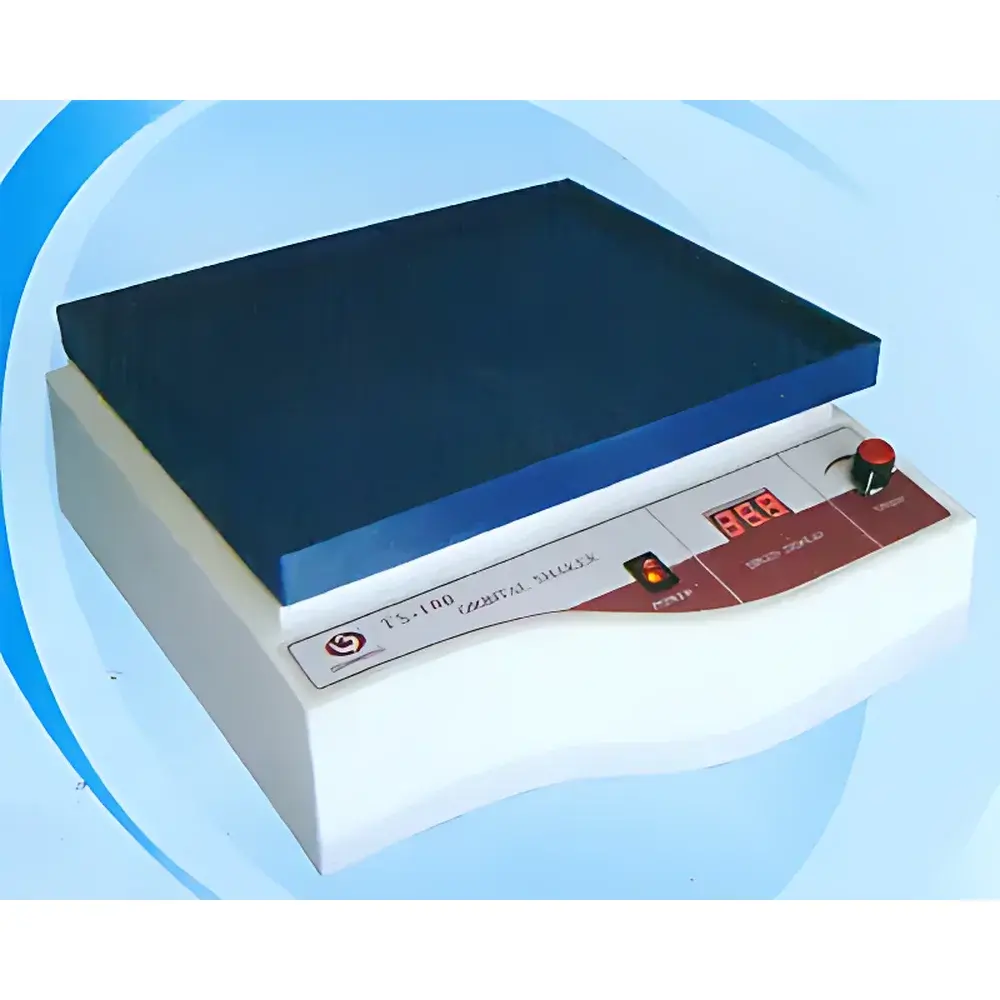
TS-2 Decolorization Shaker
| Origin | Jiangsu, China |
|---|---|
| Manufacturer Type | Distributor |
| Origin Category | Domestic (China) |
| Model | TS-2 |
| Price | USD 230 (FOB) |
| Power Supply | 220 V AC, 50 Hz |
| Rated Power | 30 W |
| Speed Range | 30–240 rpm |
| Orbit Diameter | 30 mm (15 mm radius) |
| Speed Control | Continuous digital adjustment with LED display |
| Platform Dimensions | 280 × 260 mm |
| External Dimensions | 350 × 260 × 150 mm |
| Operating Environment | Compatible with refrigerated and incubated chambers (−10 °C to 60 °C) |
Overview
The TS-2 Decolorization Shaker is a compact, digitally controlled orbital shaker engineered for precise, low-shear agitation in molecular biology and biochemistry workflows. Designed around a robust brushless DC motor and precision-machined eccentric drive mechanism, it delivers stable, repeatable orbital motion (30 mm diameter orbit) across its full speed range of 30–240 rpm. Its primary function is to facilitate uniform solution exchange and mass transfer during post-electrophoretic processing—including gel fixation, Coomassie Blue staining and destaining, silver nitrate-based staining (fixation, sensitization, development), and autoradiography film development/fixation. The unit’s low-profile form factor (150 mm height), sealed electronics, and absence of external ventilation grilles enable safe, uninterrupted operation inside cold rooms (−10 °C), standard incubators (up to 37 °C), and CO₂-controlled environments—making it suitable for membrane-based assays such as Southern/Northern/Western blotting, immunoassays, and antigen–antibody hybridization steps where temperature stability and mechanical consistency are critical.
Key Features
- Digital LED speed display with continuous, stepless adjustment from 30 to 240 rpm—enabling fine-tuned optimization for delicate membranes or viscous staining solutions.
- Stainless-steel reinforced platform (280 × 260 mm) with non-slip silicone mat surface, accommodating standard electrophoresis trays (e.g., 15 × 20 cm gels), X-ray film cassettes, and hybridization bottles up to 500 mL.
- Low-noise, maintenance-free brushless DC motor ensures long-term operational stability and eliminates carbon brush wear—critical for unattended overnight runs.
- Compact footprint (350 × 260 mm base) and shallow depth (150 mm height) allow integration into confined spaces, including under-bench refrigerated cabinets and modular incubator stacks.
- IP20-rated enclosure with internal condensation management—validated for continuous use at ambient humidity levels up to 80% RH and temperatures spanning −10 °C to 60 °C.
Sample Compatibility & Compliance
The TS-2 supports a broad range of sample containers: polyacrylamide and agarose gels in staining trays (up to 20 × 20 cm), cellulose acetate and nitrocellulose membranes in hybridization bags or roller bottles, X-ray film cassettes (standard 14 × 17 inch format), and microcentrifuge tube racks (optional accessory). It complies with IEC 61010-1:2010 for laboratory electrical equipment safety and meets EMC requirements per CISPR 11 Group 1, Class B. While not certified for GLP/GMP production environments, its consistent speed reproducibility (±2 rpm over 8-hour runtime) and traceable digital control support documentation-aligned workflows in academic and diagnostic research labs adhering to ISO/IEC 17025 principles.
Software & Data Management
The TS-2 operates as a standalone instrument with no embedded firmware or network interface. All operational parameters are set manually via front-panel keypad and displayed in real time on a 3-digit LED screen. No data logging, USB export, or remote control capability is provided—consistent with its design intent as a dedicated, low-complexity auxiliary device for routine wet-lab procedures. For laboratories requiring audit trails, manual logbook entries (time, speed, duration, operator ID) are recommended and compatible with standard QC documentation practices under CLIA and CAP guidelines.
Applications
- Post-electrophoresis gel processing: formaldehyde fixation, Coomassie R-250/Brilliant Blue G staining, methanol/acetic acid destaining, and silver nitrate sensitization/development cycles.
- Radiographic film handling: uniform agitation during developer, stop bath, and fixer immersion in autoradiography workflows (e.g., 32P- or 125I-labeled probes).
- Membrane-based detection: hybridization buffer equilibration, pre-hybridization blocking, probe hybridization (DNA/DNA, DNA/RNA), stringent washes, and antibody incubation steps on nitrocellulose or PVDF membranes.
- Cellular assays: gentle suspension of adherent cells during detachment protocols, uniform coating of culture surfaces with extracellular matrix proteins, and low-shear resuspension of transfected cell pellets prior to lysis.
FAQ
Can the TS-2 be operated inside a −20 °C freezer?
Yes—the unit has been validated for continuous operation between −10 °C and 60 °C; however, extended exposure below −10 °C may affect LED display responsiveness and rubber mat elasticity. Pre-cooling the unit for 30 minutes before insertion is advised.
Is the platform compatible with vacuum-sealed hybridization bags?
Yes—its 30 mm orbit and low acceleration profile (≤0.8 g at 240 rpm) prevent bag rupture while ensuring efficient reagent penetration across membrane surfaces.
Does the shaker include overload or thermal protection?
Yes—a thermally actuated cut-off switch interrupts power if internal motor temperature exceeds 90 °C, automatically resetting upon cooldown.
What is the tolerance for speed accuracy across the operating range?
Calibrated speed deviation is ≤ ±2 rpm at any setpoint between 30 and 240 rpm, verified using NIST-traceable optical tachometry.
Can custom platform inserts (e.g., for microtiter plates) be ordered?
No—platform configuration is fixed; however, third-party universal clamping accessories (ISO 9001-certified) may be mounted using the existing M4 threaded holes at each corner.




