
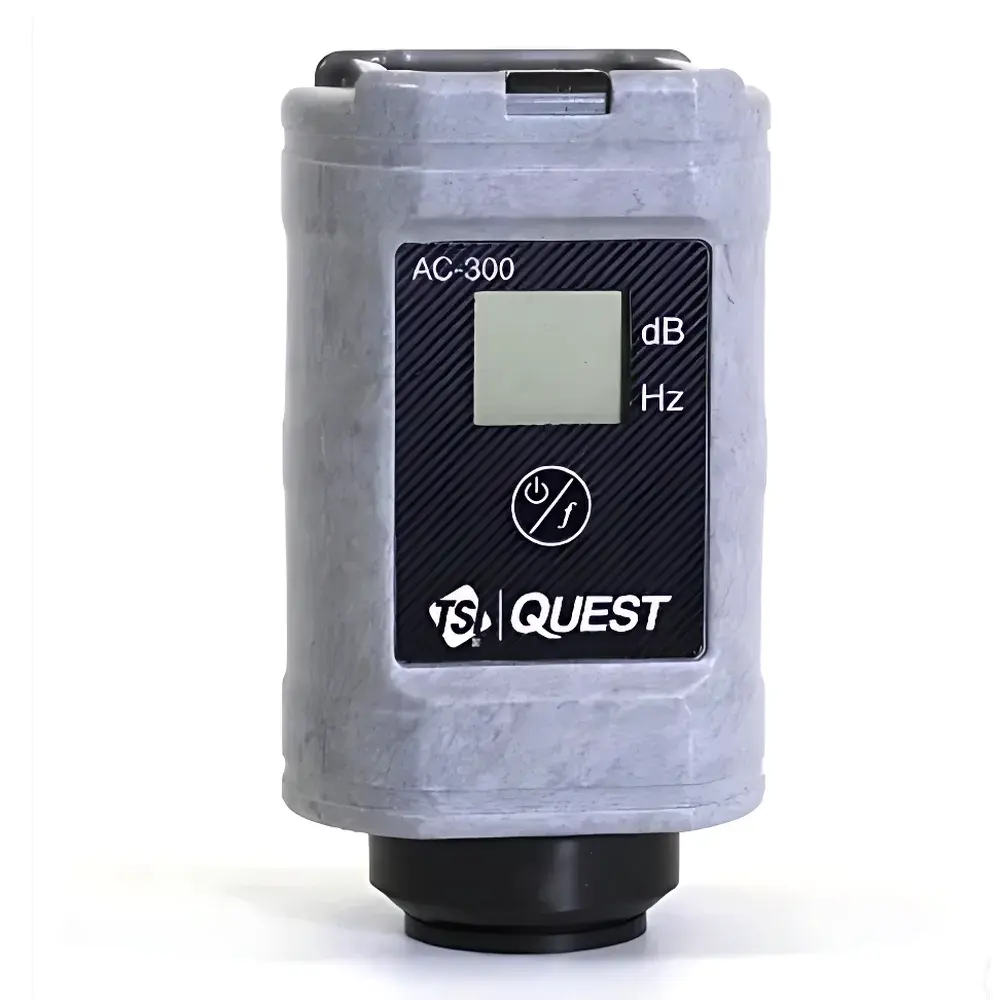
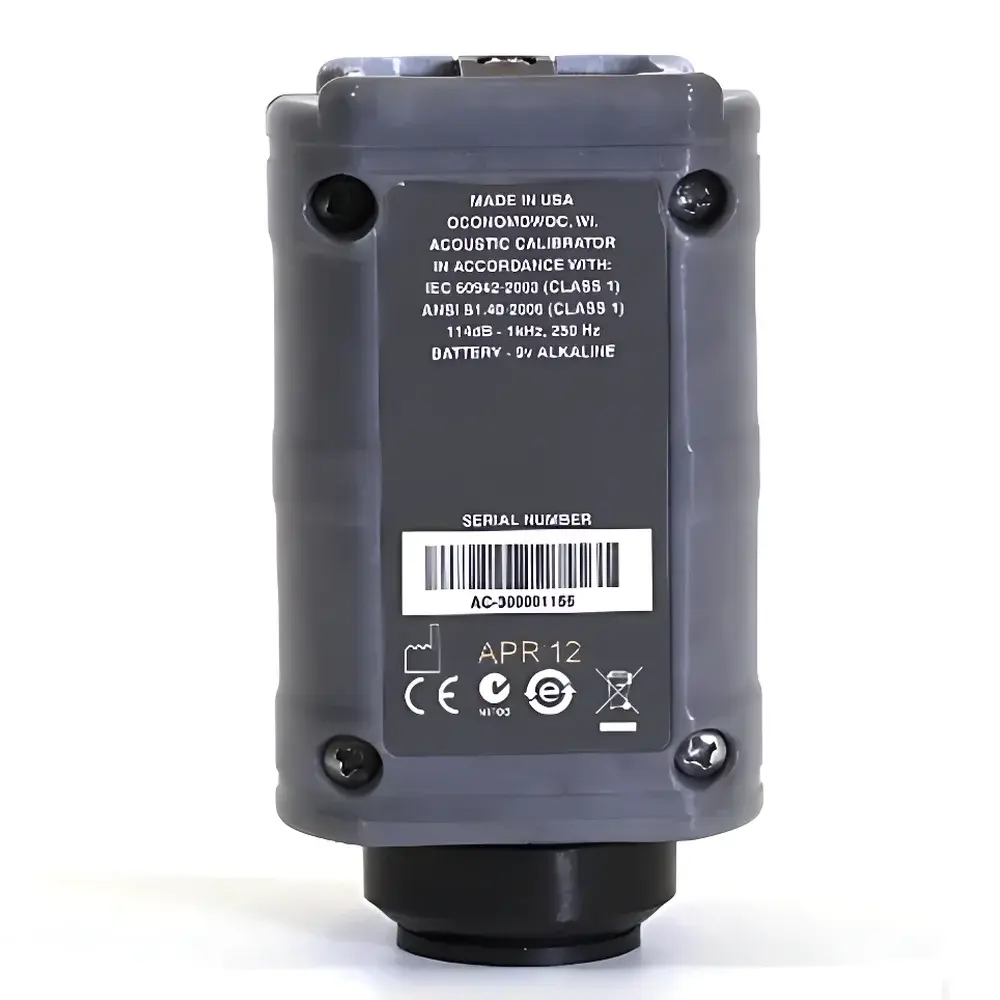
TSI 3M AC-300 Acoustic Calibrator
| Brand | TSI |
|---|---|
| Origin | USA |
| Model | 3M AC-300 |
| Sound Pressure Level | 114 dB re 20 µPa |
| Frequencies | 250 Hz and 1000 Hz |
| Accuracy Class | Class 1 per IEC 60942:2003 and ANSI S1.40-2006(R2011) |
| Dimensions | 10 cm × 5.8 cm × 4.6 cm |
| Weight | 0.17 kg |
| Power | 1 × 9 V alkaline battery |
| Battery Life | ~18 h (at 1 kHz) |
| Operating Temperature | −10 °C to 50 °C |
| Atmospheric Pressure Range | 65–108 kPa |
| Relative Humidity | 10–90 % RH (non-condensing) |
| Auto-off | 4 min inactivity |
| Compliance | CE, RoHS, WEEE, C-Tick |
Overview
The TSI 3M AC-300 Acoustic Calibrator is a portable, handheld Class 1 sound calibrator engineered for field and laboratory verification of sound level meters (SLMs), noise dosimeters, and acoustic analyzers. It operates on the principle of generating a precisely defined sinusoidal tone at fixed frequencies—250 Hz and 1000 Hz—using an integrated electroacoustic transducer housed in a sealed coupler cavity. The device delivers a stable, repeatable sound pressure level of 114.0 dB re 20 µPa, traceable to national metrological standards. Its design adheres strictly to the performance requirements of IEC 60942:2003 (Electroacoustics — Sound calibrators) and ANSI S1.40-2006(R2011) (Specifications for Acoustical Calibration Sources), ensuring compliance with international calibration protocols required for ISO/IEC 17025-accredited laboratories and regulatory noise monitoring programs.
Key Features
- Single-button operation for rapid frequency selection between 250 Hz and 1000 Hz—no menu navigation or configuration required.
- Class 1 accuracy per IEC 60942:2003 and ANSI S1.40-2006(R2011), supporting validation of Type 1 and Type 2 sound level meters used in occupational health, environmental noise assessment, and product compliance testing.
- Integrated low-battery indicator provides visual feedback prior to voltage drop below operational threshold, minimizing risk of undetected calibration drift during field use.
- Automatic power-down after 4 minutes of inactivity conserves battery life—enabling up to 18 hours of continuous operation at 1 kHz—without compromising measurement stability or requiring manual shutdown procedures.
- Compact, ergonomic housing (10 × 5.8 × 4.6 cm; 0.17 kg) designed for one-handed coupling to microphone preamplifiers and SLM inlet ports, even in confined or outdoor environments.
- Robust environmental tolerance: functional across −10 °C to 50 °C ambient temperature, 65–108 kPa atmospheric pressure, and 10–90 % non-condensing relative humidity—suitable for industrial plants, construction sites, urban noise surveys, and transportation corridors.
Sample Compatibility & Compliance
The AC-300 is compatible with all standard ½-inch and ¼-inch condenser microphone capsules commonly used in professional-grade sound level meters—including those conforming to IEC 61672-1:2013 (Electroacoustics — Sound level meters). Its coupler geometry and acoustic loading characteristics meet the dimensional and impedance-matching criteria specified in IEC 60942 for Class 1 devices. Regulatory alignment extends beyond basic calibration: the unit bears CE marking under the EU Machinery Directive, complies with RoHS 2011/65/EU and WEEE 2012/19/EU directives, and satisfies Australian C-Tick electromagnetic compatibility requirements. For quality assurance systems operating under GLP or ISO 14001 frameworks, the AC-300 supports documented calibration intervals and traceable verification records when paired with certified reference microphones and data loggers.
Software & Data Management
While the AC-300 is a standalone analog calibrator with no embedded firmware or digital interface, its output stability and repeatability support integration into automated calibration workflows. When used in conjunction with TSI’s legacy calibration management software (e.g., Q-Trak™ Suite) or third-party platforms compliant with ASTM E2622-21 (Standard Practice for Calibration of Sound Level Meters Using Acoustic Calibrators), users can generate audit-ready calibration certificates that include date/time stamps, operator ID, instrument serial numbers, and pass/fail status against tolerance limits defined in ISO 9001 Clause 7.1.5. Calibration history may be archived alongside SLM measurement datasets to satisfy FDA 21 CFR Part 11 requirements for electronic records where applicable—provided external logging hardware implements appropriate audit trails and user authentication.
Applications
- Ongoing verification of sound level meters prior to and following occupational noise exposure assessments (per OSHA 29 CFR 1910.95 and EU Directive 2003/10/EC).
- Field validation of environmental noise monitoring stations deployed near airports, highways, and rail infrastructure.
- Pre-deployment checks for noise mapping campaigns conducted under ISO 1996-2:2017 (Acoustics — Description, measurement and assessment of environmental noise).
- Quality control of acoustic test fixtures in automotive, aerospace, and consumer electronics manufacturing facilities.
- Educational use in university acoustics laboratories for teaching fundamental principles of sound pressure level traceability and uncertainty propagation.
FAQ
What standards does the AC-300 comply with?
IEC 60942:2003 (Class 1), ANSI S1.40-2006(R2011), CE, RoHS, WEEE, and C-Tick.
Can it calibrate both ½-inch and ¼-inch microphones?
Yes—the coupler design accommodates standard ½-inch and ¼-inch electret and externally polarized condenser microphones without adapters.
Is battery replacement user-serviceable?
Yes—requires a single 9 V alkaline battery (IEC 6F22 or ANSI 1604A); no tools are needed.
Does it require annual recalibration?
Per ISO/IEC 17025:2017, accredited labs must verify calibrator performance at least annually using a reference standard traceable to NIST or equivalent NMIs.
What is the uncertainty contribution of the AC-300 to overall SLM measurement uncertainty?
When operated within specification, its maximum expanded uncertainty (k=2) contributes ≤ ±0.2 dB to the combined uncertainty budget of a typical Class 1 SLM system.
Related Products







