
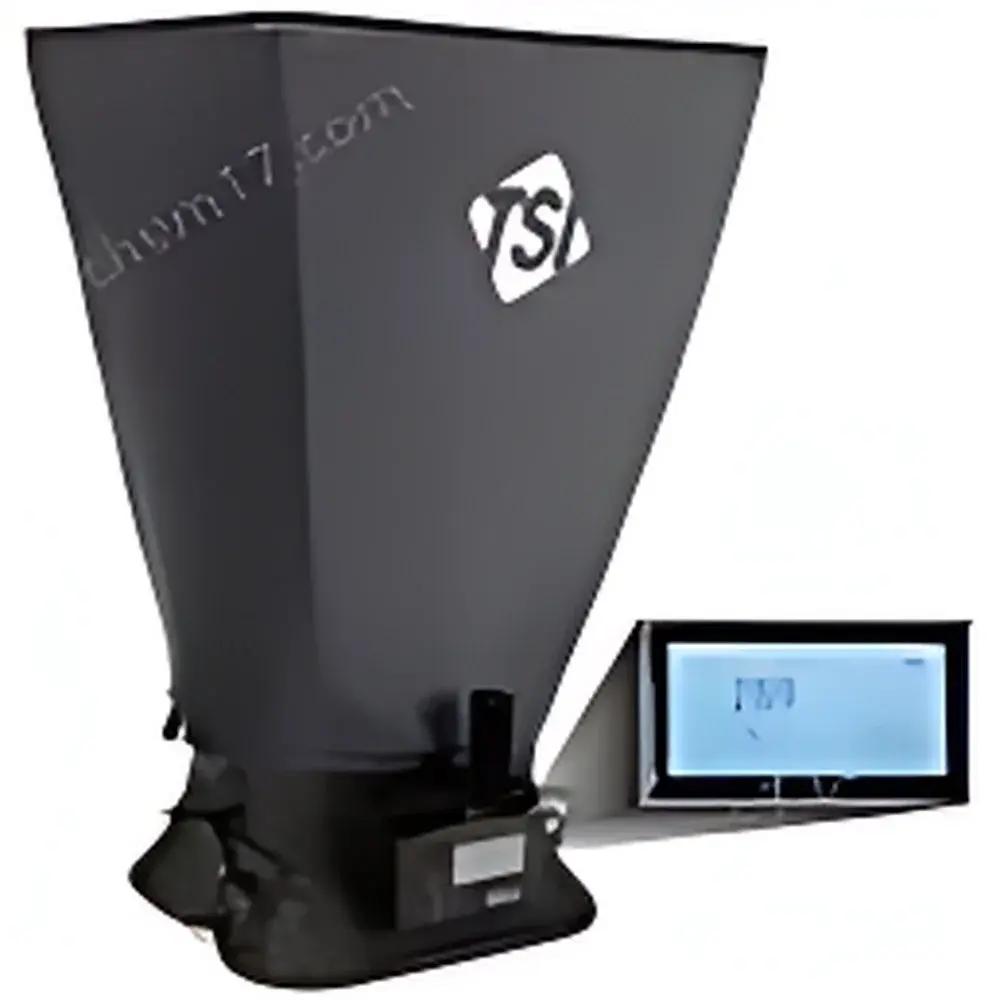
TSI ACCUBALANCE Digital Air Flow Hood
| Brand | TSI |
|---|---|
| Origin | USA |
| Model | ACCUBALANCE |
| Weight | 3.4 kg (with 610 × 610 mm hood) |
| Air Flow Range | 42–4250 m³/hr |
| Accuracy | ±3% of reading or ±12 m³/hr (for flow >85 m³/hr) |
| Resolution | 1 m³/hr |
| Velocity Range (Pitot Tube) | 0.125–78 m/s |
| Velocity Range (Air Velocity Probe) | 0.125–25 m/s |
| Velocity Range (16-Point Matrix) | 0.125–12.5 m/s |
| Velocity Accuracy | ±3% of reading or ±0.04 m/s |
| Resolution | 0.01 m/s |
| Differential Pressure | ±3735 Pa (max 37.5 kPa) |
| Absolute Pressure | 356–1016 mmHg |
| Pressure Accuracy | ±2% of reading or ±0.25 Pa |
| Relative Humidity Range | 5–95% RH |
| RH Accuracy | ±3% RH |
| RH Resolution | 0.1% RH |
| Temperature Range (Thermistor) | 4.4–60 °C |
| Temp Range (Thermo-Hygrometer Probe) | −10–60 °C |
| Temp Accuracy | ±0.3 °C |
| Temp Resolution | 0.1 °C |
| Power | 4 × AA batteries or AC adapter |
| Interface | USB |
| Operating Temperature | 0–60 °C |
| Standard Hood Size | 610 × 610 mm |
Overview
The TSI ACCUBALANCE Digital Air Flow Hood is an engineered field instrument designed for rapid, accurate, and repeatable measurement of volumetric air flow through HVAC diffusers, grilles, registers, and laminar flow hoods—including biological safety cabinets (BSCs). It operates on the principle of integrated velocity-area measurement: a calibrated, low-pressure-drop airflow capture hood—fitted with a built-in, NIST-traceable thermal anemometer array and pressure-sensing elements—collects total airflow while compensating for turbulence, swirl, and non-uniform velocity profiles via its standard X-type flow-straightening grid. The system computes real-time volumetric flow (m³/hr) by integrating point-velocity measurements across the hood’s cross-section, applying K-factor correction for diffuser-specific discharge coefficients. Its lightweight, ergonomic architecture (3.4 kg with 610 × 610 mm hood) enables single-operator deployment in ceiling-height installations, cleanroom validation, and commissioning workflows where portability and precision are critical.
Key Features
- Integrated digital air flow hood with backlit LCD display for immediate readout of supply/exhaust airflow (m³/hr), velocity (m/s), temperature (°C), and relative humidity (%RH)
- Standard swirl-compensating X-grid ensures stable, low-turbulence sampling at high-velocity or vortex-prone outlets (e.g., perforated plates, slot diffusers)
- Backpressure compensation algorithm maintains measurement integrity under variable static pressure conditions typical in ducted systems
- K-factor functionality allows user-defined calibration coefficients for diverse diffuser geometries, supporting ASHRAE 111 and ISO 16813-compliant airflow reporting
- Modular probe compatibility: accepts TSI 960-series thermal anemometers, Pitot tubes, 16-point velocity matrices, thermo-hygrometer probes, and differential pressure sensors
- NIST-traceable calibration certificate included; field recalibration supported via onboard zero and span functions
- USB interface enables direct data export to TSI’s TrakPro™ Lite software or third-party CSV-compatible platforms
Sample Compatibility & Compliance
The ACCUBALANCE accommodates a wide range of outlet configurations through interchangeable hood sizes (including 610 × 610 mm standard, plus optional smaller/larger variants) and specialized accessories such as the BSC hood kit—designed to meet NSF/ANSI 49 and EN 12469 requirements for biosafety cabinet performance verification. Its measurement methodology aligns with ASTM D1212 (air velocity), ISO 16813 (HVAC system testing), and ASHRAE Guideline 12-2020 (infection control during construction). When used with optional thermal probes and humidity sensors, it supports GLP/GMP environmental monitoring protocols requiring documented traceability, audit trails, and data integrity per FDA 21 CFR Part 11 (when paired with compliant software).
Software & Data Management
The ACCUBALANCE stores up to 26,500 time-stamped samples internally—including flow, velocity, temperature, RH, and pressure—with automatic timestamping and user-defined location tags. Data is retrievable via USB and compatible with TSI TrakPro™ Lite (free), which provides visualization, statistical analysis (min/max/avg/std dev), report generation (PDF/CSV), and export to Excel. For regulated environments, integration with validated LIMS or electronic lab notebooks is achievable using standardized data structures. All stored datasets include metadata such as instrument ID, operator name, calibration date, ambient conditions, and measurement duration—enabling full chain-of-custody documentation required under ISO/IEC 17025 accreditation.
Applications
- HVAC commissioning, balancing, and TAB (Testing, Adjusting, and Balancing) per NEBB and AABC standards
- Cleanroom classification (ISO 14644-3) and airflow uniformity mapping in pharmaceutical and semiconductor facilities
- Biosafety cabinet certification (NSF/ANSI 49) including inflow velocity, downflow velocity, and alarm verification
- Energy audits and retrocommissioning projects requiring quantified air distribution efficiency
- Academic and industrial ventilation research involving localized flow profiling and thermal comfort assessment
- Facility maintenance programs tracking long-term diffuser performance degradation
FAQ
What is the maximum airflow the ACCUBALANCE can measure?
The ACCUBALANCE measures volumetric airflow from 42 to 4250 m³/hr, with optimal accuracy above 85 m³/hr (±3% of reading or ±12 m³/hr, whichever is greater).
Does it support compliance with FDA 21 CFR Part 11?
While the instrument itself does not embed electronic signatures or role-based access, its data export structure and audit-ready metadata (time stamps, calibration records, operator IDs) enable Part 11 compliance when deployed within a validated software environment and procedural controls.
Can I use the same unit for both supply and exhaust measurements?
Yes—the ACCUBALANCE automatically detects flow direction and displays signed values (positive for supply, negative for exhaust), eliminating manual polarity correction.
Is the NIST-traceable calibration certificate valid for ISO/IEC 17025 accredited labs?
The included certificate satisfies initial metrological traceability requirements; however, accredited laboratories must perform periodic in-house verification or send the unit to an ILAC-MRA signatory calibration lab for formal scope coverage.
How does the K-factor function improve measurement accuracy?
K-factor adjusts for diffuser-specific discharge characteristics by applying a manufacturer-provided or empirically derived coefficient—ensuring reported airflow reflects true volumetric delivery rather than idealized free-jet assumptions.
Related Products







