
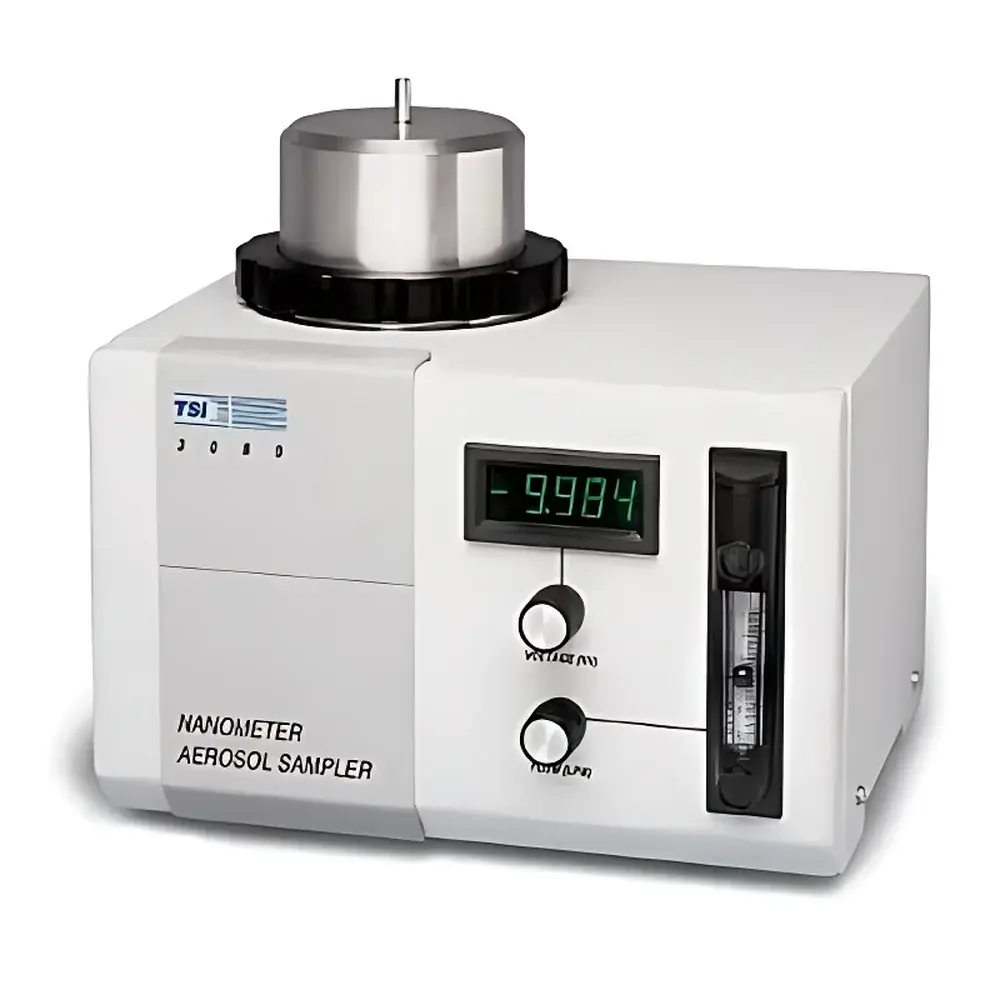
TSI Model 3089 Nanoparticle Aerosol Sampler
| Origin | USA |
|---|---|
| Manufacturer Type | Authorized Distributor |
| Origin Category | Imported |
| Model | 3089 |
| Pricing | Available Upon Request |
| Operating Principle | Electrostatic Deposition |
| Particle Type | Solid or Non-Volatile Liquid Aerosols |
| Size Range | 2–100 nm |
| Flow Rate | 0.2–2.5 L/min |
| Ambient Temperature | 10–50 °C |
| Relative Humidity | 0–90 % RH (non-condensing) |
Overview
The TSI Model 3089 Nanoparticle Aerosol Sampler is an engineered electrostatic deposition instrument designed for size-selective collection of airborne nanoparticles in the 2–100 nm diameter range. It operates on the principle of unipolar ion charging followed by controlled electrostatic precipitation onto a conductive substrate—typically a TEM grid, silicon wafer, or carbon-coated stub—enabling high-fidelity morphological and compositional analysis downstream. The sampler is optimized for integration with differential mobility analyzers (DMAs), such as the TSI 3080N Nano Differential Mobility Analyzer, to achieve monodisperse nanoparticle sampling under laminar flow conditions. Its design adheres to fundamental aerosol science principles outlined in ISO 14644-1 (cleanroom classification), ASTM D6243 (aerosol generation and characterization), and supports traceable nanoparticle metrology workflows required in nanomaterial safety assessment, semiconductor process monitoring, and inhalation toxicology research.
Key Features
- Electrostatic deposition architecture enabling high-efficiency, low-loss collection of sub-100 nm particles without thermal or mechanical stress
- Adjustable voltage supply (0–±5 kV) for precise control over deposition field strength and particle trajectory
- Modular inlet configuration compatible with standard 1/4″ Swagelok tubing and DMA coupling interfaces
- Integrated flow meter with digital readout calibrated to NIST-traceable standards (±2% full-scale accuracy)
- Temperature- and humidity-stabilized chamber housing to maintain consistent deposition efficiency across ambient conditions (10–50 °C, 0–90 % RH non-condensing)
- Removable, interchangeable collector stages supporting multiple substrate formats including 3 mm TEM grids, 12.7 mm SEM stubs, and custom-patterned wafers
Sample Compatibility & Compliance
The Model 3089 accommodates both solid nanoparticles (e.g., metal oxides, quantum dots, carbon nanotubes) and non-volatile liquid aerosols (e.g., polymeric nanoparticles, lipid vesicles). It excludes volatile organic compounds (VOCs), semi-volatile species, or thermally labile biomolecules that may evaporate or degrade during deposition. Collection substrates are compatible with subsequent analytical techniques including transmission electron microscopy (TEM), scanning electron microscopy (SEM), atomic force microscopy (AFM), scanning tunneling microscopy (STM), and energy-dispersive X-ray spectroscopy (EDS). The system meets mechanical and electrical safety requirements per IEC 61010-1 and is routinely deployed in laboratories operating under GLP-compliant protocols for nanomaterial characterization. While not a standalone regulatory device, its output supports data generation aligned with OECD Test Guideline 125 (nanomaterials) and ISO/IEC 17025-accredited testing environments.
Software & Data Management
The Model 3089 operates as a hardware-controlled analog system with no embedded firmware or proprietary software interface. All operational parameters—including applied voltage, volumetric flow rate, and ambient temperature/humidity—are monitored via front-panel analog meters and calibrated analog outputs (0–5 V DC). For integrated data logging, users commonly interface the unit with third-party DAQ systems (e.g., National Instruments USB-6009) or LabVIEW-based acquisition platforms. Voltage and flow signals support time-synchronized recording, enabling correlation with upstream DMA scan data or real-time aerosol concentration metrics from condensation particle counters (CPCs). Audit trails, electronic signatures, and 21 CFR Part 11 compliance are implemented at the laboratory information management system (LIMS) level—not within the sampler itself—ensuring flexibility in regulated environments.
Applications
- Preparation of monodisperse nanoparticle samples for high-resolution TEM/SEM imaging and crystallographic analysis
- In situ deposition of engineered nanomaterials onto sensor substrates for functional property evaluation
- Aerosol exposure studies requiring particle-size-resolved dosimetry for in vitro and in vivo inhalation models
- Source apportionment of ultrafine particulate matter (UFP) in urban, occupational, and indoor air quality monitoring
- Quality control of nanoparticle synthesis processes (e.g., flame spray pyrolysis, laser ablation) via offline morphology validation
- Reference material generation for calibration of nanoparticle sizers (e.g., SMPS, APS) and optical particle counters
FAQ
Can the Model 3089 collect volatile organic nanoparticles?
No. The electrostatic deposition mechanism requires particle stability under ambient conditions; volatile or semi-volatile species will evaporate prior to or during collection.
Is the 3089 compatible with non-TSI DMAs?
Yes—provided the DMA outlet matches the 3089’s 1/4″ inlet port and delivers a laminar, low-turbulence aerosol stream with stable sheath-to-aerosol flow ratios.
What is the typical collection efficiency for 5 nm particles?
Under optimal conditions (2.0 L/min flow, +3 kV bias, 3 mm TEM grid), collection efficiency exceeds 65% for 5 nm particles, consistent with theoretical predictions from the Pui–Liu–Kaufman model.
Does the instrument require annual recalibration?
Flow calibration is recommended annually using a NIST-traceable primary standard; voltage calibration is stable for ≥24 months under normal use.
Can it be used in Class 100 cleanrooms?
Yes—the unit’s stainless-steel housing and sealed electronics meet ISO 14644-1 Class 5 (Class 100) compatibility when installed with appropriate vibration isolation and grounded ESD-safe cabling.
Related Products







