
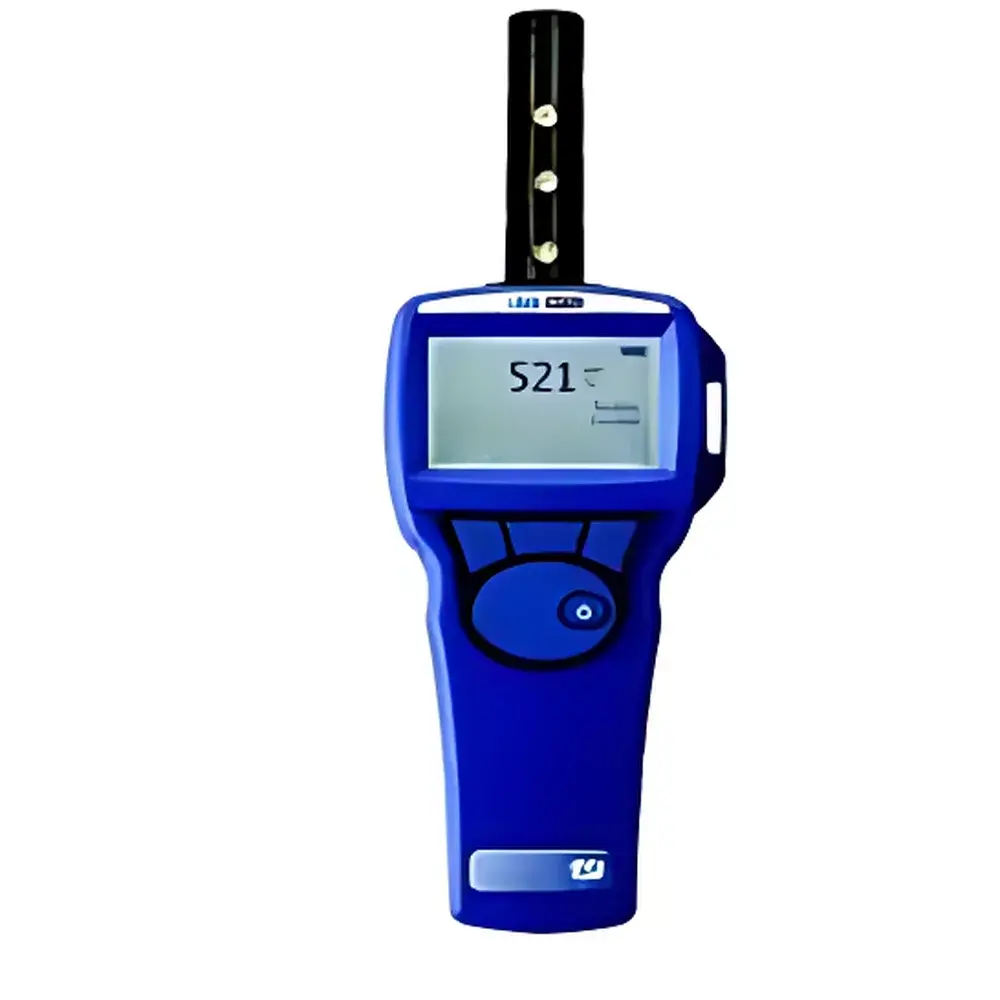
TSI Model 7515 Portable Carbon Dioxide Analyzer
| Brand | TSI |
|---|---|
| Origin | USA |
| Model | 7515 |
| Instrument Type | Portable |
| Resolution | 1 ppm |
| Response Time | 20 s |
| Measurement Range | 0–5000 ppm |
| Accuracy | ±3.0% of reading or ±50 ppm (whichever is greater) |
| Power Supply | 4 × AA batteries |
| Operating Temperature | -20 to 60 °C |
| Dimensions (main unit) | 8.4 × 17.8 × 4.4 cm |
| Probe Dimensions | 7 cm length × 1.9 cm diameter |
| Sensor Technology | Dual-wavelength NDIR (Non-Dispersive Infrared) |
| Certification | CPA Pattern Approval Certificate (P.R. China) |
Overview
The TSI Model 7515 Portable Carbon Dioxide Analyzer is an engineered field instrument designed for precise, real-time measurement of carbon dioxide (CO₂) concentration in indoor air environments. It employs dual-wavelength non-dispersive infrared (NDIR) spectroscopy — a well-established, interference-resistant optical detection principle that leverages differential absorption at specific IR wavelengths to quantify CO₂ with high selectivity and long-term stability. Unlike single-wavelength NDIR sensors, the dual-wavelength architecture actively compensates for optical drift, dust accumulation, and aging effects, ensuring consistent baseline integrity over extended operational cycles. The analyzer is calibrated traceably to NIST-certified gas standards and meets performance requirements outlined in ISO 16200-1 (indoor air quality — determination of VOCs), ASHRAE Standard 62.1 (ventilation for acceptable indoor air quality), and China’s JJG 969–2021 verification regulation for CO₂ analyzers. Its compact form factor and battery-powered operation enable deployment across diverse settings — from classroom IAQ audits and HVAC commissioning checks to post-renovation air quality validation and occupational hygiene surveys.
Key Features
- Dual-wavelength NDIR sensor with built-in reference channel for automatic compensation of optical drift and environmental interference
- High-resolution detection capability down to 1 ppm (0.0001 %), supporting sensitive differentiation of ventilation adequacy thresholds (e.g., 400 ppm outdoor baseline vs. 1000 ppm ASHRAE-recommended upper limit)
- Rapid response time of ≤20 seconds (t₉₀), enabling dynamic tracking of CO₂ transients during occupancy shifts or HVAC mode transitions
- On-device data logging with storage of up to 32,000 timestamped measurement points; supports statistical display of min/max/average values and sample count per session
- Robust mechanical design: IP54-rated enclosure, operating temperature range of –20 to +60 °C, and probe optimized for low-flow sampling without external pump requirement
- Compliance-ready firmware architecture supporting audit trails, user access levels, and configuration lockout — aligned with GLP documentation practices for environmental monitoring
Sample Compatibility & Compliance
The Model 7515 is validated for direct measurement of CO₂ in ambient air, conditioned airstreams, and recirculated ventilation ducts (with optional probe extension). It excludes cross-sensitivity to common interferents including CO, CH₄, H₂O vapor (within 0–95% RH, non-condensing), and volatile organic compounds below 500 ppm total VOC. The instrument carries CPA (China Metrology Accreditation) Pattern Approval Certificate issued by the State Administration for Market Regulation (SAMR), confirming conformity to JJF 1070–2021 and GB/T 18204.2–2014 standards for portable gas analyzers. While not FDA-cleared or CE-marked as a medical device, its metrological performance satisfies ISO/IEC 17025-accredited laboratories’ requirements for routine IAQ verification under ISO 16000-28 and EN 13725 protocols.
Software & Data Management
Data export is supported via USB-C interface using TSI’s TrakPro™ Lite software (Windows-compatible), enabling CSV-based reporting, time-series visualization, and batch calibration certificate generation. Firmware supports configurable averaging intervals (1–60 s), alarm thresholds (user-definable high/low limits), and auto-zero scheduling. All logged datasets include embedded metadata: date/time stamp, battery voltage, sensor status flags, and operator ID (if assigned). Audit trail functionality records parameter changes, calibration events, and firmware updates — fulfilling documentation requirements for ISO 9001 internal audits and third-party IAQ certification programs such as RESET Air or WELL Building Standard v2.
Applications
- Real-time assessment of ventilation effectiveness in offices, schools, hospitals, and hospitality facilities
- Commissioning and functional testing of demand-controlled ventilation (DCV) systems
- Post-occupancy evaluation (POE) studies correlating CO₂ levels with occupant-reported symptoms and thermal comfort metrics
- Verification of CO₂ scrubber performance in controlled-environment agriculture (CEA) and cleanroom support spaces
- Field validation of building energy modeling assumptions related to infiltration rates and occupancy schedules
- Supporting compliance with local regulatory mandates, including China’s GB 50325–2020 (Control Standard for Indoor Environmental Pollution of Civil Building Engineering)
FAQ
What calibration gases are required for field verification?
A certified zero gas (N₂ or synthetic air) and a span gas (typically 2000 ppm CO₂ in N₂, traceable to NIST SRM 1971) are recommended for two-point verification per ASTM D6196–19 Annex A1.
Is the probe interchangeable with other TSI instruments?
No — the 7 cm × 1.9 cm probe is mechanically and electrically integrated with the Model 7515’s optical path and signal conditioning circuitry; it is not compatible with other TSI platforms such as the Q-Trak™ or SidePak™ series.
Does the instrument support external data logging via Bluetooth or Wi-Fi?
No — the Model 7515 relies solely on wired USB-C connectivity for data transfer; wireless telemetry is not implemented to maintain electromagnetic compatibility in sensitive HVAC control environments.
Can it measure CO₂ in high-humidity environments (>80% RH)?
Yes — the dual-wavelength NDIR design inherently corrects for water vapor absorption overlap; however, condensation on the optical window must be avoided via proper probe orientation and use of desiccant filters where necessary.
How often is factory recalibration recommended?
TSI recommends annual recalibration against traceable standards; field verification using zero/span gases is advised before each critical measurement campaign or after exposure to extreme temperature/humidity cycling.
Related Products







