
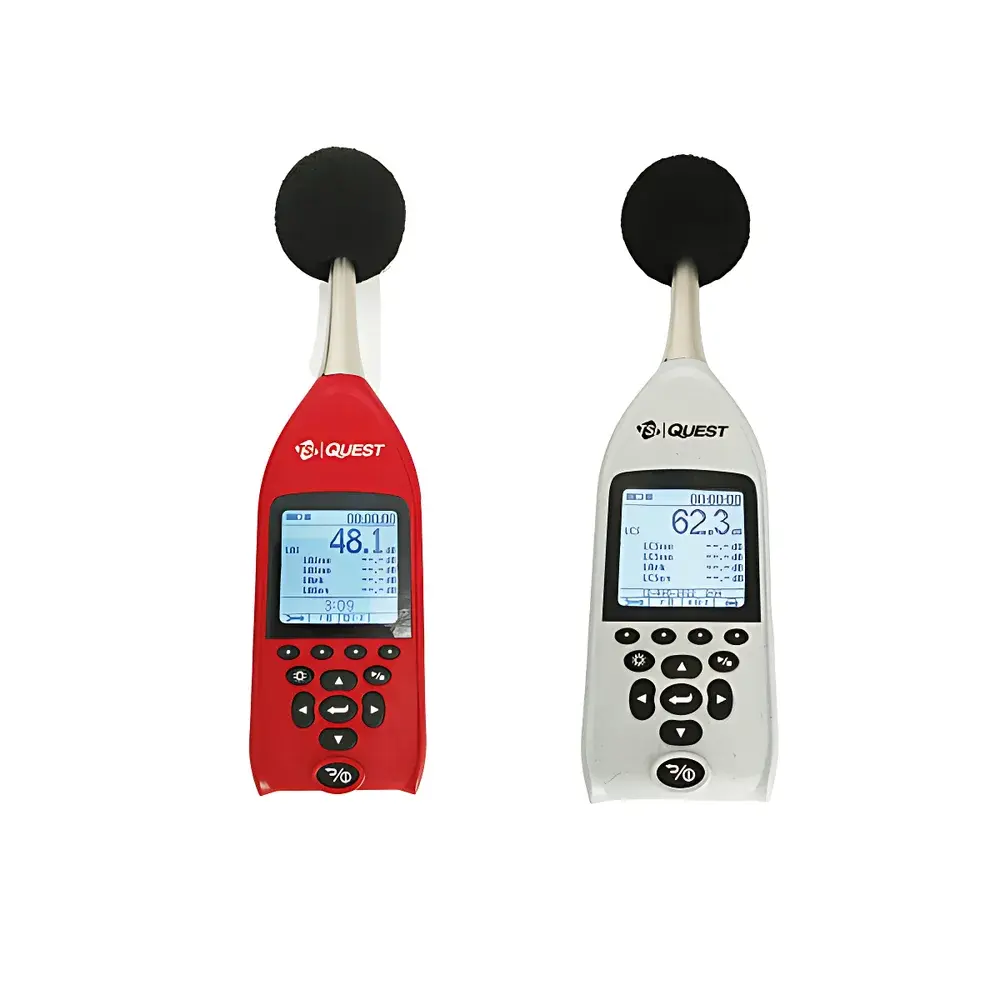
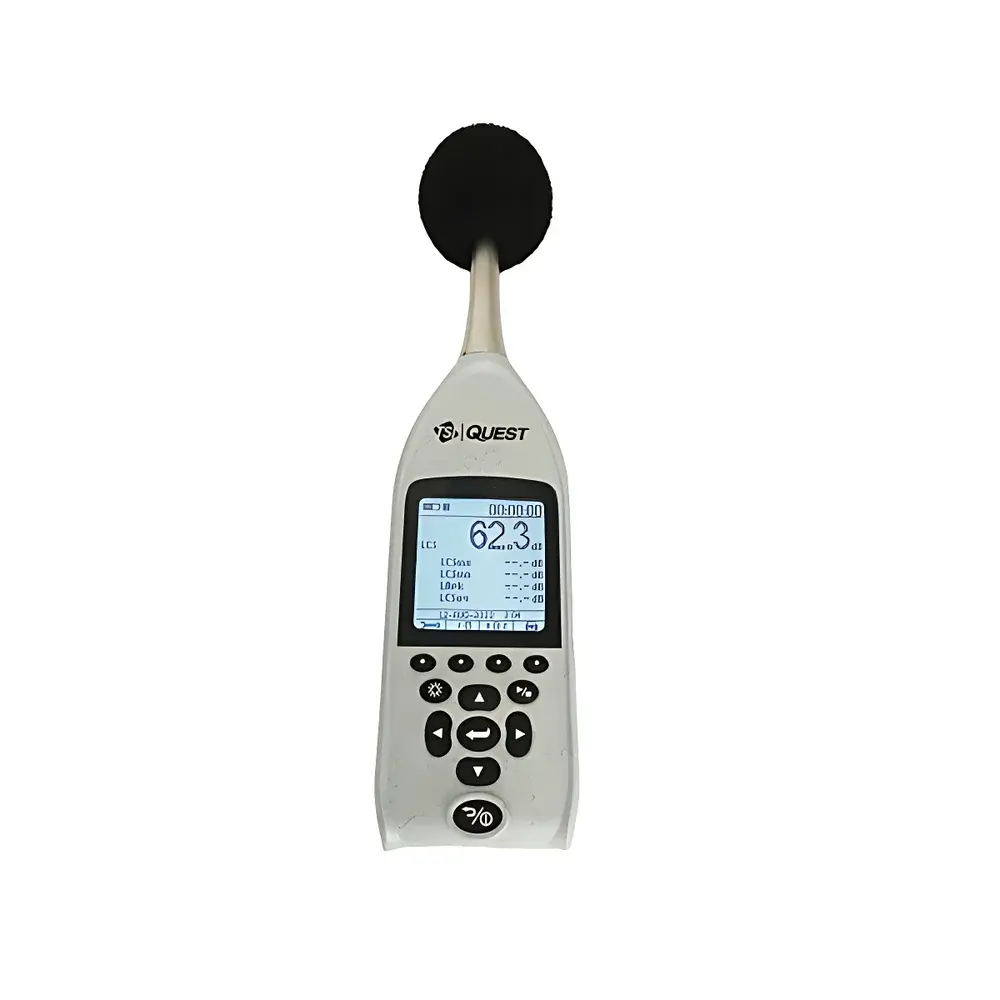
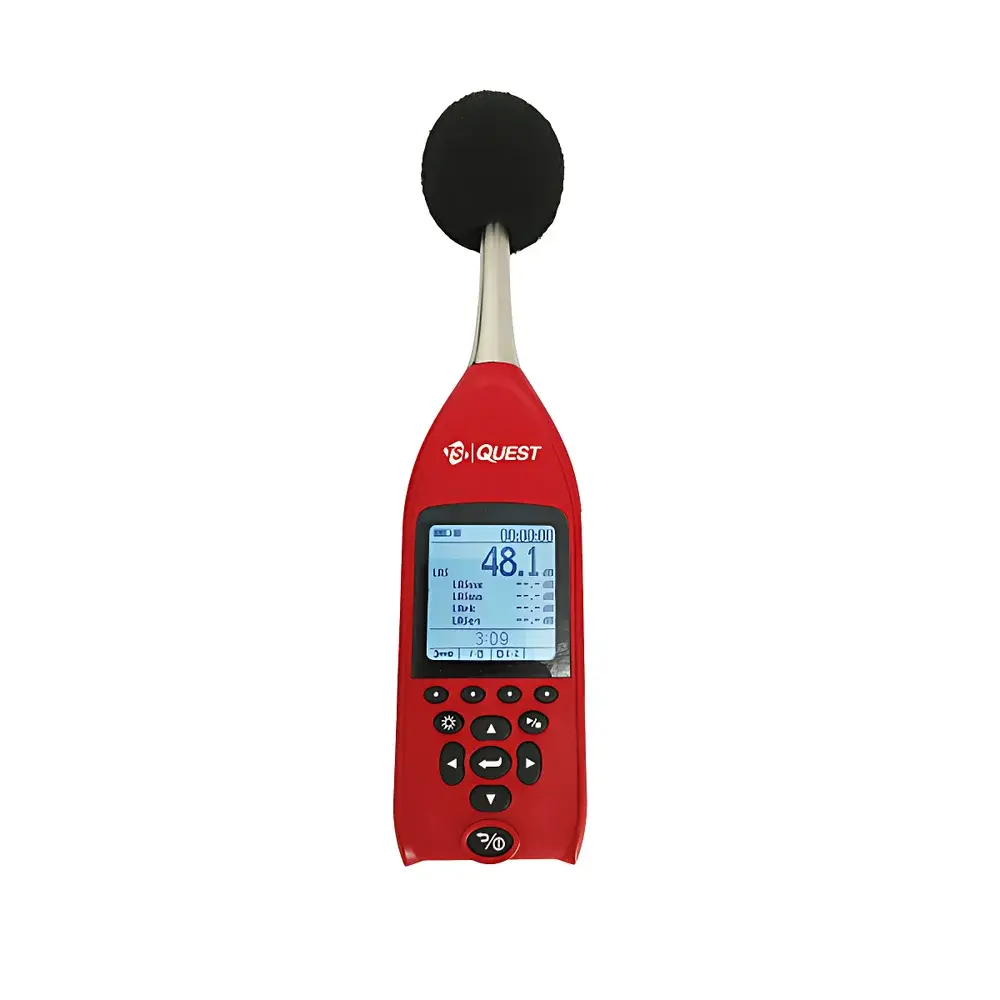
TSI SE-401/SE-402 Sound Level Meter
| Brand | TSI |
|---|---|
| Origin | USA |
| Model | SE-400 Series |
| Measurement Range | 30–140 dB(A) |
| Accuracy Class | Class 2 per IEC 61672-1:2013 |
| Dynamic Range | 110 dB(A) |
| Peak SPL | 143 dB(A) |
| Frequency Weighting | A, C, Z |
| Time Weighting | Fast, Slow |
| Metrics | L<sub>EQ</sub>, L<sub>AVG</sub>, L<sub>MAX</sub>, L<sub>MIN</sub>, L<sub>Pk</sub>, L<sub>E</sub>, Exposure Time |
| IP Rating | IP65 (housing only) |
| Operating Temperature | −10 °C to +50 °C |
| Battery Life | Up to 18 h (standard), 8 h (IS model) |
| Memory | 2 MB internal (≈34 days @ 1-min logging) |
| Compliance | IEC 61672-1:2013, ANSI S1.4-2014, ANSI S1.43-2012, CE |
Overview
The TSI SE-401 and SE-402 Sound Level Meters are portable, Class 2-certified instruments engineered for occupational noise assessment, environmental monitoring, and industrial hygiene applications. Designed in accordance with the international metrological standard IEC 61672-1:2013, these meters employ precision electret condenser microphones and low-drift analog-to-digital conversion to deliver stable, repeatable sound pressure level (SPL) measurements across a wide dynamic range of 30–140 dB(A). The instruments operate on the fundamental principle of time-weighted averaging (LEQ/LAVG) and statistical analysis of instantaneous pressure fluctuations, enabling accurate characterization of fluctuating noise environments—such as manufacturing floors, construction sites, transportation corridors, and HVAC systems—without requiring manual configuration. Both models feature single-range full-scale operation, eliminating range-switching artifacts and ensuring consistent traceability throughout the measurement cycle.
Key Features
- Class 2 accuracy per IEC 61672-1:2013 and ANSI S1.4-2014, validated through factory calibration against NIST-traceable reference standards
- Integrated A-, C-, and Z-frequency weighting with Fast and Slow time constants for real-time spectral evaluation
- Automatic computation of key metrics: LEQ, LAVG, LMAX, LMIN, LPk, LE, and exposure duration—aligned with OSHA 29 CFR 1910.95 and EU Directive 2003/10/EC requirements
- Intuitive, menu-free interface: power-on and measure immediately; no user training required for basic operation
- Dual-microphone compatibility: optional Class 1 (QE4936) or Class 2 (QE7052) microphones support application-specific uncertainty budgets
- Removable preamplifier module (SE-401/SE-402-R variants) enables field replacement and remote sensing up to 15 m (50 ft) using shielded coaxial cable
- IP65-rated ABS housing provides dust-tight protection and resistance to water jets—suitable for outdoor and harsh indoor environments
- Drop-tested to 2 m (front/back ×2); microphone failure does not compromise data integrity or stored measurement history
Sample Compatibility & Compliance
The SE-401/SE-402 series is compatible with standard ½-inch (13.2 mm) electret condenser microphones and accepts industry-standard acoustic calibrators (e.g., TSI 903, Brüel & Kjær 4231). Its physical design accommodates tripod mounting via a ¼″–20 UNC threaded port, facilitating hands-free long-term monitoring. Regulatory compliance includes full conformance to IEC 61672-1:2013 (Electroacoustics – Sound Level Meters – Part 1: Specifications), ANSI S1.4-2014 (American National Standard for Sound Level Meters), and ANSI S1.43-2012 (for integrating-averaging sound level meters). All units undergo electromagnetic compatibility (EMC) testing per EN 61326-1 and carry CE marking under the EU Low Voltage and EMC Directives. The SE-402-R and SE-401-IS variants are certified intrinsically safe per UL 913 (Class I, Division 1, Groups A–D, T4) and ATEX 2G IIC T4 Ga, making them suitable for use in hazardous locations where explosive atmospheres may be present.
Software & Data Management
Data acquisition and post-processing are supported via TSI Quest™ Software (sold separately), a Windows-based application compliant with FDA 21 CFR Part 11 for audit trail, electronic signature, and data integrity controls. Users can define custom logging intervals (1 s to 1 h), configure alarm thresholds, export time-history files in CSV or .qst format, and generate OSHA-compliant exposure reports—including dose calculation, exchange rate selection (3 dB, 4 dB, or 5 dB), and permissible exposure limit (PEL) comparison. Internal memory stores up to 2 MB of timestamped data (approximately 34 days at 1-minute resolution), accessible via mini-USB 2.0 interface. Firmware updates and configuration backups are performed directly through the software, ensuring version control and traceability during GLP/GMP audits.
Applications
- Workplace noise mapping and hearing conservation program (HCP) compliance per OSHA 29 CFR 1910.95 and ISO 9612
- Environmental noise impact assessments for infrastructure projects (e.g., airports, highways, wind farms)
- Industrial hygiene surveys in petrochemical, mining, and pharmaceutical facilities—especially where intrinsic safety is mandated
- Acoustic validation of noise control engineering solutions (barriers, enclosures, damping treatments)
- Research-grade field studies requiring ruggedized, battery-powered instrumentation with metrological traceability
- Building commissioning and HVAC system performance verification per ASHRAE Standard 110
FAQ
What calibration standards are supported?
The SE-401/SE-402 accepts pistonphone and acoustic calibrators compliant with IEC 60942, including TSI 903 (94 dB @ 1 kHz) and Brüel & Kjær 4231 (114 dB @ 1 kHz). Field calibration verification is performed prior to each measurement session.
Is the device suitable for continuous unattended monitoring?
Yes—when mounted on a tripod and powered via USB-C adapter (optional), the meter supports extended logging. Battery life exceeds 18 hours at default settings; external power eliminates runtime limitations.
Can measurement data be exported in formats compatible with statistical analysis tools?
Yes—Quest™ Software exports time-series data as CSV and Excel-compatible .xlsx files, preserving timestamps, metric identifiers, and metadata required for regression analysis or regulatory submission.
Does the instrument meet requirements for legal metrology or court-admissible evidence?
While Class 2 instruments are widely accepted for occupational health enforcement and environmental reporting, Class 1 certification (e.g., TSI Q451) is recommended for litigation-critical applications requiring maximum uncertainty reduction.
How is firmware updated and verified?
Firmware updates are distributed via TSI’s secure customer portal and installed through Quest™ Software, which logs update timestamps, version numbers, and operator credentials in an immutable audit trail.
Related Products







