
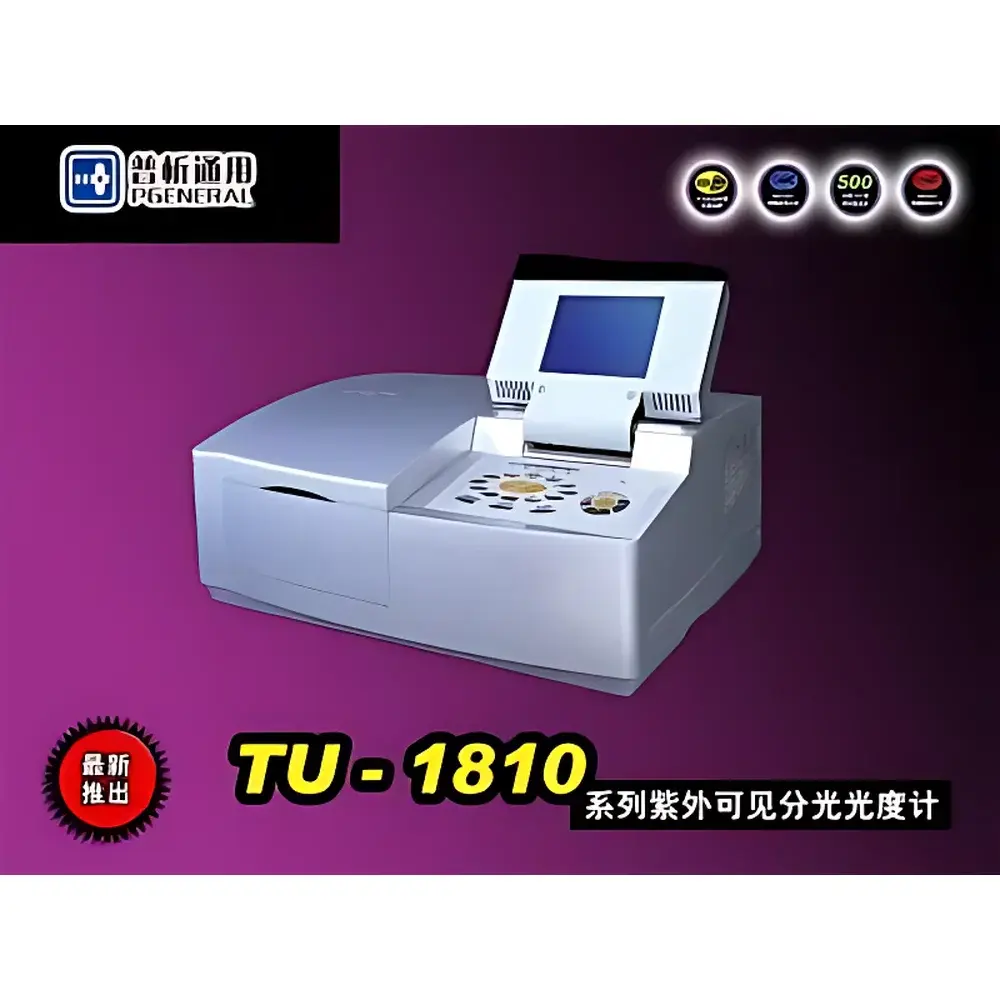
TU-1810 UV-Vis Spectrophotometer
| Origin | Beijing, China |
|---|---|
| Manufacturer Type | Authorized Distributor |
| Origin Category | Domestic (China) |
| Model | TU-1810 |
| Quotation | Upon Request |
| Wavelength Range | 190–1100 nm |
| Wavelength Accuracy | ±0.3 nm (auto-calibrated at startup) |
| Wavelength Repeatability | 0.2 nm |
| Spectral Bandwidth | Fixed 2 nm |
| Stray Light | <0.3%T (220 nm, NaI |
| Photometric Modes | Transmittance (%T), Absorbance (Abs), Energy |
| Photometric Range | −0.3 to 3.0 Abs |
| Photometric Accuracy | ±0.002 Abs (0–0.5 Abs) |
| Photometric Repeatability | 0.001 Abs (0–0.5 Abs) |
| Baseline Flatness | ±0.002 Abs (190–1100 nm) |
| Baseline Drift | 0.001 Abs/h (500 nm, 0 Abs, after 2 h warm-up) |
| Photometric Noise | ±0.001 Abs (500 nm, 0 Abs, 2 nm SBW) |
Overview
The TU-1810 UV-Vis Spectrophotometer is a benchtop double-beam (or pseudo-double-beam) absorption spectrometer engineered for precision quantitative and qualitative analysis across research, quality control, and regulatory environments. Operating on the principle of Beer–Lambert law-based absorbance measurement, it employs a high-stability optical path with a holographic grating monochromator to deliver accurate spectral data from 190 nm to 1100 nm — fully covering the far-UV, near-UV, visible, and near-infrared regions. Its dual-beam architecture compensates for source intensity drift and detector sensitivity variation in real time, ensuring high photometric reproducibility and long-term baseline stability. Designed for robust daily operation in routine laboratories, the instrument integrates a thermally stabilized tungsten-halogen lamp and deuterium arc lamp with proprietary socket-mounting — eliminating optical realignment during lamp replacement and reducing maintenance downtime.
Key Features
- Pseudo-double-beam optical design with real-time reference beam correction for enhanced signal stability and reduced environmental interference
- Holographic concave grating with low aberration optics, achieving stray light levels below 0.3%T at critical wavelengths (220 nm with NaI, 340 nm with NaNO₂)
- Configurable spectral bandwidth: fixed 2 nm or variable selection (0.5, 1.0, 2.0, 5.0 nm) to balance resolution and signal-to-noise ratio per application requirement
- Plug-and-play tungsten and deuterium lamps with mechanical alignment-free socket interface — no collimation or focus adjustment required after replacement
- Onboard microprocessor enables standalone operation: direct execution of photometric measurements, fixed-wavelength quantitation, full-spectrum scanning (190–1100 nm), nucleic acid/protein A260/A280 analysis, and thermal printer output without PC connection
- Modular electrical architecture with standardized signal interfaces facilitates field-level diagnostics and component-level servicing
- Optional automatic 8-cell rotating sample holder supports sequential multi-sample analysis — validated for USP dissolution testing (6-vessel configurations) and high-throughput pesticide residue screening
Sample Compatibility & Compliance
The TU-1810 accommodates standard 10 mm pathlength quartz, glass, or plastic cuvettes (including matched pairs for ratio-based measurements), as well as microvolume adapters (e.g., 5 µL capillary cells) and flow-through cells for continuous monitoring applications. Its optical design supports both transmission and reflectance accessories (e.g., integrating spheres for diffuse reflectance). From a regulatory standpoint, the instrument’s firmware and PC software support GLP-compliant operation: electronic audit trails, user access controls, parameter locking, and timestamped data export meet foundational requirements for ISO/IEC 17025-accredited labs and FDA-regulated environments. While not inherently 21 CFR Part 11 compliant out-of-the-box, its data structure and metadata logging framework are compatible with validated third-party LIMS or ELN integrations that enforce electronic signature and change-control protocols.
Software & Data Management
When connected to Windows-based PCs via USB 2.0, the TU-1810 operates with dedicated acquisition and analysis software featuring three-dimensional spectral mapping (X: wavelength, Y: sample ID/time, Z: absorbance), overlay comparison of up to 12 spectra, derivative spectroscopy (1st–3rd order), peak identification with wavelength/absorbance reporting, and customizable calibration curve generation (linear, quadratic, cubic, or non-linear fitting with residual error reporting). The embedded expert database includes preloaded methods for common analytes — including organophosphate pesticides (e.g., parathion, malathion), heavy metals (via colorimetric chelation), nitrate/nitrite, formaldehyde, and pharmaceutical actives — each referencing relevant ASTM D5158, ISO 11929, or Chinese Pharmacopoeia methodologies. All raw data (.spc binary format) and processed reports (.pdf/.xlsx) are stored with immutable timestamps, operator ID, instrument serial number, and environmental metadata (lamp hours, ambient temperature log).
Applications
- Environmental monitoring: Quantification of NO₂⁻, NO₃⁻, PO₄³⁻, COD, TOC precursors, and trace pesticides in water and soil extracts
- Pharmaceutical QC: Assay of active ingredients, excipient compatibility studies, dissolution profile verification per USP , and cleaning validation swab extract analysis
- Food & agriculture safety: Rapid screening of carbamate and organophosphate residues in fruits, vegetables, and grains using AOAC 2007.01–aligned extraction protocols
- Biochemistry & molecular biology: DNA/RNA concentration and purity assessment (A260/A280, A260/A230), Bradford/Lowry protein assays, enzyme kinetics (time-resolved absorbance at 340/405 nm)
- Materials science: Thin-film transmittance/absorption profiling, semiconductor bandgap estimation, and nanoparticle surface plasmon resonance characterization
- Academic teaching labs: Foundational instruction in spectroscopic theory, calibration methodology, and analytical validation (LOD/LOQ, linearity, ruggedness)
FAQ
Does the TU-1810 support GMP/GLP-compliant data integrity requirements?
Yes — when used with validated software and procedural controls, its audit-trail-capable firmware, user authentication, and metadata-rich data export align with core principles of GLP (OECD Series on Principles of Good Laboratory Practice) and support GMP Annex 11 readiness.
What is the typical warm-up time required for photometric stability?
The instrument achieves thermal equilibrium within 30 minutes; however, for highest baseline stability (≤0.001 Abs/h drift), a 2-hour preheat at 500 nm zero-absorbance condition is recommended per ISO 6326-1.
Can the TU-1810 perform kinetic measurements?
Yes — the PC-linked software supports time-scan mode with user-defined interval acquisition (100 ms to 60 s per point) and automated rate calculation for first-order or Michaelis–Menten enzymatic reactions.
Is the 8-cell auto-sampler compatible with temperature-controlled sample compartments?
No — the standard 8-cell rack operates at ambient temperature. For thermostatted measurements, users must integrate external Peltier-controlled cuvette holders or use the instrument’s optional single-cell temperature-jacketed accessory (−5 °C to 105 °C range).
How frequently should wavelength calibration be performed?
The system performs automatic wavelength calibration at power-on using internal holmium oxide and didymium filters; manual recalibration is only required if physical shock occurs or after lamp replacement — verified annually per ISO/IEC 17025 calibration schedules.



