
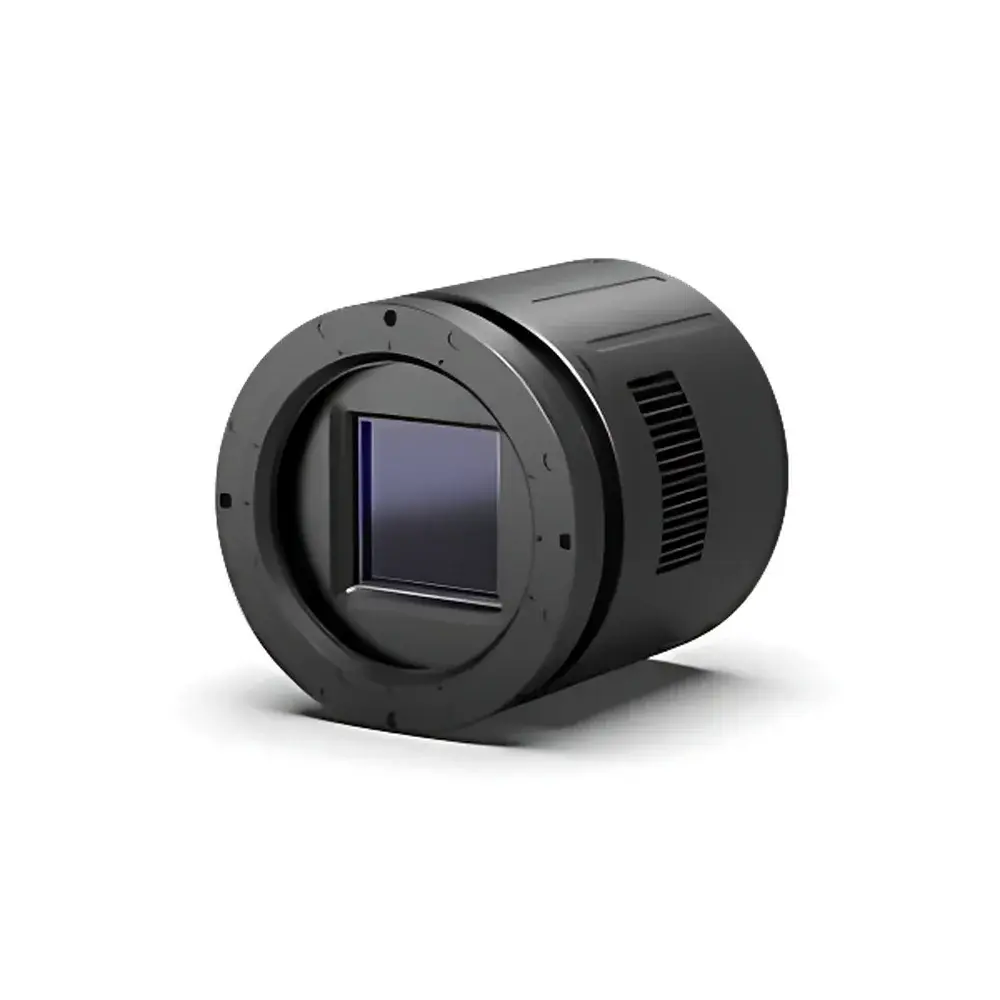
Tucsen Dhyana 6060 FSI sCMOS Camera for Space Debris Detection, Astrophysics, Soft X-ray Imaging & Quantum Optics
| Brand | Tucsen |
|---|---|
| Origin | Fujian, China |
| Manufacturer Type | OEM Manufacturer |
| Regional Category | Domestic (China) |
| Model | Dhyana 6060 |
| Pricing | Upon Request |
| Image Resolution | 6144 (H) × 6144 (V) |
| Pixel Size | 10 µm × 10 µm |
| Sensor Diagonal | 86.8 mm |
| Readout Speed | 44 fps @ 12-bit STD |
| Dynamic Range | 91 dB |
| Quantum Efficiency | 72% @ 550 nm |
| Full Well Capacity | 123 ke⁻ (typ.) |
| Read Noise | 3 e⁻ (median) |
| Dark Current | 0.25 e⁻/pix/s (air-cooled), 0.15 e⁻/pix/s (water-cooled) |
| Cooling | Active air/water cooling (ΔT ≤ −45 °C below ambient) |
| Shutter | Rolling shutter |
| Exposure Range | 7 µs – 300 s |
| Timestamp Accuracy | 1 µs |
| Trigger Modes | Hardware/software |
| output signals | exposure start, global reset, readout end, TTL high/low |
| Interface | CoaXPress 2.0 (CXP-6) |
| Bit Depth | 12/14/16 bit |
| Optical Mount | Customizable |
| Power Supply | 12 V / 10 A |
| Power Consumption | < 100 W |
| Dimensions | Ø160 mm × 164 mm |
| Weight | 4 kg |
| Compatible Software | SamplePro, MaxIm DL, LabVIEW, MATLAB, EPICS SDK (C/C++/C#) |
| OS Support | Windows, Linux |
| Operating Environment | −35 °C to +45 °C, 0–95% RH (non-condensing) |
| Storage | −35 °C to +60 °C, 0–95% RH |
Overview
The Tucsen Dhyana 6060 is a large-format front-side illuminated (FSI) scientific CMOS (sCMOS) camera engineered for high-fidelity, low-noise imaging in demanding photon-starved and high-dynamic-range applications. With a monolithic 86.8 mm diagonal sensor—among the largest commercially available sCMOS imagers—it delivers native 36.9 megapixel resolution (6144 × 6144) at pixel pitch of 10 µm. Its architecture leverages Gpixel’s GSENSE6060 die, optimized for quantum efficiency up to 72% at 550 nm and extended spectral response into the soft X-ray regime (with appropriate optical coatings or vacuum-compatible configurations). Unlike legacy CCD systems, the Dhyana 6060 combines high frame rates (44 fps full-frame at 12-bit), ultra-low read noise (3 e⁻ median), and exceptional dynamic range (91 dB)—enabling simultaneous capture of faint astrophysical structures and bright foreground objects without saturation or post-acquisition stitching.
Key Features
- Monolithic 86.8 mm diagonal sCMOS sensor: Eliminates tiling artifacts and registration errors common in mosaic-based wide-field detectors—critical for space debris tracking, stellar photometry, and interferometric fringe analysis.
- 123 ke⁻ full-well capacity: Supports quantitative measurement across orders-of-magnitude intensity gradients—essential for laser-induced fluorescence, plasma diagnostics, and quantum optics experiments involving heralded photon pairs.
- CoaXPress 2.0 (CXP-6) interface: Enables deterministic, low-jitter data streaming at >5 Gbps per lane; supports precise hardware triggering with sub-microsecond timestamping for time-resolved pump-probe or synchrotron-gated imaging.
- Dual-stage active cooling: Configurable air or water cooling achieves sensor stabilization up to 45 °C below ambient, reducing dark current to ≤0.15 e⁻/pix/s—vital for long-exposure astronomical surveys and soft X-ray spectroscopy where thermal noise dominates background.
- Multi-bit depth acquisition: Selectable 12-bit (high-speed), 14-bit (balanced), or 16-bit (high-dynamic-range) modes—compatible with ISO 15739-compliant noise modeling and ASTM E2847-21 calibration workflows.
Sample Compatibility & Compliance
The Dhyana 6060 is routinely deployed in vacuum-compatible beamlines (e.g., synchrotron soft X-ray microscopes), cryogenic telescope focal planes (e.g., wide-field survey instruments), and quantum lab setups requiring single-photon-level sensitivity. Its mechanical design accommodates custom optical mounts—including C-mount, F-mount, and direct vacuum flange integration—and supports optional anti-reflective coatings for enhanced transmission in UV (200–400 nm) and soft X-ray (0.1–2 keV) bands. The camera complies with CE, FCC, and RoHS directives. Firmware and driver stacks are validated for GLP/GMP-aligned environments: metadata embedding includes EXIF-compliant timestamps, temperature logs, gain settings, and trigger source identification—facilitating audit-ready traceability per FDA 21 CFR Part 11 requirements when integrated with compliant LIMS or ELN platforms.
Software & Data Management
Tucsen provides native SDKs for C, C++, and C# under Windows and Linux, along with certified wrappers for MATLAB, Python (via PyTango or NumPy-compatible buffers), LabVIEW, and EPICS IOC integration. Third-party compatibility includes MaxIm DL (v6.2+), AstroImageJ, and SAOImage DS9. All acquisitions embed standardized FITS headers (including BSCALE/BZERO, EXPTIME, DATE-OBS, and DETECTOR keywords) and support lossless compression (FITS tile-compressed or HDF5 chunked storage). Time-synchronized multi-camera operation is enabled via GenICam-compliant trigger distribution and PTPv2 (IEEE 1588) timestamp alignment—enabling synchronized stereo imaging or distributed aperture arrays for orbital object characterization.
Applications
- Space situational awareness: Wide-field detection and trajectory reconstruction of LEO/MEO debris using ground-based optical tracking telescopes—leveraging single-shot 61×61 mm FOV to reduce revisit latency and improve orbit determination accuracy.
- Astrophysical instrumentation: Integral field spectroscopy, exoplanet transit photometry, and transient event monitoring (e.g., kilonovae, fast radio burst afterglows) on 1–4 m class observatories.
- Soft X-ray microscopy: Zone-plate-based imaging at synchrotron facilities (e.g., ALS, BESSY II), where high QE and radiation-hardened packaging ensure stable performance under prolonged flux exposure.
- Quantum optics & metrology: Coincidence imaging with entangled photon sources, spatial-mode tomography, and high-resolution Talbot-Lau interferometry—benefiting from low PRNU (<0.20%) and DSNU (1.5 e⁻ RMS) for pixel-wise responsivity correction.
FAQ
Is the Dhyana 6060 suitable for vacuum-integrated soft X-ray imaging?
Yes—the sensor package is compatible with UHV environments (≤10⁻⁶ mbar) when equipped with optional hermetic feedthroughs and non-outgassing materials. Consult Tucsen’s Application Engineering team for beamline-specific mounting and shielding recommendations.
Does the camera support global shutter operation?
No—the Dhyana 6060 employs a high-fidelity rolling shutter with precisely controlled row timing. For applications requiring true global exposure (e.g., high-speed particle tracking), external illumination gating or post-processing motion correction may be employed.
Can I perform on-chip binning or ROI readout to increase frame rate?
Yes—hardware-supported 2×2 and 4×4 binning modes are available, as well as arbitrary rectangular ROIs. At 1024×1024 ROI, frame rates exceed 200 fps in 12-bit mode.
What calibration data is provided with the camera?
Each unit ships with factory-measured flat-field, dark frame, and gain maps (per bit-depth mode), traceable to NIST-traceable photodiode standards. Optional annual recalibration services include QE curve verification and linearity assessment per ISO 15739 Annex D.
Is firmware upgradable in the field?
Yes—firmware updates are delivered via signed .bin files through the Tucsen Device Manager utility, supporting rollback and version-locking for regulated laboratory environments.





