
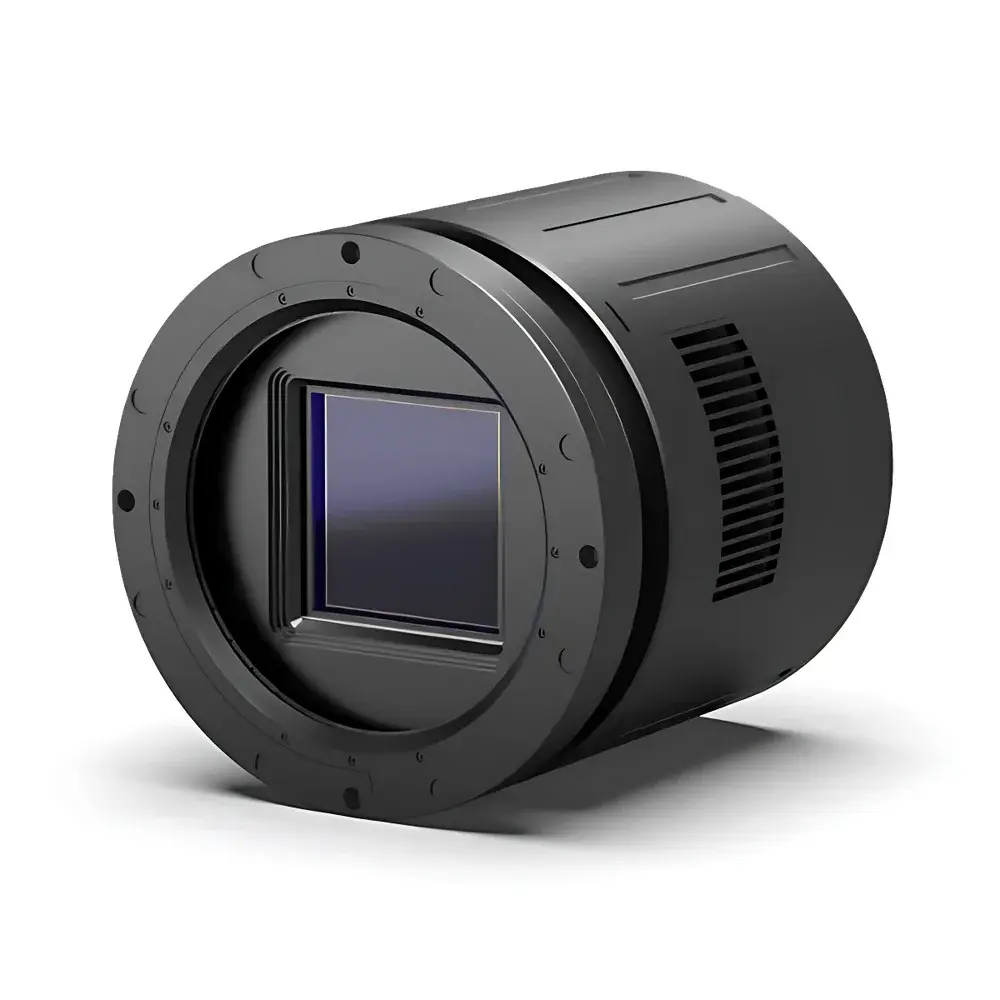
Tucsen Dhyana 6060BSI Back-Illuminated sCMOS Camera for Space Debris Detection, Astrophysics, Soft X-ray Imaging, and Quantum Optics
| Brand | Tucsen |
|---|---|
| Origin | Fujian, China |
| Manufacturer Type | Original Equipment Manufacturer (OEM) |
| Regional Classification | Domestic (China) |
| Model | Dhyana 6060BSI |
| Image Resolution | 6144 × 6144 pixels |
| Pixel Size | 10 µm × 10 µm |
| Sensor Diagonal | 86.8 mm |
| Readout Speed | 44 fps @ 12-bit STD (full resolution) |
| Dynamic Range | 90 dB |
| Quantum Efficiency | 95 % @ 580 nm |
| Read Noise | 3 e⁻ (median) |
| Full Well Capacity | 102 ke⁻ (typ.) |
| Cooling | Air & Liquid, ΔT ≤ 45 °C below ambient |
| Dark Current | 0.25 e⁻/pix/s (air-cooled), 0.15 e⁻/pix/s (liquid-cooled) |
| Spectral Response | 200–1100 nm |
| Interface | CoaXPress 2.0 (CXP-6) |
| Bit Depth | 12 / 14 / 16 bit |
| Shutter Type | Rolling |
| Exposure Range | 12 µs – 300 s |
| Timestamp Accuracy | 1 µs |
| Trigger Modes | Hardware & Software (SMA), Global Reset Support |
| Binning | 2×2, 4×4 |
| ROI | Supported |
| Power | 12 V / 10 A, <100 W |
| Dimensions | Ø160 mm × 164 mm |
| Weight | 4 kg |
| OS Support | Windows, Linux |
| Environmental Rating | Operating –35 to +45 °C, 0–95% RH |
Overview
The Tucsen Dhyana 6060BSI is a high-performance, back-illuminated scientific CMOS (sCMOS) camera engineered for demanding low-light imaging applications in space situational awareness, astrophysical observation, soft X-ray detection, and quantum optical experimentation. Built around the Gpixel GSENSE6060BSI sensor—a 36-megapixel monochrome device with a 86.8 mm diagonal active area—the camera delivers single-shot wide-field imaging without mechanical tiling or image stitching. Its architecture leverages true back-illumination to achieve exceptional quantum efficiency across an extended spectral range (200–1100 nm), with peak QE of 95% at 580 nm. The sensor’s large pixel pitch (10 µm), high full-well capacity (102 ke⁻), and ultra-low read noise (3 e⁻ median) collectively enable high dynamic range (90 dB) and superior signal fidelity under photon-starved conditions—critical for detecting faint orbital debris signatures, resolving stellar coronae, capturing synchrotron-based soft X-ray emission, or resolving quantum interference fringes.
Key Features
- 36 MP monochrome sCMOS sensor with 6144 × 6144 resolution and 10 µm square pixels
- 86.8 mm diagonal sensor format enabling wide-field, distortion-free imaging at f/2–f/8 optics
- Back-illuminated architecture delivering >90% QE from 400–700 nm and usable response down to 200 nm (VUV-enhanced coatings optional)
- CoaXPress 2.0 (CXP-6) interface supporting sustained 44 fps at 12-bit standard mode and 26.4 fps at full 12-bit depth with CXP synchronization
- Dual cooling options: forced-air and liquid, achieving up to 45 °C delta-T below ambient; dark current reduced to 0.15 e⁻/pix/s under liquid cooling
- Precision timing infrastructure: 1 µs timestamp accuracy, hardware-triggered global reset, and programmable exposure control from 12 µs to 300 s
- Flexible data handling: selectable bit depth (12/14/16-bit), ROI readout, binning (2×2, 4×4), and on-board histogram generation
Sample Compatibility & Compliance
The Dhyana 6060BSI is compatible with standard C-mount, F-mount, and custom optical interfaces via user-defined flange adapters. Its vacuum-compatible housing design (optional) supports integration into beamlines and space-qualified enclosures. The camera meets IEC 61000-6-2/6-4 electromagnetic compatibility standards and operates reliably within environmental specifications defined per MIL-STD-810G for temperature cycling and humidity exposure. While not certified to ISO 13485 or FDA 21 CFR Part 11 out-of-the-box, its deterministic trigger logic, non-volatile configuration storage, and audit-ready metadata logging (including exposure time, gain, temperature, and timestamp) support validation pathways for GLP-compliant astronomical surveys and quantum metrology protocols.
Software & Data Management
The camera is supported by Tucsen’s SamplePro SDK, offering native APIs for C/C++, C#, Python, and MATLAB. It integrates seamlessly with third-party platforms including MaxIm DL, LabVIEW (NI Vision), EPICS IOC environments, and Python-based observatory control systems (e.g., Observatory Control System – OCS). All acquired frames embed EXIF-compliant metadata: sensor temperature, exposure duration, gain setting, timestamp (UTC-synchronized via optional GPS module), and hardware trigger status. Raw data output follows FITS 4.0 conventions, ensuring interoperability with IRAF, Astropy, and DS9. Firmware updates are performed via signed binary packages with SHA-256 verification to maintain system integrity in regulated research environments.
Applications
- Space debris tracking: Wide-field survey mode enables simultaneous monitoring of multiple LEO objects with sub-arcsecond centroiding precision using centroid fitting algorithms on full-frame data.
- Astrophysics: Used in solar corona imaging, transient detection (e.g., fast radio burst afterglows), and narrowband nebula mapping where high spatial sampling and low read noise are essential.
- Soft X-ray imaging: Coupled with ZnS:Ag scintillators or EUV-transparent microchannel plates, the sensor resolves 0.1–2.0 keV photons with energy-resolved event counting capability when operated in photon-counting mode (via external thresholding).
- Quantum optics: Supports Hong–Ou–Mandel interference measurements, Bell-state tomography, and intensity correlation (g²(τ)) experiments requiring high temporal fidelity and single-photon sensitivity across visible and NIR bands.
FAQ
Is the Dhyana 6060BSI suitable for vacuum chamber integration?
Yes—custom vacuum-housing variants are available upon request, featuring CF-63 flanges and bake-out rated materials compliant with UHV (<10⁻⁹ mbar) operational requirements.
Does the camera support hardware-synchronized multi-camera triggering?
Yes—via SMA inputs/outputs with sub-microsecond jitter; CXP-2.0 frame sync ensures deterministic inter-camera latency below 200 ns across up to four synchronized units.
Can I perform real-time centroid calculation onboard?
No—onboard processing is limited to histogram generation and basic ROI statistics; full centroiding requires host-side computation using provided centroiding libraries in Python or C++.
What calibration files are provided with the camera?
Factory-measured flat-field, dark-frame, and pixel-response non-uniformity (PRNU <0.20%) maps are delivered in FITS format, along with temperature-dependent dark current characterization curves.
Is Linux driver support maintained for long-term kernel versions?
Yes—Tucsen provides LTS kernel support (5.10+, 6.1+, 6.6+) with quarterly security patch updates and documented ABI stability guarantees for embedded observatory deployments.






