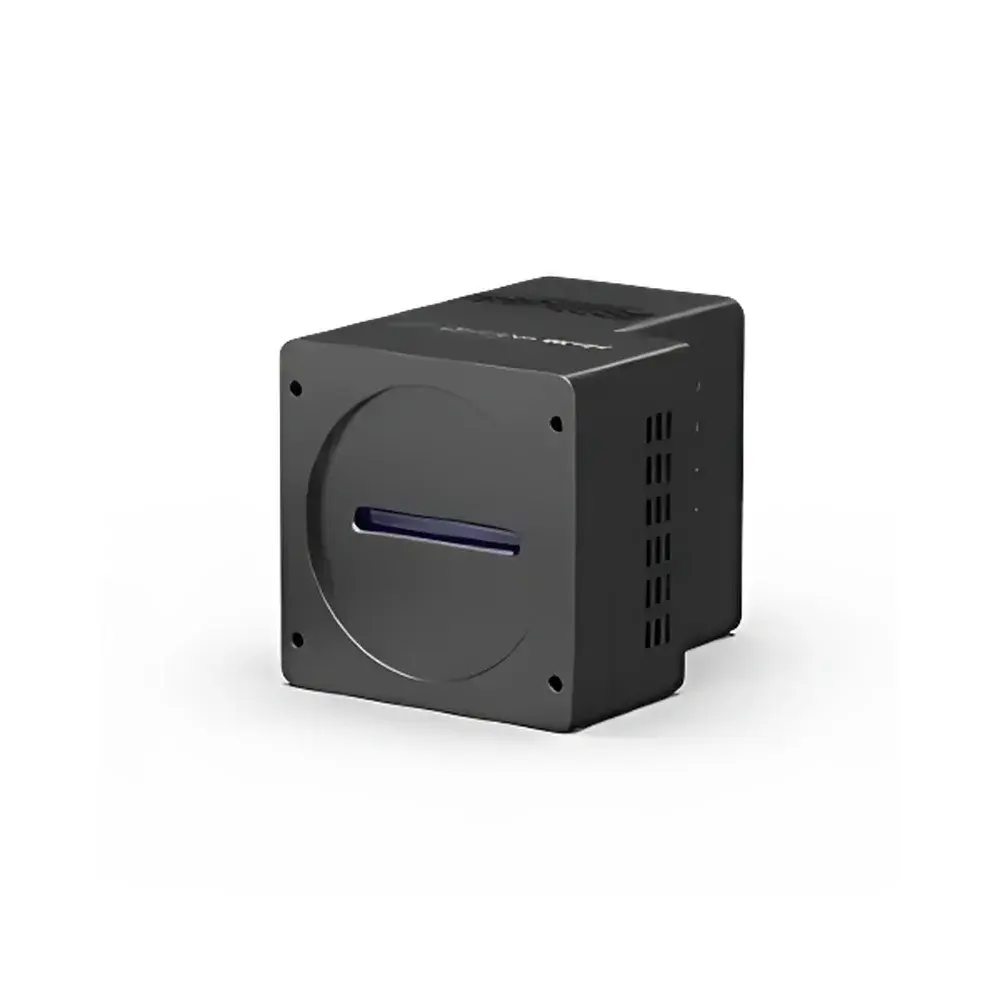
TUCSEN Dhyana 9KTDI Back-Illuminated sCMOS TDI Line-Scan Camera
| Brand | TUCSEN |
|---|---|
| Origin | Fujian, China |
| Manufacturer Type | Original Equipment Manufacturer (OEM) |
| Regional Category | Domestic (China) |
| Model | Dhyana 9KTDI |
| Image Resolution | 9072 × 256 |
| Pixel Size | 5 µm × 5 µm |
| Sensor Diagonal | 45.4 mm |
| Readout Speed | 510 kHz @ 8-bit |
| Dynamic Range | 68.7 dB (typical, @ 12-bit) |
| Quantum Efficiency | 82% @ 550 nm |
| Spectral Response | 200–1100 nm |
| TDI Stages | 4–256 (programmable) |
| Data Interface | CoaXPress 2.0 (CXP-12) |
| Cooling | Air/Water, ΔT = −35 °C below ambient (water-cooled) |
| Full Well Capacity | 15.5 ke⁻ (@ 12-bit) |
| Read Noise | 7.2 e⁻ (@ 12-bit) |
| DSNU | 1.5 e⁻ (@ 12-bit) |
| PRNU | 0.30% (typical) |
| Trigger Timestamp Accuracy | 8 ns |
| Power | 12 V / 8 A, < 60 W |
| Dimensions | 86 × 86 × 109 mm |
| Weight | 1100 g |
Overview
The TUCSEN Dhyana 9KTDI is a high-performance, back-illuminated scientific CMOS time-delay integration (TDI) line-scan camera engineered for demanding industrial and research applications requiring ultra-low-noise, high-throughput imaging under low-light conditions. Built around the Gpixel GLT5009BSI sensor—a 9K-pixel (9072 × 256) BSI sCMOS architecture—the camera delivers exceptional quantum efficiency (82% peak at 550 nm) across an extended spectral range from 200 nm (deep UV) to 1100 nm (near-infrared). Its core functionality relies on TDI acquisition, where charge is synchronously transferred along the pixel column with precise sub-pixel timing to accumulate signal from moving objects—enabling high-sensitivity inspection without motion blur. This principle makes the Dhyana 9KTDI particularly suitable for continuous-motion imaging in semiconductor wafer scanning, flat-panel display (FPD) defect detection, fluorescence-based biological assay readout, and hyperspectral line-scanning applications.
Key Features
- Back-illuminated sCMOS sensor with 9072 × 256 active pixels and 5 µm × 5 µm pixel pitch, optimized for high spatial resolution and fill-factor efficiency.
- Programmable TDI operation across 14 discrete stages (4, 8, 16, 32, 64, 96, 128, 160, 192, 224, 240, 248, 252, 256), enabling adaptive signal integration for variable scan velocities and illumination levels.
- CoaXPress 2.0 (CXP-12) interface supporting sustained data throughput of up to 4.59 Gpixels/s (9072 × 256 × 510 kHz), exceeding mainstream 8K line-scan systems by ~6× and CCD-TDI cameras by ~46×.
- Multi-mode cooling system (air or water) achieving stable sensor temperatures up to 35 °C below ambient, critical for suppressing dark current and maintaining long-exposure stability in quantitative imaging.
- Low read noise (7.2 e⁻ typical @ 12-bit), high full-well capacity (15.5 ke⁻ @ 12-bit), and excellent uniformity (PRNU ≤ 0.30%, DSNU ≤ 1.5 e⁻ @ 12-bit) ensure high-fidelity radiometric accuracy.
- Flexible triggering architecture with bidirectional scan control, strobe output, Hirose HR10A-7R-4S connector, and 8 ns timestamp precision for synchronization with motion stages or pulsed light sources.
Sample Compatibility & Compliance
The Dhyana 9KTDI supports monochrome imaging only, eliminating chromatic artifacts and maximizing photon collection efficiency—essential for fluorescence intensity quantification and spectral line profiling. Its M72 optical mount accommodates high-NA telecentric and UV-grade lenses, while custom mechanical interfaces can be implemented per OEM integration requirements. The camera operates within ISO 13406-2 Class I viewing condition guidelines for industrial inspection systems and meets electromagnetic compatibility (EMC) standards per CISPR 32 and IEC 61000-6-2/6-4. Firmware and SDK support audit-trail logging and metadata embedding compatible with GLP/GMP-aligned workflows; raw image headers include timestamp, TDI stage, gain settings, and sensor temperature—facilitating traceability in regulated environments such as semiconductor fab metrology or clinical assay validation.
Software & Data Management
TUCSEN provides the SamplePro acquisition software suite with native support for Windows and Linux (x86_64), offering real-time preview, ROI selection, multi-channel histogram analysis, and non-uniformity correction (NUC) calibration tools. A comprehensive C/C++, C#, and Python SDK enables deep integration into custom machine vision platforms—including HALCON, OpenCV, and LabVIEW—and supports GenICam-compliant configuration via XML feature description files. All acquired frames are saved in standard TIFF or HDF5 formats with embedded EXIF-like metadata (including exposure time, TDI count, analog/digital gain, and thermal sensor readings). Time-stamped trigger logs and hardware-level error reporting assist in root-cause analysis during production-line downtime investigations.
Applications
- Semiconductor & Wafer Inspection: High-speed, high-SNR detection of nanoscale defects (particles, scratches, pattern deviations) on 200–300 mm wafers using UV or visible illumination.
- Flat-Panel Display (FPD) Metrology: Automated inspection of OLED/LCD substrates, touch panel electrodes, and micro-LED arrays with sub-pixel registration accuracy.
- Biological Fluorescence Imaging: Quantitative line-scan readout of microarray slides, western blot membranes, and in-vitro diagnostic strips under low-dose excitation.
- Spectroscopic Line Scanning: Coupling with imaging spectrometers for push-broom hyperspectral acquisition in material classification, pharmaceutical tablet coating analysis, and environmental monitoring.
- Industrial Sorting & Web Inspection: Real-time defect classification on continuous webs (films, foils, textiles) at line speeds exceeding 10 m/s.
FAQ
What is the maximum usable TDI stage for optimal SNR in low-light fluorescence applications?
For most fluorescence-limited scenarios, TDI stages between 128 and 256 yield diminishing returns beyond read noise floor constraints; empirical optimization is recommended using representative sample brightness and motion velocity.
Does the camera support hardware binning during TDI acquisition?
No—binning is disabled during active TDI mode to preserve spatial sampling integrity; however, 2×2, 4×4, and 8×8 binning are available in Area mode for rapid focus/alignment.
Is FDA 21 CFR Part 11 compliance supported?
While the camera itself does not implement electronic signatures or audit-trail encryption, its SDK and metadata architecture enable third-party ISV integration with Part 11–compliant LIMS or MES platforms.
Can the Dhyana 9KTDI be synchronized with external laser pulse trains?
Yes—via programmable trigger delay (0–100 ms, 10 ns resolution) and edge-triggered strobe output, enabling precise lock-in detection with pulsed UV/visible/NIR sources.
What is the minimum detectable signal level under water-cooled operation at −20 °C sensor temperature?
At 256-stage TDI, 12-bit depth, and 510 kHz line rate, the effective detection limit is approximately 3.2 photons/pixel/frame (based on read noise + dark current modeling), assuming unity system QE and diffraction-limited optics.