
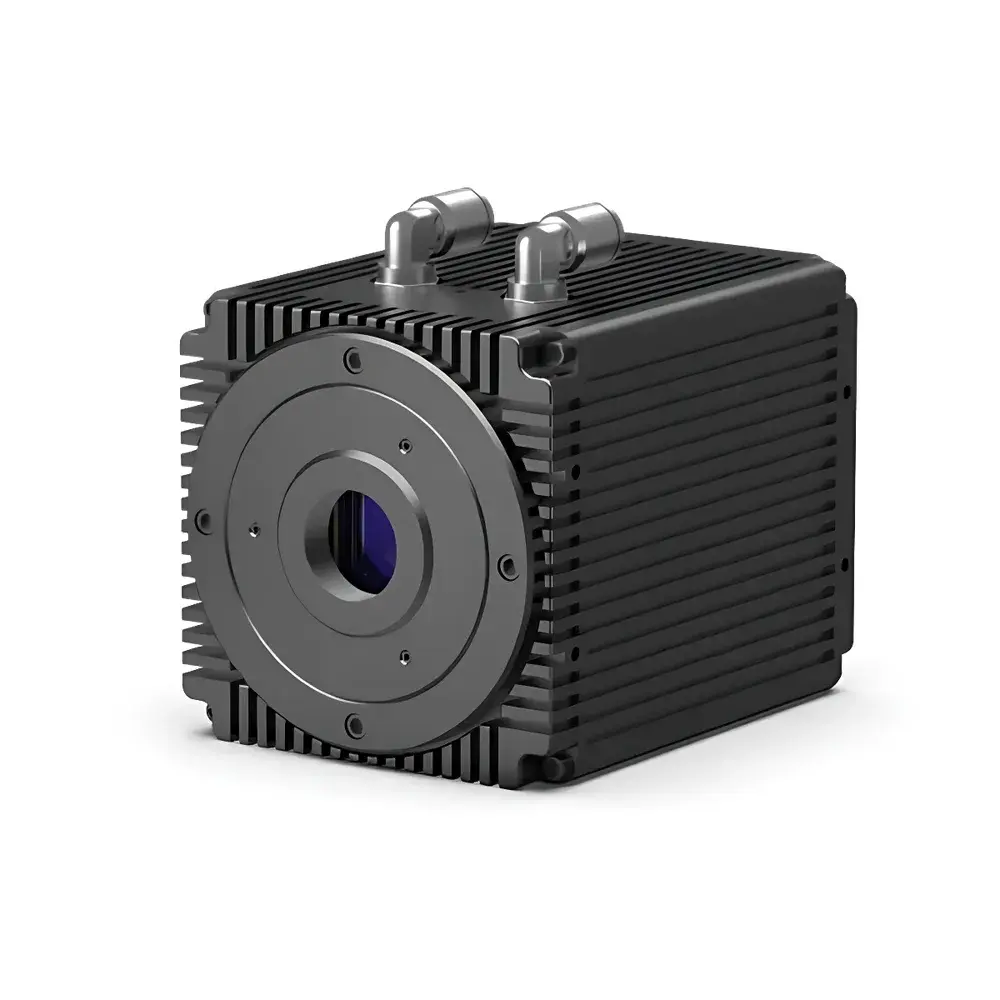
TUCSEN Dhyana95 V2 Back-Illuminated sCMOS Camera for Scientific Imaging and Spectroscopy
| Brand | TUCSEN |
|---|---|
| Origin | Fujian, China |
| Manufacturer Type | OEM Manufacturer |
| Region of Origin | Domestic (China) |
| Model | Dhyana95 V2 |
| Image Resolution | 2048 × 2048 |
| Pixel Size | 11 µm × 11 µm |
| Sensor Diagonal | 31.9 mm |
| Readout Speed | 24 fps @ 16-bit HDR |
| Dynamic Range | 90 dB |
| Quantum Efficiency | 95% @ 560 nm |
| Full Well Capacity | 100 ke⁻ (STD mode) |
| Read Noise | 1.6 e⁻ (median), 1.7 e⁻ (RMS) |
| Dark Current | 0.6 e⁻/pixel/s @ −10 °C |
| Cooling | Air & Liquid (ΔT ≤ 45 °C below ambient) |
| Shutter Type | Rolling |
| Exposure Range | 21 µs – 10 s |
| DSNU | 0.2 e⁻ |
| PRNU | 0.3% |
| Binning | 2×2, 4×4 |
| ROI Support | Yes |
| Timestamp Accuracy | 1 µs |
| Trigger Modes | Hardware / Software |
| Trigger Outputs | Exposure Start, Global, Readout End, High/Low Level, Ready |
| Interface | USB 3.0, Camera Link |
| Bit Depth | 12-bit / 16-bit |
| Mount | C-mount / F-mount |
| Power | 12 V / 8 A |
| Power Consumption | 60 W |
| Dimensions (C-mount) | 100 × 118 × 127 mm |
| Weight | 1613 g |
Overview
The TUCSEN Dhyana95 V2 is a high-performance, back-illuminated scientific CMOS (sCMOS) camera engineered for demanding low-light imaging applications across optical microscopy, spectroscopy, soft X-ray detection, and astrophysical research. Built around the Gpixel GSENSE400BSI sensor, it delivers exceptional quantum efficiency (95% peak at 560 nm) and broad spectral sensitivity from 200 nm (deep UV) to 1100 nm (NIR), enabling quantitative photon-limited measurements without compromise. Its 2048 × 2048 pixel array features 11 µm square pixels, yielding a 31.9 mm diagonal sensor format with an effective imaging area of 22.5 mm × 22.5 mm. The camera operates on a dual-gain architecture optimized for high dynamic range (90 dB typical) and ultra-low read noise (1.6 e⁻ median), making it suitable for simultaneous capture of weak and intense signal components in heterogeneous illumination fields—critical for fluorescence lifetime imaging, Raman mapping, EUV plasma diagnostics, and narrowband solar observation.
Key Features
- Back-illuminated sCMOS architecture with 95% peak quantum efficiency and extended UV–NIR response (200–1100 nm)
- Ultra-low read noise (1.6 e⁻ median) and sub-electron dark signal stability (0.6 e⁻/pixel/s @ −10 °C)
- High full-well capacity: 100,000 electrons (STD mode), supporting robust linearity in mixed-intensity scenes
- Dual cooling options—forced-air and liquid—with thermal stabilization up to 45 °C below ambient temperature
- Advanced pixel-level calibration: DSNU < 0.2 e⁻ and PRNU < 0.3%, ensuring spatial uniformity for absolute radiometric quantification
- Flexible acquisition modes: 24 fps at 16-bit HDR or 48 fps at 12-bit standard mode; programmable rolling shutter with microsecond-level exposure control (21 µs – 10 s)
- Hardware-triggered synchronization with µs-precision timestamping and multiple TTL-compatible trigger outputs
- Modular mechanical design compatible with both C-mount and F-mount optical systems
Sample Compatibility & Compliance
The Dhyana95 V2 is designed for integration into regulated and non-regulated laboratory environments, including ISO/IEC 17025-accredited testing labs and GLP-compliant research facilities. Its calibrated response and traceable gain/noise characterization support adherence to ASTM E1548 (Standard Guide for Characterization of Detectors Used in Imaging Systems) and ISO 15739 (Photography — Electronic Still Picture Imaging — Noise Measurements). While not FDA-cleared as a medical device, its stable, linear response and audit-ready metadata logging (via supported SDKs) align with data integrity expectations under 21 CFR Part 11 when deployed in instrument qualification workflows. The camera’s vacuum-compatible housing option (upon request) enables use in UHV-compatible beamlines for soft X-ray microscopy applications per ISO 15739 Annex D guidelines.
Software & Data Management
The Dhyana95 V2 ships with TUCSEN’s Mosaic and SamplePro acquisition suites, offering real-time histogram analysis, multi-channel time-lapse sequencing, and hardware-synchronized multi-camera triggering. It supports native integration with industry-standard platforms including LabVIEW (NI Vision), MATLAB (Image Acquisition Toolbox), Micro-Manager 2.0 (v2.0.4+), and Python (via PyTUCSEN and OpenCV bindings). All SDKs provide full access to low-level register control, region-of-interest definition, binning configuration, and non-volatile parameter storage. Metadata—including exposure time, gain settings, sensor temperature, and precise timestamps—is embedded directly into TIFF/FITS output files, facilitating reproducible analysis and FAIR (Findable, Accessible, Interoperable, Reusable) data practices. Firmware updates are delivered via signed packages with SHA-256 verification to ensure system integrity.
Applications
- Biological Microscopy: Widefield and TIRF imaging of dim fluorophores (e.g., mNeonGreen, Cy5), single-molecule tracking, and super-resolution modalities requiring high spatiotemporal fidelity
- Spectroscopic Imaging: Hyperspectral mapping in Raman, PL, and absorption spectroscopy where SNR and spectral registration accuracy are paramount
- Soft X-ray & EUV Optics: Detection of 1–50 nm radiation in synchrotron beamlines, laser-plasma sources, and zone-plate microscopes—leveraging high QE in the water-window (2.3–4.4 nm) via optional Zr/Si multilayer filters
- Astrophysics & Solar Observation: High-cadence narrowband imaging of solar prominences, coronal mass ejections, and exoplanet transit photometry using custom bandpass filters
- Industrial Metrology: Defect inspection in semiconductor mask review and thin-film thickness mapping via interference contrast techniques
FAQ
What spectral range does the Dhyana95 V2 cover, and how is UV sensitivity achieved?
The sensor exhibits native responsivity from 200 nm to 1100 nm. Deep-UV performance is enabled by a specialized anti-reflective coating and quartz window option (available upon request), minimizing absorption losses below 250 nm.
Is the camera suitable for time-resolved fluorescence experiments?
Yes—the 21 µs minimum exposure and hardware-triggered global reset enable precise gating synchronized with pulsed lasers or LED drivers, supporting TCSPC-adjacent intensity-based lifetime estimation protocols.
Does the Dhyana95 V2 support true global shutter operation?
No—it employs a high-fidelity rolling shutter with <1 ms skew; however, its fast readout and programmable trigger delay allow effective pseudo-global acquisition in many static or slowly evolving samples.
Can the camera be integrated into a vacuum chamber?
Standard units are air-cooled and not vacuum-rated; however, a vacuum-compatible variant with feedthrough connectors and sealed liquid cooling loops is available under custom configuration (lead time applies).
How is calibration traceability maintained across units?
Each production unit undergoes factory calibration for DSNU, PRNU, gain, and linearity against NIST-traceable reference sources, with certificates provided digitally and embedded in firmware.




