
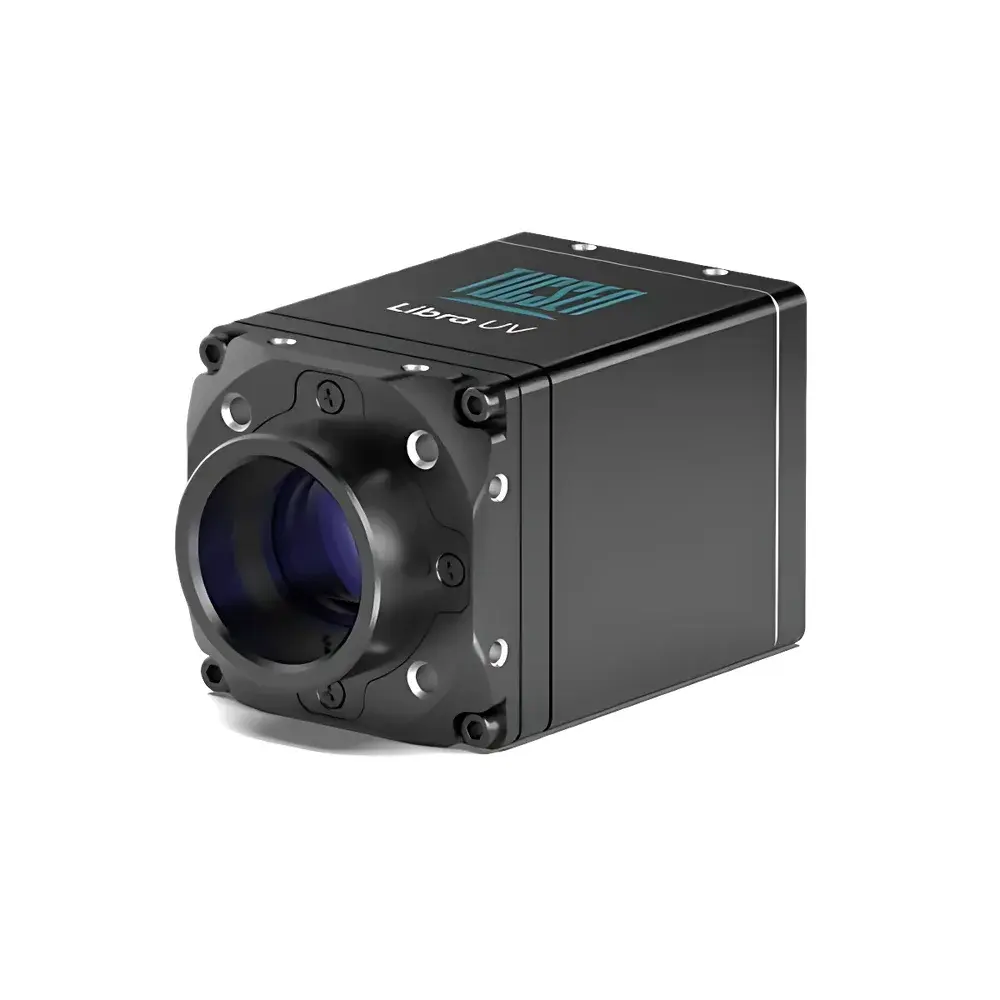
Tucsen Libra UV Back-Illuminated CMOS Camera
| Brand | Tucsen |
|---|---|
| Origin | Fujian, China |
| Manufacturer Type | OEM Manufacturer |
| Model | Libra UV |
| Image Resolution | 2856 (H) × 2848 (V) |
| Pixel Size | 2.74 µm × 2.74 µm |
| Readout Speed | 152 fps @ 8 bit |
| Dynamic Range | 72 dB @ gain 1 |
| Quantum Efficiency | 56% @ 500 nm |
| Spectral Range | 200–1000 nm |
| Sensor | Sony IMX487, Global Shutter, 2/3″ format |
| Interface | 10G GigE |
| Bit Depth | 8/10/12 bit |
| Power | 12 V / 2 A or PoE |
| Dimensions | 45 mm × 45 mm × 74.3 mm |
| Operating Temperature | −10 to +40 °C |
Overview
The Tucsen Libra UV is a high-performance, back-illuminated global shutter CMOS camera engineered for demanding scientific and industrial imaging applications requiring extended spectral sensitivity—particularly in the ultraviolet (UV) range. Built around the Sony IMX487 sensor, it delivers exceptional quantum efficiency (56% at 500 nm; 48% at 365 nm) across a broad spectral band from 200 nm to 1000 nm. This makes the Libra UV uniquely suited for UV-enhanced fluorescence microscopy, semiconductor wafer inspection, thin-film metrology, UV-curable material analysis, and life science applications such as UV-DNA visualization or protein crosslinking studies. Its global shutter architecture eliminates motion distortion during high-speed acquisition, while the 10GigE interface ensures deterministic, low-latency data transfer—critical for synchronized multi-camera systems and real-time process monitoring in automated optical inspection (AOI) platforms.
Key Features
- UV-Optimized Back-Illuminated Sensor: The IMX487 sensor features deep-depletion silicon architecture and anti-reflective coating optimized for high UV photon capture, enabling reliable quantitative imaging below 300 nm without external phosphor conversion.
- Global Shutter Performance: Full-frame global shutter operation with exposure control from 2 µs to 10 s (8-bit) or 3 µs to 10 s (10/12-bit), eliminating rolling shutter artifacts in fast-moving or pulsed-light applications.
- High-Speed Data Throughput: Native 10GigE interface supports sustained frame rates up to 152 fps at 8-bit, 100 fps at 10-bit, and 100 fps at 12-bit—fully utilizing the sensor’s 8.1 MP resolution without subsampling or compression.
- Low-Noise Architecture: Read noise as low as 1.5 e⁻ RMS (12-bit, max gain) and dark signal non-uniformity <0.38% ensure high-fidelity signal extraction in low-light conditions typical of UV fluorescence or Raman spectroscopy.
- Compact Industrial Form Factor: 45 mm × 45 mm × 74.3 mm housing with C-mount lens interface and Hirose 12-pin I/O connector enables seamless integration into OEM instrumentation, endoscopy systems, and embedded machine vision platforms.
- Firmware-Enabled Flexibility: On-sensor binning (1×2, 2×1, 2×2), region-of-interest (ROI) selection, precise hardware-triggered timestamping (±1 µs), and programmable GPIO support deterministic synchronization with lasers, shutters, and motion stages.
Sample Compatibility & Compliance
The Libra UV supports monochrome imaging across UV-VIS-NIR spectra, making it compatible with standard UV-transmissive optics (e.g., fused silica lenses, MgF₂ windows) and common fluorophores excited at 254 nm, 280 nm, 302 nm, and 365 nm. It meets RoHS 3 and CE directives for electromagnetic compatibility (EN 61326-1) and safety (EN 62368-1). While not certified for medical device use per IEC 62304, its firmware architecture supports audit-ready logging and deterministic trigger response—enabling validation under ISO 13485-aligned quality management systems for instrument manufacturers. For regulated environments, the camera’s SDK provides traceable metadata embedding (exposure time, gain, temperature, timestamp) required for GLP/GMP-compliant documentation workflows.
Software & Data Management
The Libra UV is supported by Tucsen’s SamplePro SDK—a cross-platform development toolkit offering native C/C++, C#, and Python APIs with full access to all sensor controls, ROI configuration, and hardware triggering. SamplePro includes built-in calibration routines for dark frame subtraction, flat-field correction, and defect pixel mapping (DPC). Integration with third-party platforms—including HALCON, OpenCV, MATLAB Image Acquisition Toolbox, and National Instruments LabVIEW—is validated via GenICam-compliant driver implementation (GenTL producer v2.2+). All acquired images embed EXIF-style metadata compliant with IEEE 1789-2020 recommendations for scientific image provenance, supporting traceability in FDA 21 CFR Part 11–governed environments when paired with validated application software.
Applications
- Semiconductor Inspection: High-resolution UV imaging of photomasks, wafer defects, and lithography alignment marks using 254 nm or 365 nm illumination sources.
- Materials Classification: Discrimination of polymer degradation, additive distribution, or crystallinity via UV-induced luminescence contrast in composite materials and coatings.
- Infrastructure Diagnostics: UV-induced fluorescence detection of hydrocarbon contamination, corrosion inhibitors, or biofilm formation on pipelines and concrete surfaces.
- Life Science Research: Quantitative UV epifluorescence imaging of nucleic acids, tryptophan-containing proteins, and UV-sensitive dyes in fixed or live-cell preparations.
- Industrial Metrology: Real-time measurement of UV-cured adhesive spread, solder paste deposition, or micro-feature registration in PCB and MEMS assembly lines.
FAQ
Does the Libra UV require external UV-transmissive optics to operate below 350 nm?
Yes. Standard BK7 glass lenses absorb strongly below ~350 nm; fused silica or calcium fluoride optics are required for optimal UV transmission and resolution preservation.
Is PoE (Power over Ethernet) supported at full 10G bandwidth?
PoE support is provided via IEEE 802.3bt Type 4 (up to 90 W), but 10GigE operation requires separate 12 V power input for guaranteed thermal stability and maximum frame rate performance.
Can the camera be synchronized with external laser pulses at sub-microsecond jitter?
Yes—the Hirose 12-pin connector provides dedicated trigger-in, exposure-out, and readout-out signals with hardware-level timing accuracy ±1 µs, compatible with Q-switched and ultrafast laser systems.
What calibration files are included with the camera?
Each unit ships with factory-measured dark frame, flat-field, and defect pixel maps; users may generate updated calibration sets via SamplePro’s integrated acquisition wizard.
Is the SDK compatible with Linux-based embedded systems?
The SamplePro SDK supports x86_64 Linux distributions (Ubuntu 20.04+, CentOS 8+) and OpenEuler 22.03 LTS, including ARM64 cross-compilation toolchains for edge-AI inference deployment.




