
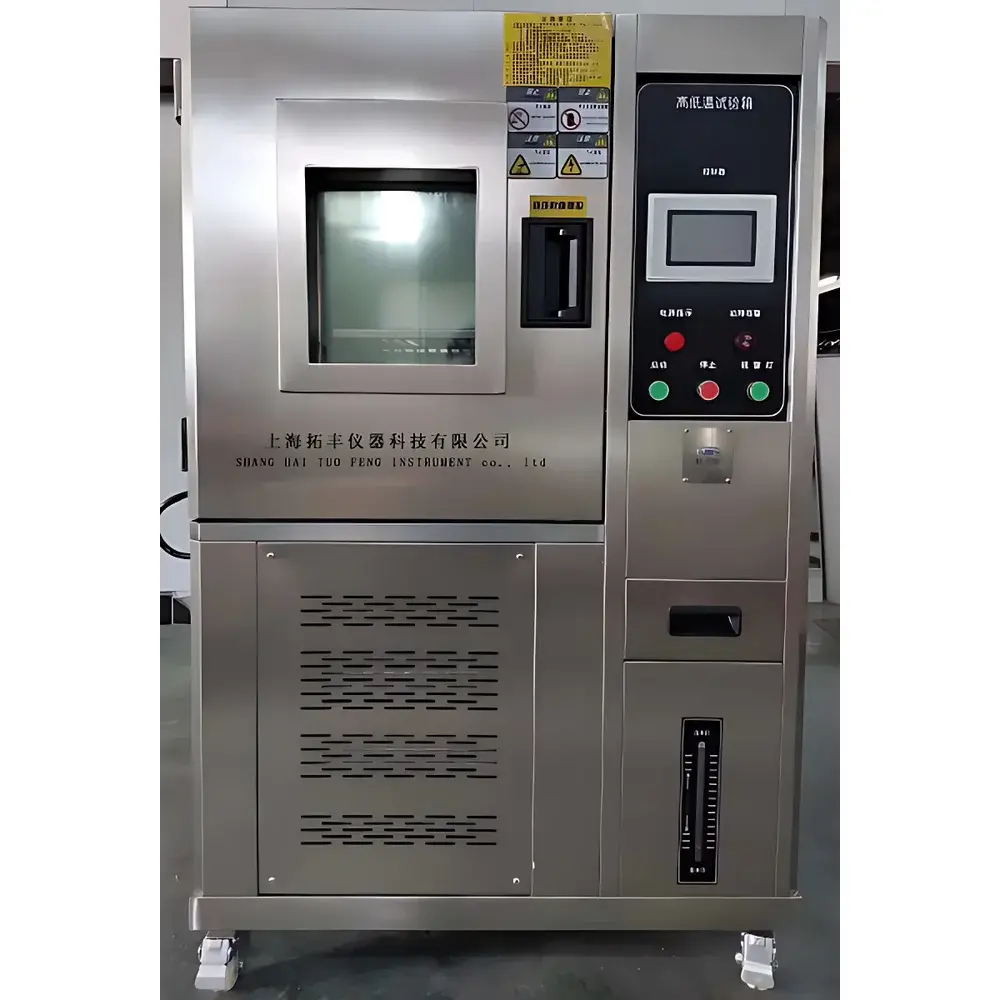
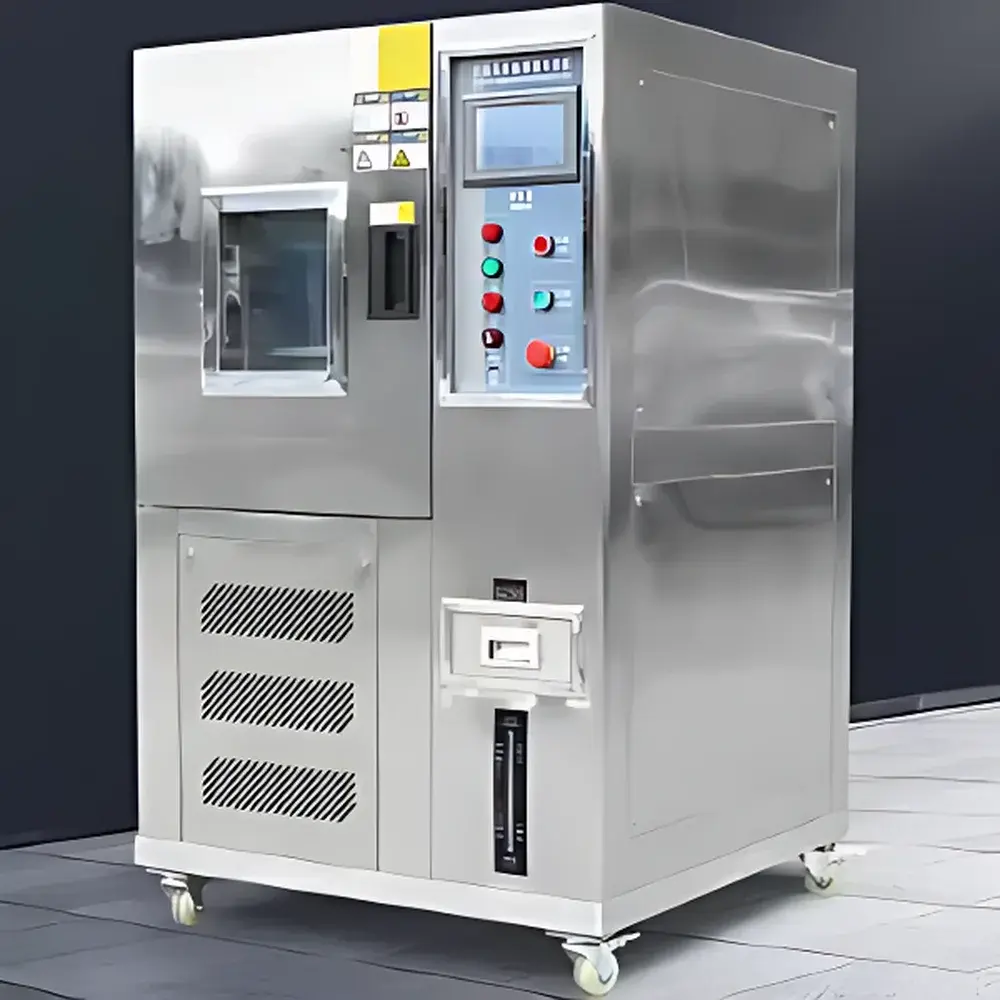
Tuofeng TF-320B-150L Temperature and Humidity Controlled Environmental Test Chamber
| Brand | Tuofeng |
|---|---|
| Origin | Shanghai, China |
| Manufacturer Type | Direct Manufacturer |
| Product Category | Domestic |
| Model | TF-320B-150L |
| Instrument Type | Upright Chamber |
| Temperature Range | −40 °C to +150 °C |
| Humidity Range | 20–98% RH |
| Temperature Uniformity | ±0.1 °C |
| Temperature Fluctuation | ±1 °C (high/low temp) |
| Humidity Uniformity | ±0.1% RH |
| Humidity Fluctuation | ±3% RH |
| Heating Rate | 1.0–3.0 °C/min |
| Internal Dimensions (W×H×D) | 600 × 500 × 500 mm |
Overview
The Tuofeng TF-320B-150L Temperature and Humidity Controlled Environmental Test Chamber is an engineered precision system designed for accelerated environmental stress testing of materials and finished products under rigorously controlled thermal and hygrothermal conditions. Based on dual-refrigeration circuit architecture with cascade compression cooling and PID-controlled steam humidification, the chamber delivers stable, repeatable exposure profiles across a wide operational envelope—from deep-freeze at −40 °C to high-temperature bake at +150 °C, and humidity levels spanning 20–98% RH. Its design complies with fundamental thermodynamic and psychrometric principles governing heat transfer, moisture diffusion, and condensation dynamics in sealed enclosures. The system is intended for laboratory-based reliability validation, quality assurance screening, and pre-compliance environmental simulation—particularly where deterministic control over temperature ramping, dwell stability, and humidity cycling is required per standardized test protocols.
Key Features
- Upright structural configuration optimized for floor-space efficiency and ergonomic access to the 150 L test volume (600 × 500 × 500 mm internal dimensions)
- Dual-stage refrigeration system utilizing French Tecumseh compressors, enabling reliable operation down to −40 °C without liquid nitrogen assistance
- Precision PID-based humidity control via stainless-steel steam generator and calibrated capacitive RH sensor, achieving ±0.1% RH uniformity at steady state
- High-density polyurethane insulation with chlorinated ethyl foam formulation (k-value ≤ 0.022 W/m·K), minimizing thermal bridging and energy drift
- Robust SUS304 stainless steel interior and exterior cladding, resistant to corrosion from repeated condensation cycles and chemical vapor exposure
- Integrated safety architecture including high/low pressure cutouts, compressor overload protection, over-temperature/over-humidity interlocks, and fuse-backed fault diagnostics
- Korean TEMI programmable controller with 100-segment ramp-soak profile capability, real-time data logging, and USB export functionality
Sample Compatibility & Compliance
The TF-320B-150L accommodates diverse sample geometries—including PCB assemblies, polymer housings, medical device packaging, automotive ECUs, and pharmaceutical primary containers—within its unobstructed test space. Airflow distribution is engineered to meet ISO 16750-4 (road vehicles), IEC 60068-2 series (environmental testing), and MIL-STD-810H Method 502.7 (temperature shock) requirements for spatial uniformity. It supports full-cycle execution of GB/T 2423.1–2423.4 (China national standards), JIS C 0041, ASTM D4332, and IPC-9701A. All control algorithms and data records are structured to align with GLP and GMP documentation practices, supporting audit-ready traceability when paired with optional 21 CFR Part 11-compliant software modules.
Software & Data Management
The TEMI controller provides intuitive touch-interface navigation, multi-step program sequencing, and real-time graphical display of chamber setpoints versus actuals. Logged data (temperature, humidity, elapsed time, alarm status) is stored internally for ≥30 days and exportable via USB to CSV or Excel-compatible formats. Optional PC-based software enables remote monitoring, automated report generation (PDF/HTML), statistical process analysis (SPC), and integration into enterprise LIMS environments. Calibration certificates for integrated sensors are traceable to NIM (National Institute of Metrology, China) standards; periodic verification procedures follow ISO/IEC 17025 guidelines.
Applications
This chamber serves as a core tool in R&D labs and QC departments for evaluating thermal expansion coefficients, hygroscopic dimensional stability, seal integrity under cyclic stress, solder joint fatigue, battery electrolyte volatility, and accelerated aging of elastomeric gaskets. It is routinely deployed in electronics manufacturing for JEDEC JESD22-A104 qualification, in aerospace for DO-160 Section 4.5 environmental screening, and in pharma packaging validation per USP and Annex 15. Its reproducible performance supports failure mode identification during HALT/HASS development phases and long-term storage condition mapping for shelf-life studies.
FAQ
What is the maximum allowable sample load volume inside the 150 L chamber without compromising temperature/humidity uniformity?
For optimal compliance with ±0.1 °C/±0.1% RH uniformity specifications, total sample volume should not exceed 30% of internal chamber volume (i.e., ≤45 L). Larger loads require extended stabilization time and may necessitate recalibration of airflow parameters.
Does the system support rapid temperature transition testing (e.g., thermal shock) between extreme setpoints?
While optimized for steady-state and ramp-soak profiles, the TF-320B-150L achieves average heating rates of 1.0–3.0 °C/min and cooling rates of ~1.0 °C/min (−40 °C to +150 °C). For true thermal shock (≤15 sec transition), a dedicated two-chamber system is recommended.
Is the TEMI controller firmware upgradable, and does it support third-party SCADA integration?
Yes—firmware updates are available via Tuofeng’s authorized service portal. Modbus RTU (RS-485) and optional Ethernet/IP interfaces enable integration with industrial automation platforms and centralized monitoring systems.
How frequently must the humidity sensor be recalibrated, and what is the recommended calibration standard?
Capacitive RH sensors require annual recalibration using NIST-traceable saturated salt solutions (e.g., LiCl, MgCl₂, K₂SO₄) across three points (11%, 33%, 75% RH) per ISO 17025-accredited procedures.
Can the chamber operate continuously at 98% RH above 85 °C without condensation on internal surfaces or samples?
Yes—the chamber’s dew point management logic, combined with heated observation window and drain-heated chamber floor, prevents unintended surface condensation during high-humidity, high-temperature holds, ensuring valid test conditions per IEC 60068-2-78.



