
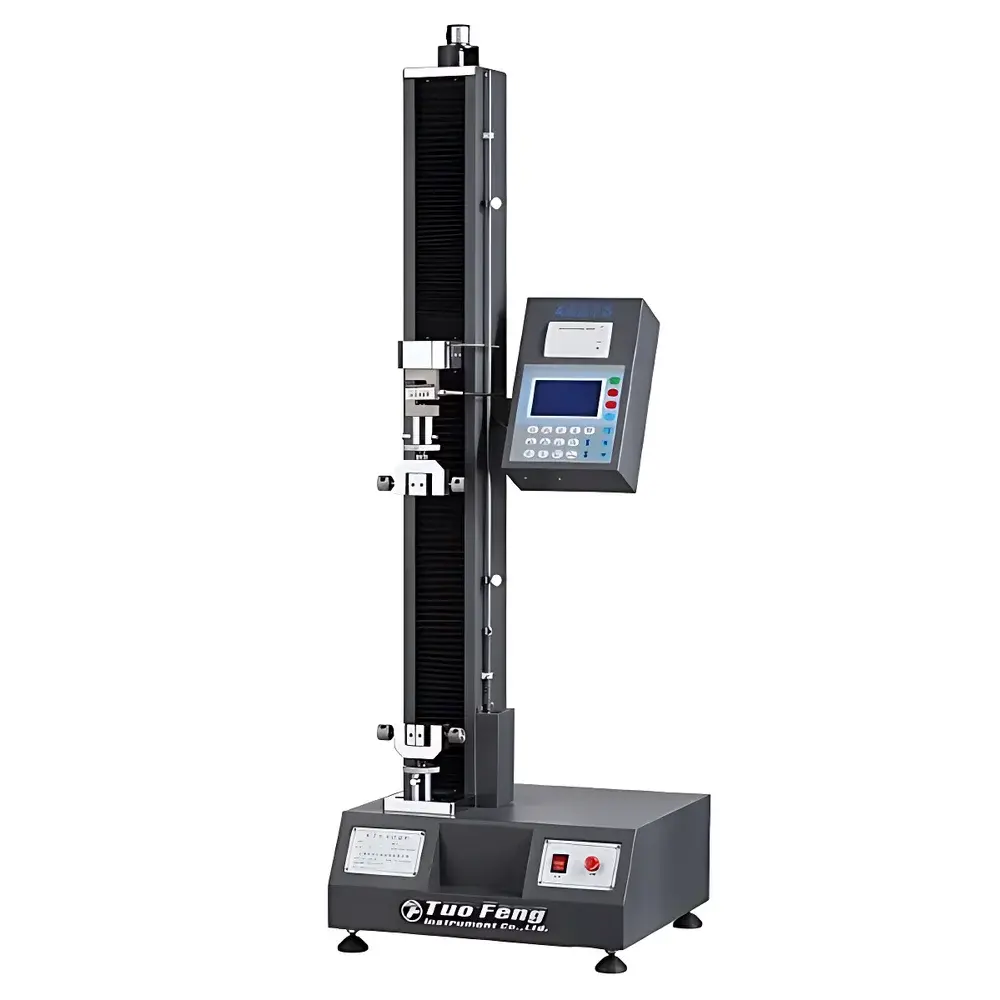
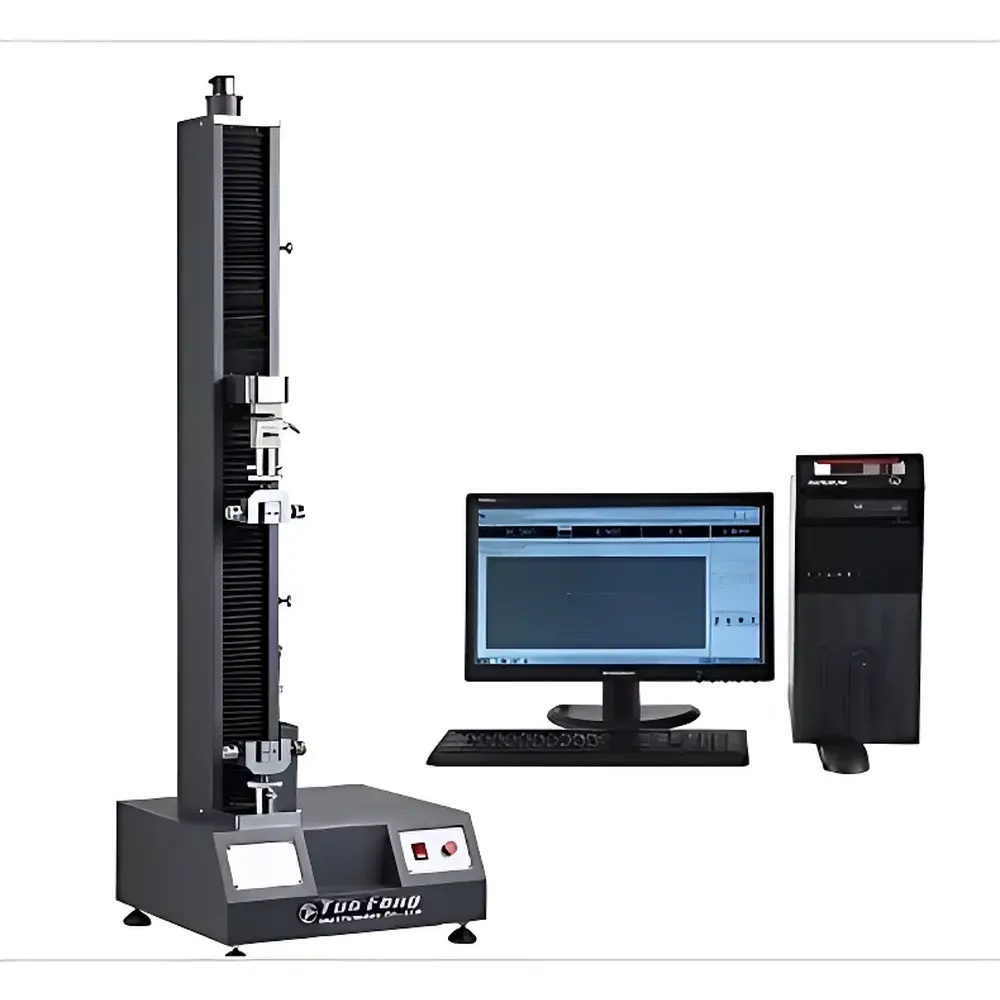
Tuofeng TFL-11 Single-Column Microcomputer-Controlled Electronic Tensile Testing Machine
| Brand | Tuofeng |
|---|---|
| Origin | Shanghai, China |
| Manufacturer Type | Direct Manufacturer |
| Country of Origin | China |
| Model | TFL-11 |
| Instrument Type | Electronic Tensile Testing Machine |
| Maximum Test Load | 0.1 kN (100 N) |
| Force Measurement Range | 1–1000 N |
| Force Accuracy | ±0.5% of reading |
| Crosshead Travel | 700 mm |
| Displacement Resolution | 0.0001 mm |
Overview
The Tuofeng TFL-11 is a single-column, microcomputer-controlled electronic tensile testing machine engineered for precision mechanical property evaluation of low-force specimens in research laboratories, quality control environments, and R&D departments. Based on servo-motor-driven electromechanical actuation and high-resolution load cell transduction, the system operates under controlled displacement or load-rate conditions to measure fundamental mechanical responses—including tensile strength, elongation at break, Young’s modulus, peel adhesion, tear resistance, and bond strength—according to standardized test protocols. Its compact architecture and calibrated force range (1–1000 N) make it especially suited for thin-film substrates, fine metallic wires, polymer foils, coated papers, biomedical films, adhesive tapes, and micro-electronic interconnects where high sensitivity and sub-micron displacement resolution are critical.
Key Features
- Single-column rigid frame with aluminum alloy extrusion and precision-ground linear guides for minimal deflection and high axial alignment stability
- High-resolution load measurement via temperature-compensated S-type load cell, certified to ISO 7500-1 Class 0.5 accuracy (±0.5% of reading)
- Crosshead travel of 700 mm with optical encoder-based displacement feedback; resolution down to 0.0001 mm (0.1 µm), traceable to NIST-traceable calibration standards
- Programmable speed control from 0.01 to 500 mm/min (infinitely variable), enabling compliance with ASTM D882 (thin plastics), ISO 527-3 (films), and ASTM F88 (peel strength)
- Dual-mode operation: closed-loop displacement control and closed-loop load control, both with real-time PID tuning capability
- Integrated safety architecture including dual-channel electronic limit switches, emergency stop circuitry, and automatic overload cutoff at 110% of full-scale capacity
- Motorized crosshead with three-speed jog control (fast/medium/slow) and programmable return-to-start function post-test
Sample Compatibility & Compliance
The TFL-11 accommodates specimens ranging from 1 mm wide polymer strips to 25 mm wide composite laminates, with optional fixtures for film clamping, peel adhesion (180°/90°), puncture, and loop tensile configurations. It supports standardized specimen geometries per ASTM D882 (plastic film), ISO 1184 (cellulosic films), GB/T 1040.3 (plastics—film and sheet), and JIS Z 1707 (packaging films). All force and displacement data acquisition meets GLP documentation requirements, with audit trail functionality available in software configuration. The instrument is designed to operate within ambient laboratory conditions (23 ± 2°C, 40–60% RH) and complies with CE electromagnetic compatibility (EMC) directives and IEC 61000-6-3 emissions standards.
Software & Data Management
The Windows-based TensilePro™ software (v5.x) provides full test method definition, real-time data visualization, and automated report generation. It supports multi-language UI (English, Simplified Chinese, Traditional Chinese), customizable unit systems (N, lbf, MPa, psi, %, mm, inch), and dynamic curve overlays for comparative analysis across batches or material variants. During testing, synchronized plots include load–time, load–displacement, stress–strain, and displacement–time. Post-test calculations automatically derive tensile strength, yield point, modulus (secant/tangent), elongation, peel force (N/mm), and tear energy (kJ/m²) when geometric inputs (width, thickness, gauge length) are entered. Data export is supported in CSV, XLSX, and PDF formats; all raw datasets include timestamped metadata, operator ID, and calibration certificate references. Software updates are delivered remotely and maintain backward compatibility with legacy test files.
Applications
- Characterization of barrier films used in pharmaceutical blister packaging and food vacuum pouches
- Quality assurance of lithium-ion battery separator membranes (polyolefin microporous films)
- Mechanical validation of biodegradable agricultural mulch films under accelerated aging conditions
- Adhesion strength assessment of pressure-sensitive tapes and medical transdermal patches
- Tensile performance mapping of electrospun nanofiber mats for tissue engineering scaffolds
- Interfacial bond strength evaluation of laminated flexible printed circuits (FPCs)
- Routine QC testing of textile elastane blends, nonwovens, and technical geotextiles
FAQ
What international standards does the TFL-11 support out-of-the-box?
The system includes pre-configured test methods for ASTM D882, ISO 527-3, GB/T 1040.3, JIS Z 1707, and DIN EN ISO 1209-1, with editable parameters to accommodate custom protocols.
Is the force sensor calibrated and traceable to national standards?
Yes—the load cell is factory-calibrated against NIST-traceable deadweight standards and supplied with a documented calibration certificate compliant with ISO/IEC 17025 requirements.
Can the TFL-11 be integrated into a LIMS or MES environment?
Via optional OPC UA or TCP/IP API module, raw data streams and test summary reports can be exported to enterprise systems with configurable metadata tagging and secure authentication.
Does the software meet FDA 21 CFR Part 11 requirements for electronic records?
The optional 21 CFR Part 11-compliant software package provides role-based access control, electronic signatures, audit trails, and data integrity safeguards for regulated pharmaceutical and medical device applications.
What is the recommended maintenance schedule?
Biannual verification of force and displacement accuracy is advised using certified reference standards; annual preventive maintenance includes lubrication of lead screws, encoder inspection, and firmware update validation.



