
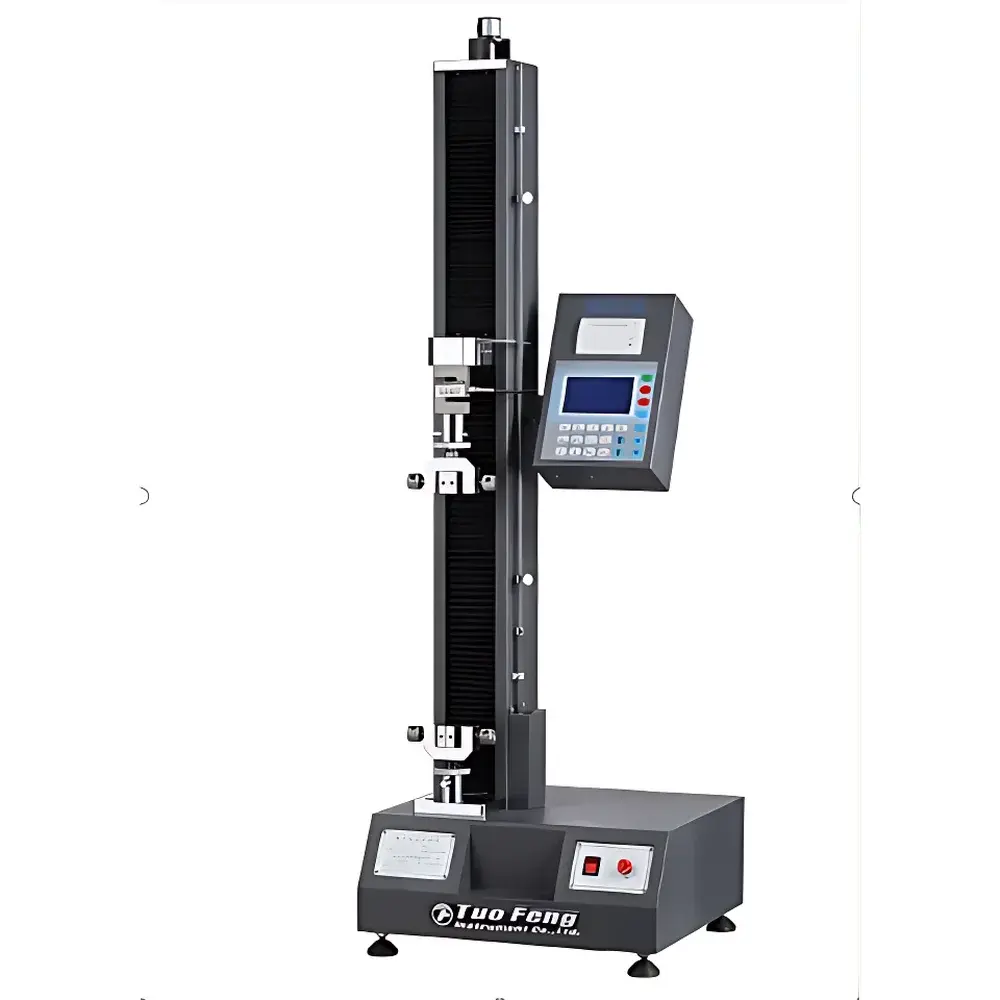
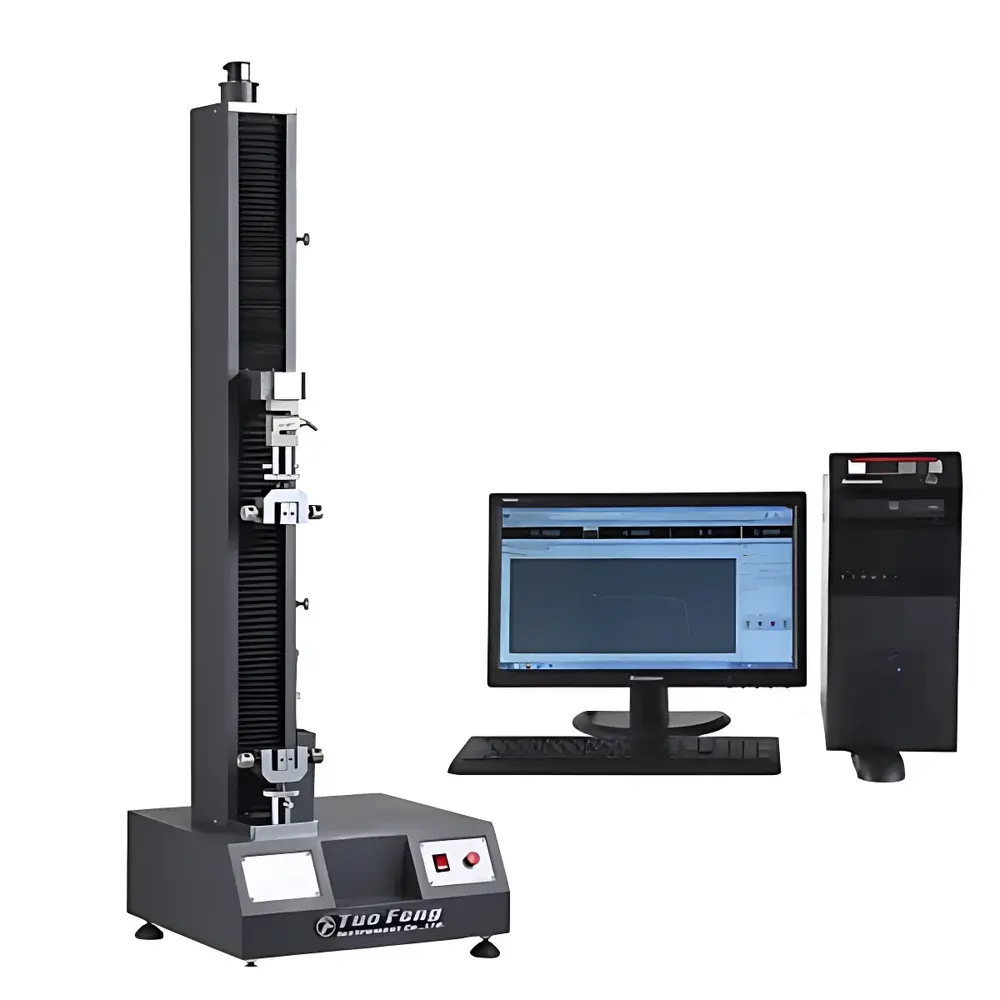
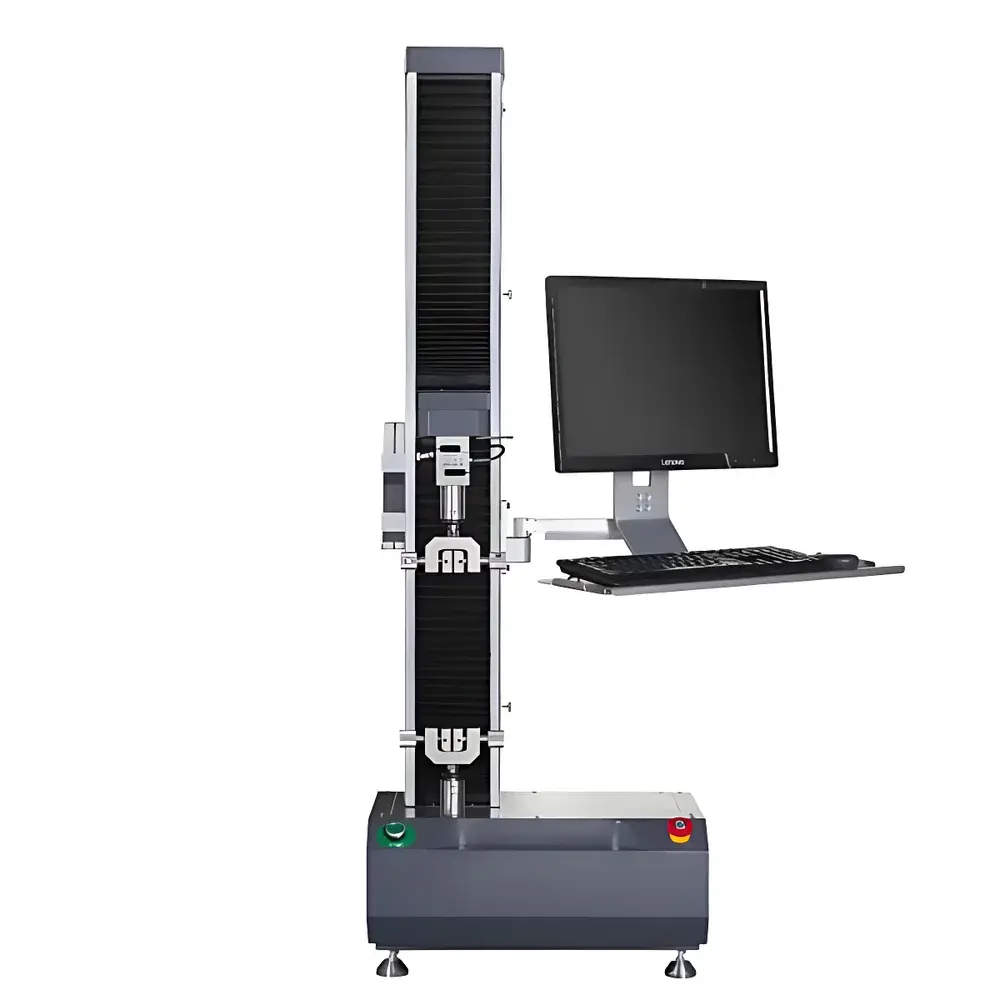
Tuofeng TFL-30S Computer-Controlled Tensile Testing Machine for Terminal Pull-Off and Mechanical Property Evaluation
| Brand | Tuofeng |
|---|---|
| Origin | Shanghai, China |
| Manufacturer Type | Direct Manufacturer |
| Instrument Type | Electromechanical Tensile Tester |
| Model | TFL-30S |
| Max Test Load | 5 kN |
| Force Measurement Range | 0.4%–100% FS |
| Force Accuracy | ±0.5% of reading |
| Crosshead Travel | 700 mm |
| Displacement Resolution | ±0.5% of reading |
| Test Speed Range | 0.01–500 mm/min (infinitely variable) |
| Position Sensing | Optical Encoder |
| Protection | Electronic Limit Switches, Emergency Stop, Overload Cutoff (≥110% F.S.) |
| Power Supply | 220 V AC, 50 Hz, 400 W |
| Dimensions (W×D×H) | ≈460×460×1500 mm |
| Weight | ≈120 kg |
Overview
The Tuofeng TFL-30S is a precision-engineered, computer-controlled electromechanical tensile testing machine designed for quantitative mechanical evaluation of small-scale components and materials—particularly electrical terminals, crimped connectors, wire harnesses, solder joints, and adhesive-bonded interfaces. It operates on the fundamental principle of uniaxial force application under controlled displacement or load rate, conforming to standardized test methodologies defined in ISO 14577 (instrumented indentation), ASTM D903 (peel strength), ASTM D3330 (adhesive tape peel), IEC 60512-2 (electrical connector mechanical testing), and GB/T 228.1 (metallic materials tensile testing). The system delivers high reproducibility in pull-off force measurement, critical for validating terminal retention strength, crimp integrity, and interfacial bond reliability in automotive wiring harnesses, consumer electronics assemblies, and industrial control modules.
Key Features
- Robust dual-column frame with reinforced aluminum alloy crosshead and precision-ground ball-screw drive, ensuring minimal deflection and long-term dimensional stability during repeated loading cycles.
- High-resolution load cell calibrated to ISO 376 Class 0.5 accuracy, with full-scale resolution of 1/300,000 counts—enabling reliable detection of sub-newton forces during low-load terminal release events.
- Optical encoder-based displacement feedback system with ±0.5% linearity across the entire 700 mm travel range, supporting both high-speed return (up to 500 mm/min) and ultra-low-speed creep testing (0.01 mm/min).
- Integrated electronic limit protection, hardware-based emergency stop circuitry, and software-enforced overload cutoff (triggered at ≥110% of rated capacity) ensure operator safety and equipment longevity.
- Modular fixture interface compatible with standardized wedge grips, pneumatic clamps, and custom-designed terminal-holding fixtures—including DIN 46228-compliant crimp verification jaws and IEC 60512-2 compliant pin-pull adapters.
- Real-time dual-channel data acquisition (force + displacement) at ≥1 kHz sampling rate, synchronized with event-triggered logging for precise identification of yield onset, peak load, and failure mode transitions.
Sample Compatibility & Compliance
The TFL-30S accommodates specimens ranging from 0.1 mm diameter micro-wires to 25 mm wide flat busbars, with standard configurations supporting terminal widths up to 12 mm and crimp heights ≤8 mm. It meets essential regulatory and quality framework requirements for production-line validation and R&D labs operating under ISO/IEC 17025, IATF 16949, and IPC-A-610 compliance regimes. All force calibration certificates are traceable to NIM (National Institute of Metrology, China) and include uncertainty budgets per ISO/IEC 17025 Annex A. Software audit trails comply with FDA 21 CFR Part 11 requirements when configured with user authentication, electronic signatures, and immutable data archiving—supporting GLP/GMP documentation workflows.
Software & Data Management
The Windows-based TensileTest Pro v3.2 software provides full test method scripting, real-time multi-curve visualization (load–time, load–displacement, stress–strain, extension–time), and automated parameter extraction—including ultimate tensile strength (UTS), yield point (0.2% offset), elongation at break, peel adhesion energy (J/m²), and crimp retention force (N). Units are fully configurable (N/kN/lbf, mm/inch, MPa/psi), with language support for English, Simplified Chinese, Traditional Chinese, and German. Raw ASCII data exports (.csv/.txt) and PDF report generation include metadata stamping (operator ID, timestamp, environmental conditions), statistical summaries (n ≥ 5), and comparative overlay analysis for batch-to-batch consistency assessment. Firmware and software updates are delivered via secure HTTPS portal with version-controlled changelogs and backward-compatible file format preservation.
Applications
- Quantitative pull-off testing of insulated and non-insulated electrical terminals (e.g., FAKRA, USCAR-2, JASO D001) per SAE J1797 and UL 486A/B.
- Peel strength evaluation of flexible printed circuit (FPC) laminates, heat-sealed packaging films, and pressure-sensitive adhesive tapes.
- Tensile property characterization of thin metallic foils (Cu, Al, Ni), elastomeric gaskets, and thermoplastic insulating sleeves.
- Mechanical validation of solder joint shear strength (via modified push-off fixtures) and ultrasonic weld integrity in battery module interconnects.
- Quality gate testing for incoming material inspection of crimped wire assemblies prior to final harness integration.
FAQ
What standards does the TFL-30S support out-of-the-box?
Preloaded test methods include ASTM D903 (180° peel), ISO 8510-2 (t-peel), GB/T 2790 (adhesive peel), IEC 60512-2-1 (connector pull force), and ISO 19973-1 (pneumatic component durability)—with customizable method templates for proprietary protocols.
Can the system be integrated into an automated production line?
Yes—the TFL-30S supports RS-232, Ethernet TCP/IP, and optional PLC I/O modules (24 V DC digital inputs/outputs) for external trigger synchronization, pass/fail signal output, and MES/SCADA data handshaking.
Is third-party calibration certification available?
Factory calibration includes NIM-traceable certificate; optional UKAS-accredited calibration (ISO/IEC 17025) is available upon request with documented uncertainty values and temperature-compensated drift correction factors.
How is data integrity ensured during long-duration tests?
All acquired data streams are written directly to non-volatile memory buffers before disk write, with CRC-32 checksum validation on every 4 KB sector and automatic recovery from unexpected power loss without data corruption.
What maintenance intervals are recommended for sustained accuracy?
Load cell zero-point verification every 200 hours of operation; annual full recalibration including mechanical alignment check, encoder linearity verification, and ball-screw lubrication per OEM service manual (Revision 4.1, 2023).



