
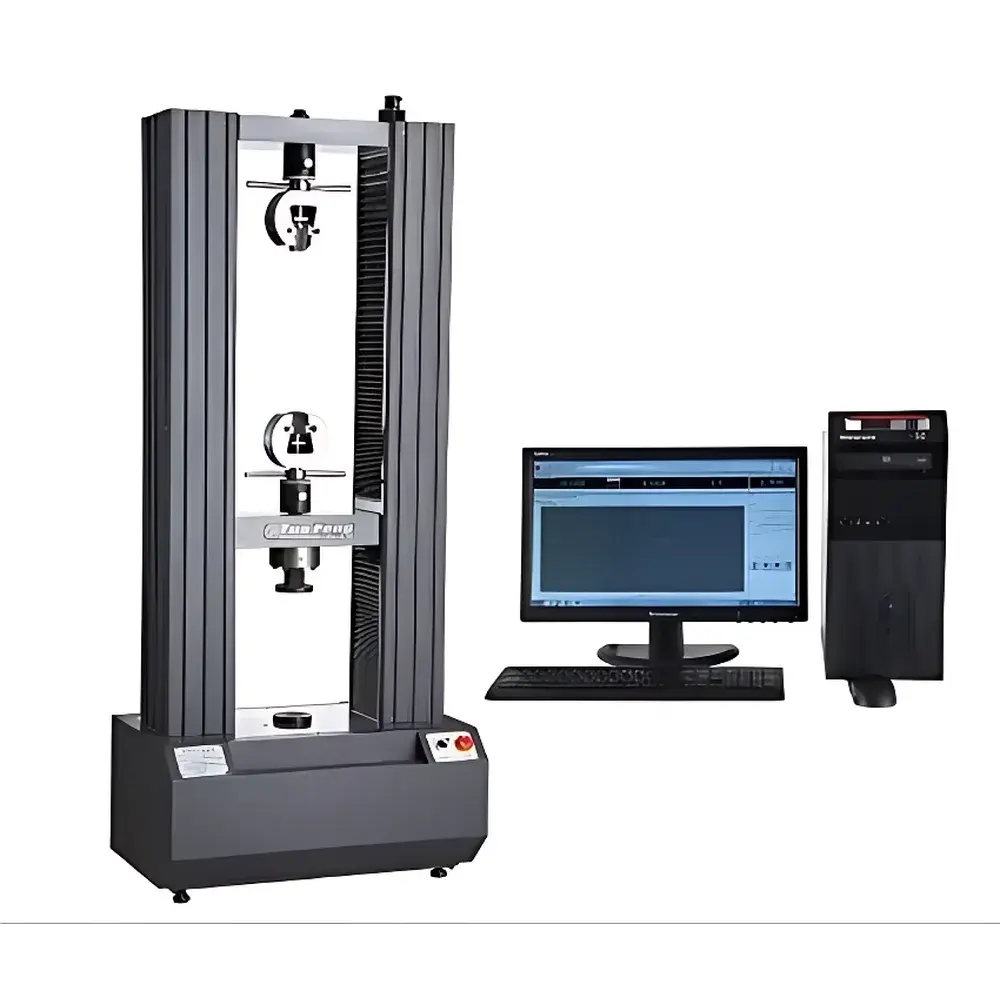
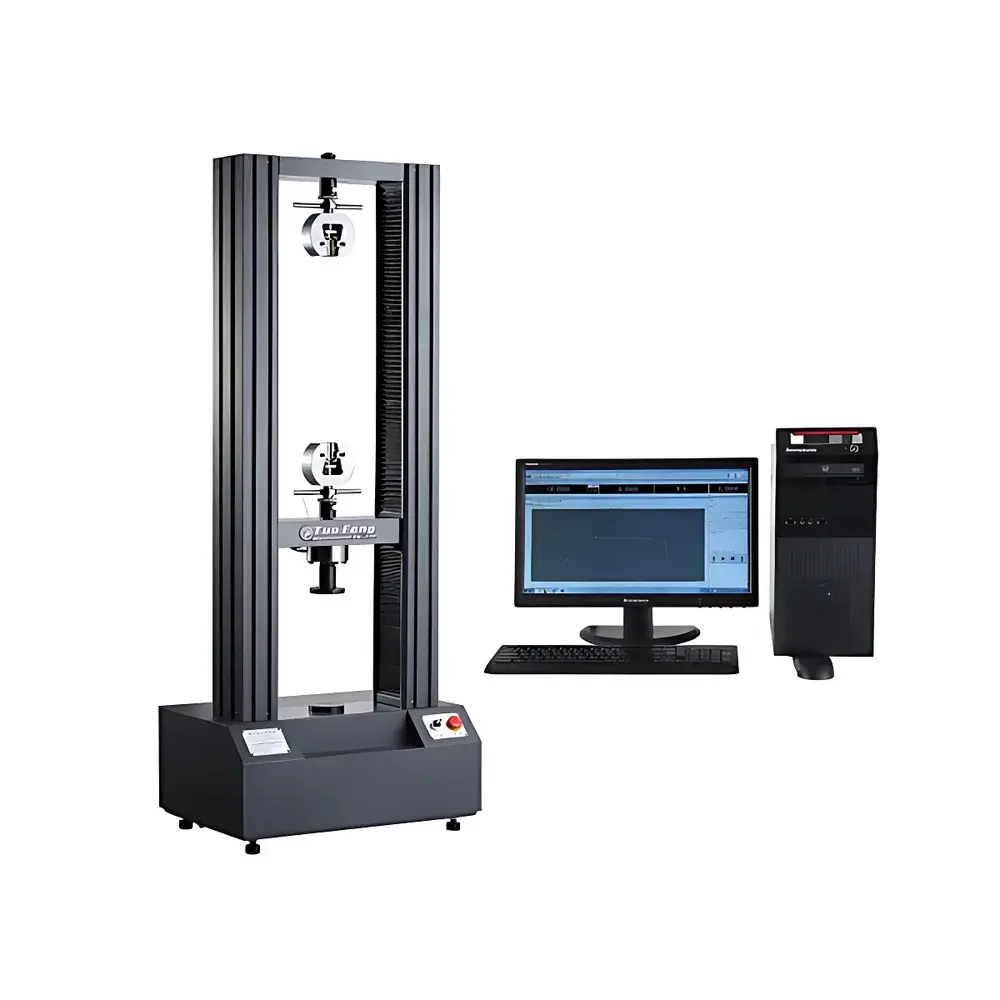
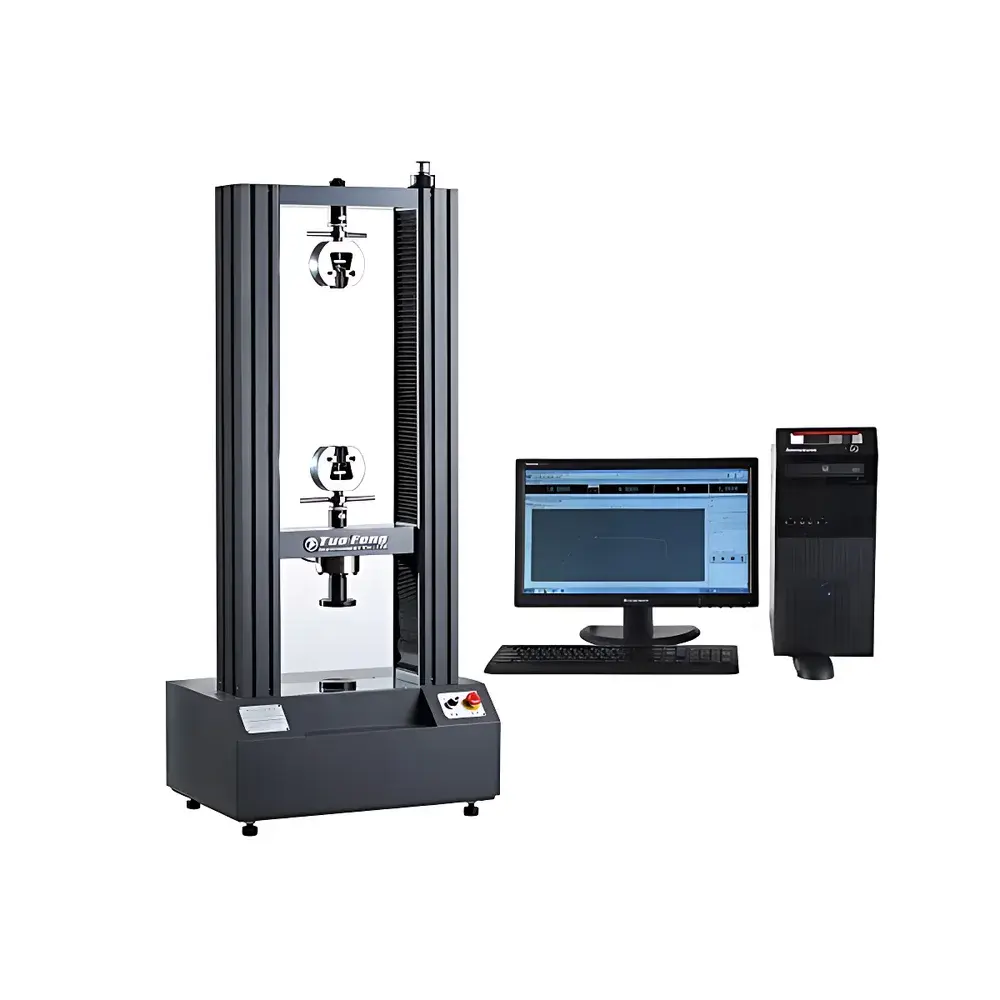
Tuofeng TFW-1 Electronic Universal Tensile Testing Machine
| Brand | Tuofeng |
|---|---|
| Origin | Shanghai, China |
| Manufacturer Type | Direct Manufacturer |
| Instrument Type | Electronic Tensile Testing Machine |
| Model | TFW-1 |
| Max Test Load | 0.1 kN (100 N) |
| Force Range | 1–5000 N |
| Force Accuracy | ±0.5% of reading |
| Crosshead Travel | 800 mm |
| Displacement Resolution | 0.0001 mm |
Overview
The Tuofeng TFW-1 Electronic Universal Tensile Testing Machine is a precision-engineered dual-column electromechanical system designed for static mechanical property evaluation of polymeric, elastomeric, and composite materials under controlled uniaxial loading conditions. Operating on the principle of servo-controlled force application via high-precision ball screws and optical encoder-based displacement feedback, the TFW-1 delivers repeatable, traceable, and standards-compliant tensile, compression, flexure, shear, tear, peel, and puncture measurements. Its architecture adheres to fundamental metrological requirements defined in ISO 7500-1 (static calibration of testing machines), ASTM E4 (load verification), and GB/T 16491–2008 (Chinese national standard for electronic universal testing machines). The system is optimized for low-force applications—particularly relevant to soft polymers, thin films, elastomers, adhesives, and biomedical specimens—where sub-newton resolution and micron-level displacement fidelity are critical for capturing nonlinear viscoelastic response, yield onset, and failure initiation.
Key Features
- Dual-column rigid frame with reinforced aluminum alloy crosshead and precision-ground steel load train, ensuring minimal deflection (<0.02 mm under full load) and long-term geometric stability.
- Imported AC servo motor coupled with worm-gear reduction and preloaded ball screw drive, enabling smooth, silent, and backlash-free motion across the full speed range (0.001–500 mm/min, infinitely variable).
- High-resolution load cell calibrated to ±0.5% FS accuracy, with internal digital filtering and temperature compensation to maintain repeatability across ambient lab conditions (10–35°C).
- Optical rotary encoder-based displacement measurement system delivering 0.0001 mm resolution and ±0.005% accuracy—fully traceable to NIST-traceable standards.
- Integrated electronic limit switches, emergency stop circuitry, and overload protection (auto-shutdown at 110% of rated capacity) compliant with IEC 61800-5-2 functional safety guidelines.
- Motorized crosshead with dual-speed (fast/slow) positioning and programmable return-to-start functionality for high-throughput batch testing.
Sample Compatibility & Compliance
The TFW-1 accommodates specimens ranging from thin rubber sheets (≥0.1 mm thickness) to molded plastic tensile bars (ASTM D638 Type V), elastomeric foams, textile laminates, and pressure-sensitive adhesive tapes. Standard pneumatic, wedge-action, or vise-type grips (customizable per ISO 527, ASTM D882, GB/T 1040) ensure secure clamping without slippage or premature edge failure. All test protocols support automatic compliance with major international standards—including ASTM D412 (rubber tensile), ASTM D882 (thin plastics), ISO 37 (vulcanized rubber), ISO 527-2 (plastics), and GB/T 528 (Chinese rubber standard)—with built-in calculation modules for tensile strength, elongation at break, modulus at specified strain, tear strength (ASTM D624), peel adhesion (ASTM D903), and puncture resistance (ASTM F1306). Full audit trail and calibration certificate documentation meet GLP/GMP data integrity expectations per FDA 21 CFR Part 11 when configured with optional electronic signature and user access control.
Software & Data Management
The Windows-based Tuofeng TestSuite software provides ISO/IEC 17025-aligned test configuration, real-time multi-curve visualization (load–time, load–displacement, stress–strain, displacement–time), and automated parameter extraction—including ultimate tensile strength, yield point (0.2% offset), Young’s modulus, elongation, and energy to break. Users may define custom test sequences (e.g., preload → ramp → hold → unload) and set pass/fail criteria against specification limits. Data export supports CSV, Excel, PDF, and XML formats; all raw and processed results are timestamped, user-logged, and stored with immutable metadata. Software supports multilingual UI (English, Simplified/Traditional Chinese), unit conversion (N/kN/lbf, mm/inch, MPa/psi), and curve overlay for comparative analysis across material batches or processing conditions. Optional firmware updates and protocol libraries are provided free of charge for the instrument’s operational lifetime.
Applications
The TFW-1 serves as a primary mechanical characterization tool in R&D laboratories and QC departments focused on polymer formulation, rubber compounding, medical device component validation, packaging film development, and automotive interior material qualification. Typical use cases include: evaluating cure-state dependency of silicone elastomers; quantifying creep-recovery behavior of thermoplastic polyurethanes; validating bond strength of laminated PET–Al foil structures; assessing tensile anisotropy in extruded polyolefin films; and performing accelerated aging studies on EPDM gaskets per SAE J200. Its compact footprint (780 × 560 × 1700 mm) and low-power consumption (220 V, 750 W) make it suitable for benchtop deployment in shared instrumentation facilities or regulated cleanroom environments.
FAQ
What standards does the TFW-1 comply with for calibration and verification?
It conforms to GB/T 16491–2008, JJG 475–2008, ISO 7500-1, and ASTM E4 for force measurement accuracy and system linearity verification.
Can the system perform cyclic or fatigue testing?
No—the TFW-1 is designed exclusively for static monotonic tests. For dynamic or fatigue applications, consider Tuofeng’s servo-hydraulic series (e.g., TFH-50F) with closed-loop waveform control.
Is third-party calibration certification available?
Yes—factory-calibrated units include a NIST-traceable certificate; accredited third-party calibration (e.g., CNAS or A2LA) can be arranged upon request.
What grip options are supported for rubber sheet testing?
Pneumatic side-action grips with rubber-coated jaws (standard) and custom-designed roller grips for low-modulus elastomers are available.
Does the software support 21 CFR Part 11 compliance?
Yes—when deployed with role-based user accounts, electronic signatures, and audit trail logging enabled, the system meets core Part 11 requirements for regulated pharmaceutical and medical device testing.
Related Products



