
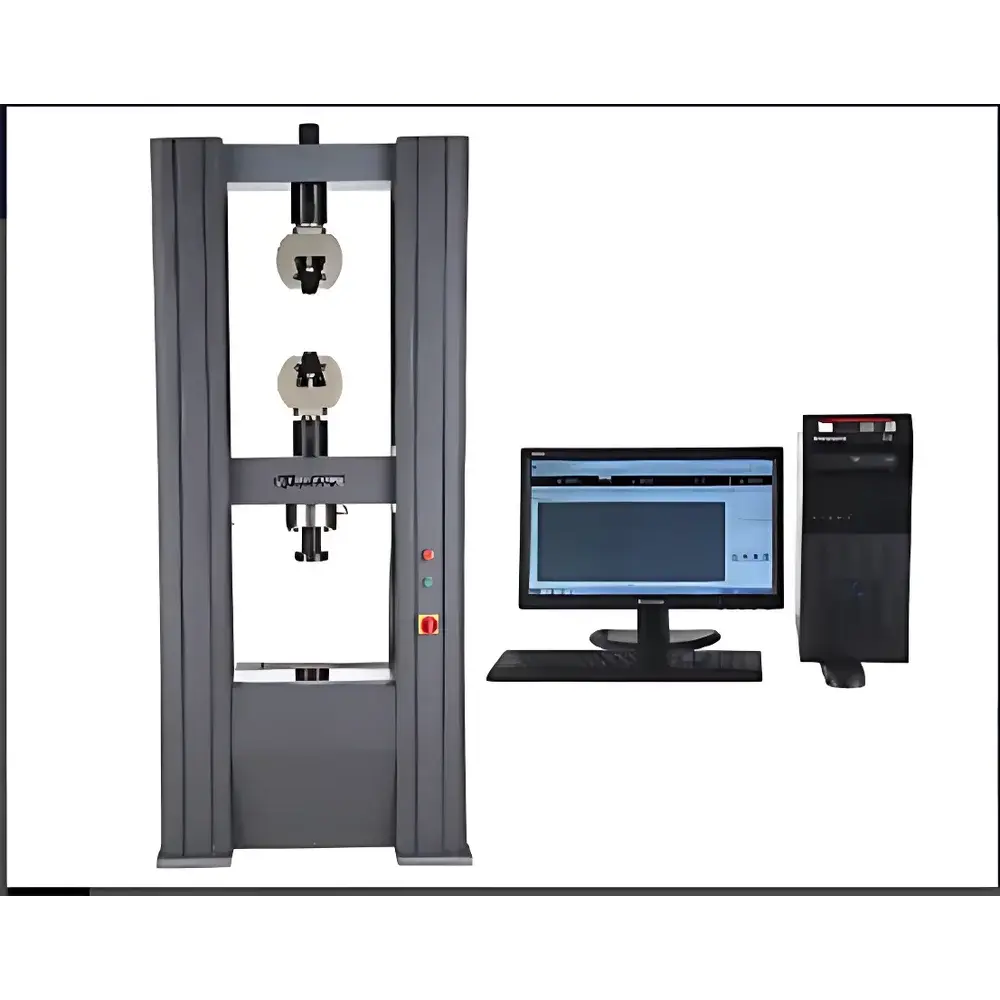
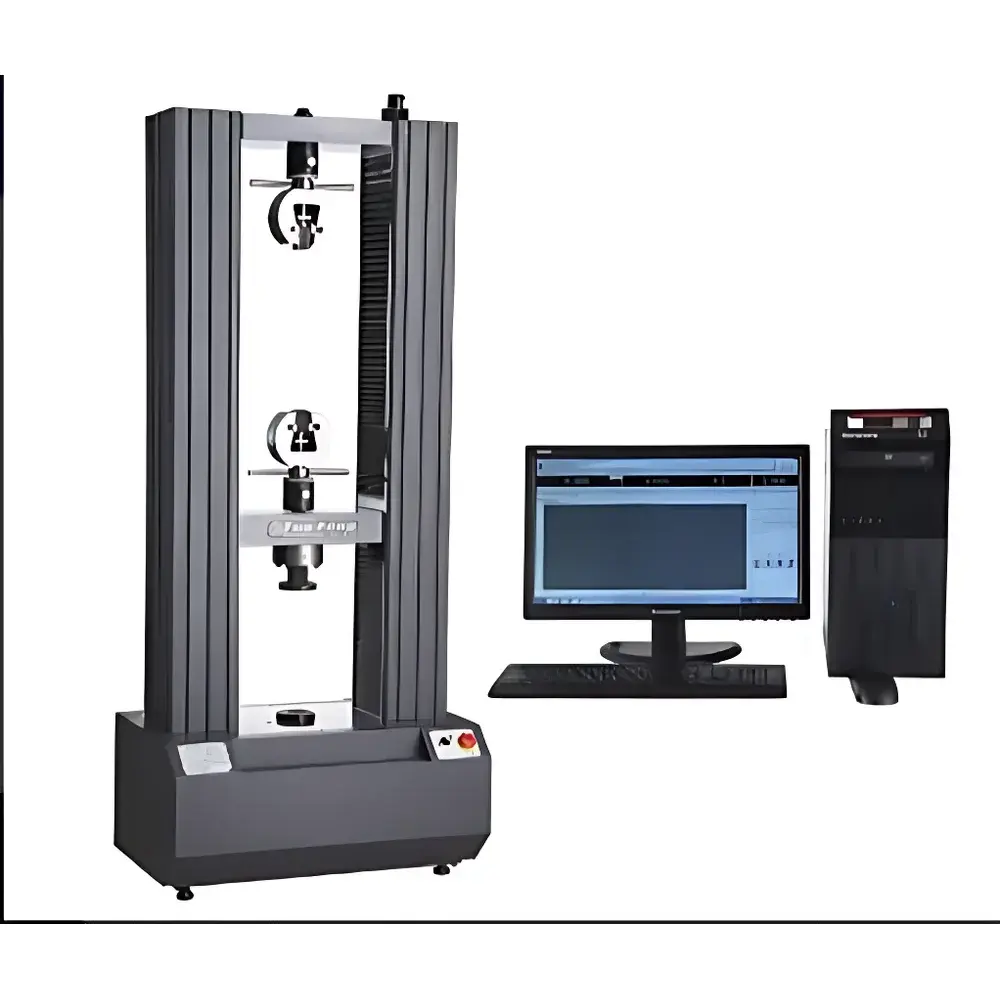
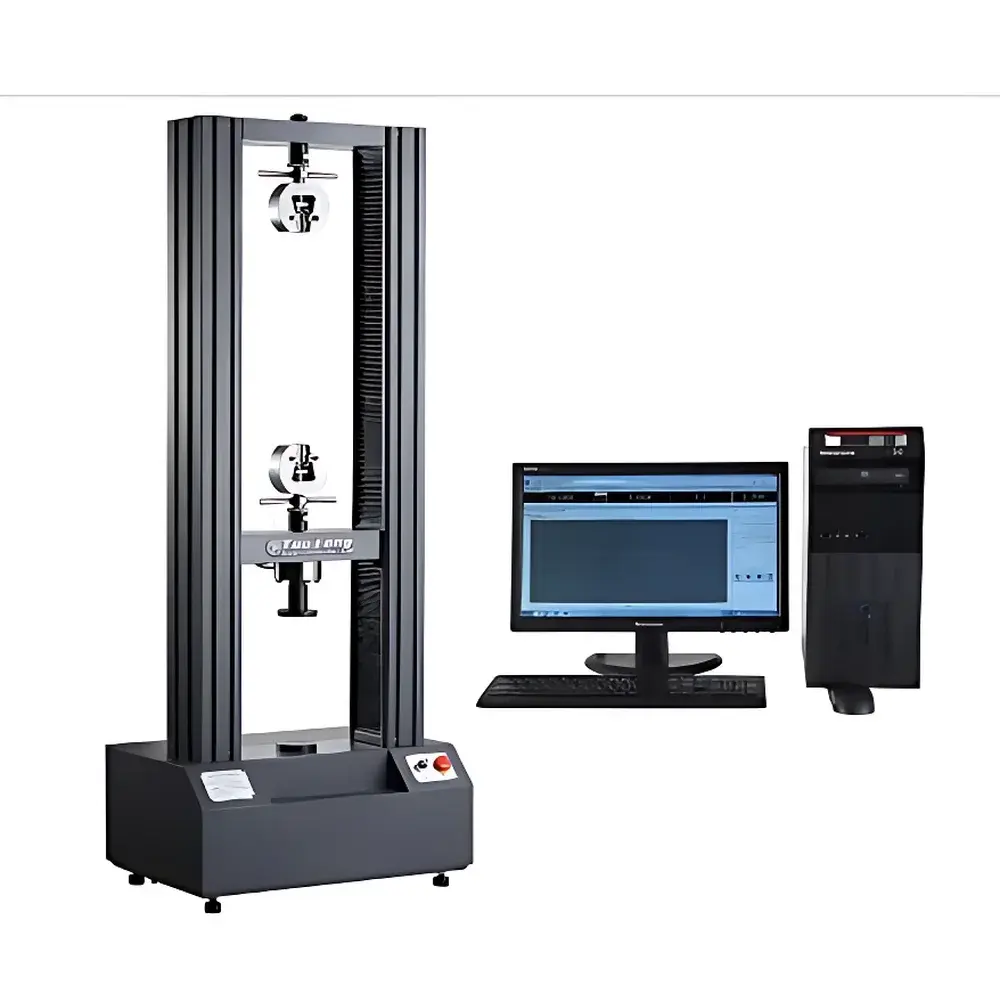
Tuofeng TFW-103 Microcomputer-Controlled Servo-Electric Universal Testing Machine
| Brand | Tuofeng |
|---|---|
| Origin | Shanghai, China |
| Manufacturer Type | Direct Manufacturer |
| Country of Origin | China |
| Model | TFW-103 |
| Price Range | USD 1,400 – 7,200 |
| Instrument Type | Electromechanical Universal Testing Machine |
| Load Capacity | 10 kN |
| Accuracy Class | ISO 7500-1 / ASTM E4 Grade 0.5 |
| Effective Force Range | 0.2%–100% of Full Scale |
| Force Measurement Accuracy | ±0.005% of reading |
| Resolution | 1 part in ±500,000 full-scale codes (single-range, no auto-ranging) |
| Drive System | Imported AC servo motor with precision worm-gear reducer |
| Lead Screw | High-precision preloaded ball screw |
| Effective Test Width | 400 mm (customizable up to 600 mm) |
| Max Stroke | 800 mm (extendable) |
| Speed Range | 0.001–500 mm/min (infinitely variable, closed-loop controlled) |
| Displacement Measurement | Optical encoder |
| Displacement Accuracy | ±0.005% of reading |
| Strain Measurement | Optional clip-on extensometer or large-deformation extensometer |
| Strain Accuracy | ±0.005% of reading |
| Safety Protection | Dual-limit electronic travel stops, emergency stop button, overload cutoff (>110% FS), automatic return on test completion |
| Crosshead Control | Dual-speed motorized lift (fast/slow mode with jog function) |
| Fixture Customization | Application-specific grips and fixtures available per ASTM/ISO/GB standards |
| Power Supply | 220 VAC, 1.0 kW |
| Dimensions (W×D×H) | 780 × 680 × 1780 mm |
| Net Weight | ~300 kg |
| Compliance | GB/T 16491–2008, JJG 475–2008, ISO 7500-1:2018, ASTM E4–2022, EN 10002-1 |
Overview
The Tuofeng TFW-103 is a dual-column, microcomputer-controlled electromechanical universal testing machine engineered for high-precision static mechanical property evaluation of metallic, polymeric, composite, and ceramic materials. It operates on the fundamental principle of controlled axial force application via a servo-driven ball-screw actuation system, enabling accurate displacement-controlled and load-controlled testing modes. Designed to meet international metrological and regulatory requirements—including ISO 7500-1:2018 (static calibration), ASTM E4–2022 (verification of force-measuring instruments), and GB/T 16491–2008 (Chinese national standard for UTM design)—the TFW-103 delivers traceable, repeatable results essential for R&D validation, quality assurance, and regulatory submission workflows. Its modular architecture supports seamless integration into GLP-compliant laboratories and GMP-aligned production environments where audit-ready data integrity is mandatory.
Key Features
- Grade 0.5 force measurement accuracy per ISO 7500-1, verified across the full 0.2–100% FS range without range switching
- Single-range, high-resolution load cell (1:500,000 internal resolution) ensures consistent sensitivity from sub-newton to 10 kN loads
- Precision preloaded ball screw transmission with imported AC servo drive enables smooth, low-noise operation and long-term mechanical stability
- Dual-speed crosshead control (jog/fast/slow) with programmable return-to-start functionality minimizes operator intervention between tests
- Comprehensive safety suite: hardware-based emergency stop, dual electronic limit switches, real-time overload cutoff (>110% FS), and mechanical overload protection
- Modular fixture interface compatible with standardized wedge-action, pneumatic, hydraulic, and custom-designed grips per ASTM D638, ISO 527, GB/T 228.1, and other method-specific requirements
Sample Compatibility & Compliance
The TFW-103 accommodates specimens ranging from thin polymer films (≥0.05 mm thickness) to structural metal coupons (up to 40 mm width × 20 mm thickness), provided within its 400 mm effective test width and 800 mm stroke envelope. It supports standardized tensile, compression, flexure (3-point/4-point), shear, peel, tear, and puncture configurations—each configurable via interchangeable load train components and software-defined test profiles. The system complies with mandatory calibration and verification protocols under JJG 475–2008 (PRC national verification regulation) and aligns with internationally accepted test standards including ASTM D638 (tensile plastics), ASTM D3039 (composite tensile), ISO 6892-1 (metal tensile), ISO 178 (flexural properties), and EN 10002-1 (metallic materials). All force, displacement, and strain measurements are traceable to national metrology institutes via documented calibration certificates.
Software & Data Management
The embedded Windows-based testing software provides full compliance with FDA 21 CFR Part 11 requirements through role-based user access control, electronic signatures, and immutable audit trails for all test parameters, raw data, and result modifications. It supports six primary control modes: constant rate of extension (CRE), constant rate of loading (CRL), constant stress, constant strain, hold-to-load, and hold-to-strain—enabling precise simulation of service conditions such as creep, relaxation, and fatigue pre-conditioning. Real-time plotting includes synchronized force–time, force–displacement, stress–strain, and displacement–time curves, with overlay capability for comparative analysis of up to 16 test records. Units are fully convertible (N/kN/lbf, mm/in, MPa/psi), and report generation includes customizable templates compliant with ISO/IEC 17025 documentation requirements. Data export supports CSV, XML, and PDF formats; local storage is encrypted and automatically timestamped.
Applications
The TFW-103 serves as a core characterization platform across industrial and academic sectors requiring deterministic mechanical data. In aerospace manufacturing, it validates tensile strength and elongation of carbon-fiber prepregs per ASTM D3039. In medical device development, it quantifies peel strength of sterile packaging per ISO 8553 and tensile modulus of biodegradable sutures per USP . Automotive suppliers use it for rubber bushing compression set testing (ASTM D395) and wire harness tensile integrity verification (SAE J1127). Within construction materials labs, it performs compressive strength testing of concrete cylinders (ASTM C39) and flexural strength of fiber-reinforced cement boards (ASTM C1185). Universities leverage its programmability for teaching fracture mechanics, viscoelastic modeling, and constitutive law validation.
FAQ
Does the TFW-103 support third-party calibration certificate issuance by accredited labs?
Yes—calibration is performed per ISO/IEC 17025-accredited procedures; certificates include uncertainty budgets and traceability statements.
Can the system be integrated into an existing LIMS or MES environment?
Yes—via OPC UA or TCP/IP API, supporting automated job dispatch, result ingestion, and metadata synchronization.
Is strain measurement included as standard or optional?
Basic displacement-based strain calculation is standard; contact-type extensometers (e.g., 10–50 mm gauge length, ±0.5 µm resolution) are optional accessories.
What is the recommended maintenance interval for the ball screw and drive system?
Lubrication and torque verification every 1,000 operational hours; full metrological recalibration recommended annually or after 5,000 test cycles.
Are software updates provided for life, and do they require re-validation?
Yes—free updates include version-controlled release notes; each update package contains IQ/OQ documentation templates for internal validation per ISO 13485 or 21 CFR Part 11.



