
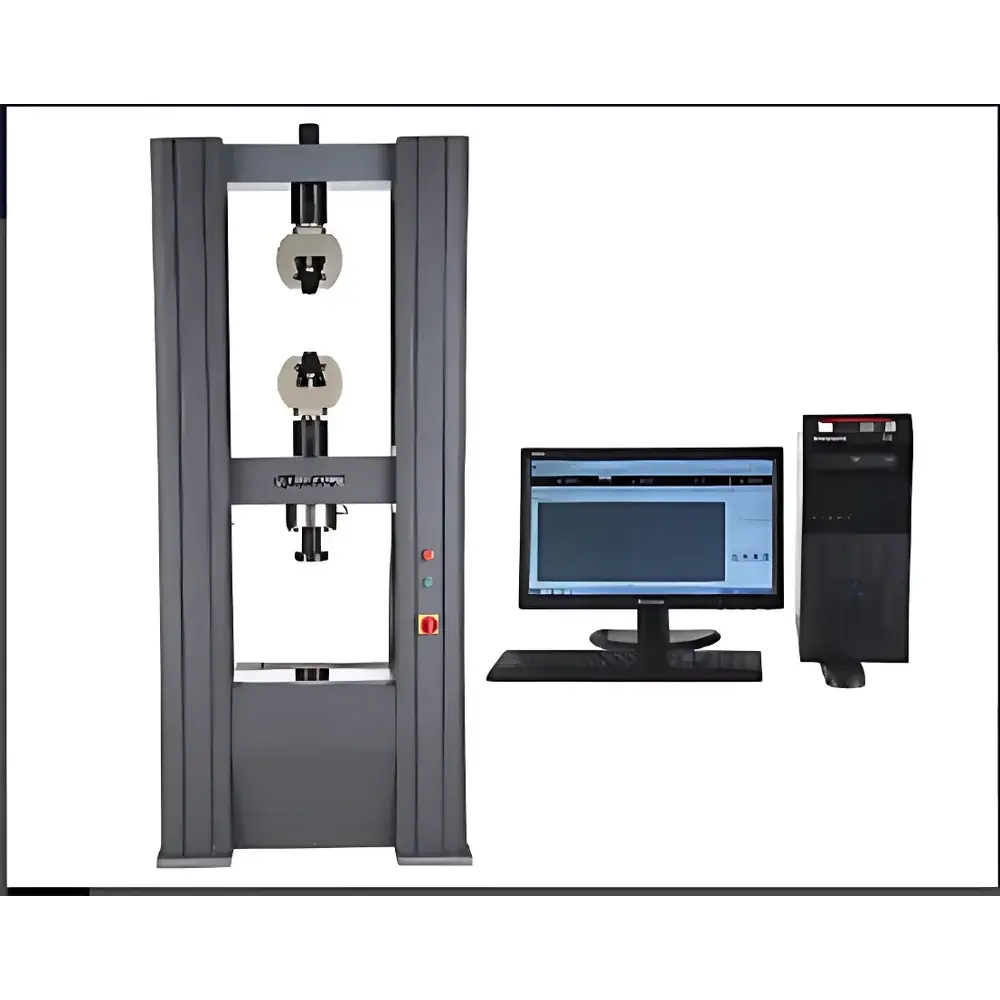
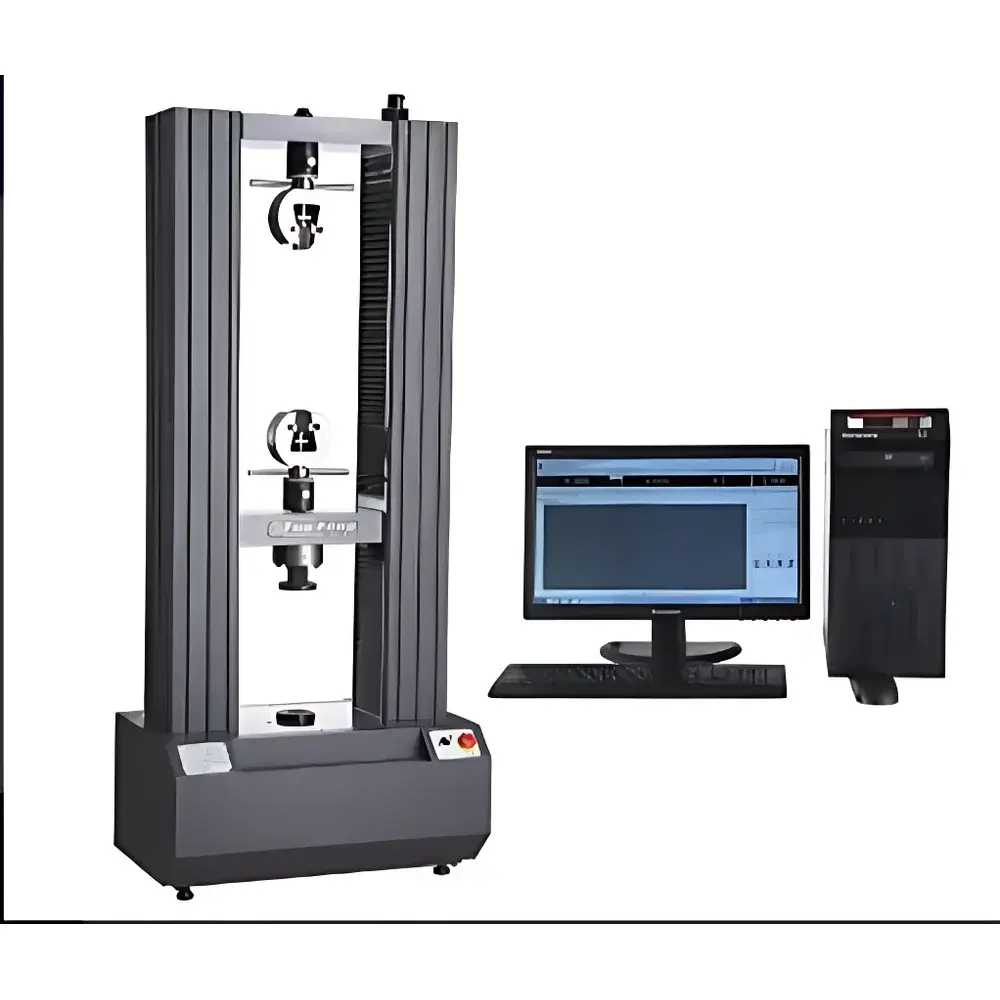
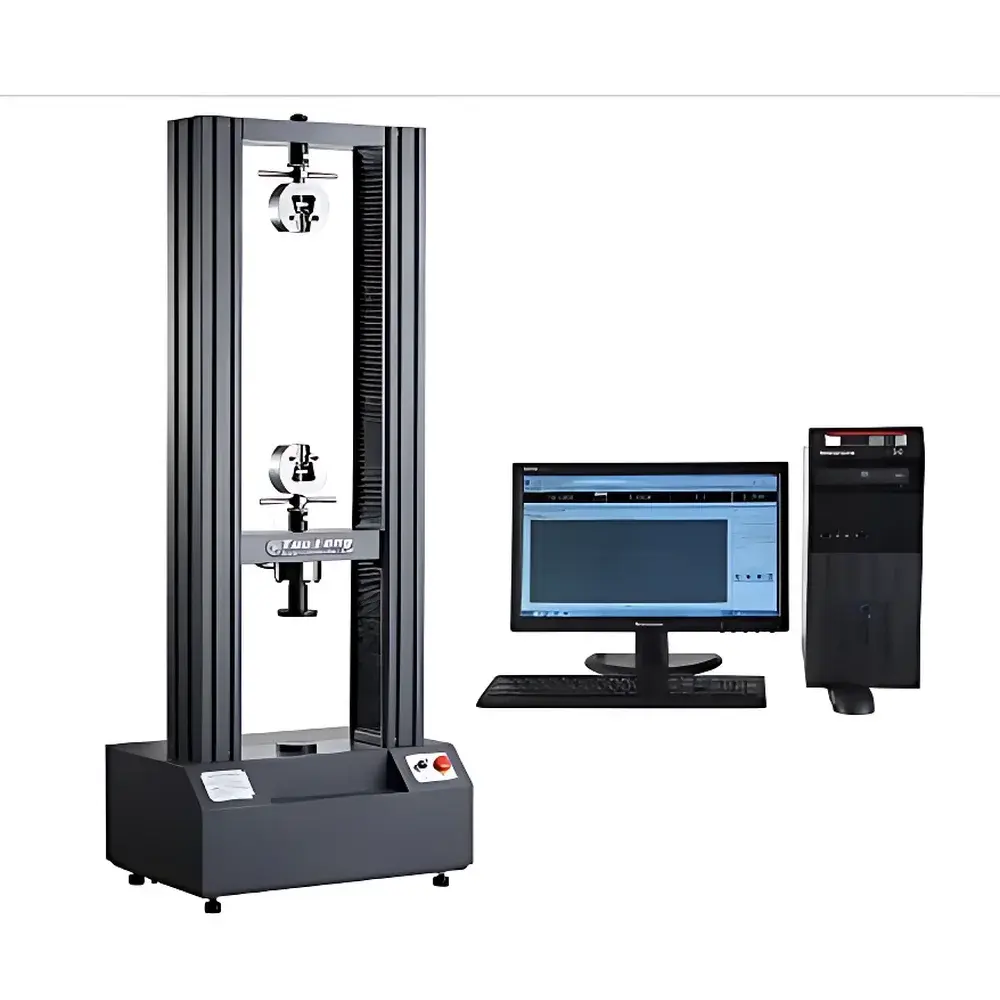
Tuofeng TFW-111 Advanced Electromechanical Universal Testing Machine
| Brand | Tuofeng |
|---|---|
| Origin | Shanghai, China |
| Manufacturer Type | Direct Manufacturer |
| Model | TFW-111 |
| Instrument Type | Electromechanical Universal Testing Machine |
| Maximum Test Load | 200 kN |
| Force Measurement Range | 1 kg to 200 kN (0.2%–100% FS) |
| Force Accuracy | ±0.5% of reading |
| Crosshead Travel | 1000 mm |
| Displacement Resolution | 0.001 mm |
| Effective Test Width | 400 mm (customizable up to 600 mm) |
| Test Speed Range | 0.001–500 mm/min (infinitely variable) |
| Position Measurement | High-resolution optical encoder |
| Displacement Accuracy | ±0.005% of reading |
| Strain Measurement | Optional extensometer or large-deformation sensor (±0.005% accuracy) |
| Control System | Windows-based software with multi-language support (English, Simplified/Traditional Chinese) |
| Compliance | GB/T 16491–2008, JJG 475–2008, ASTM E4, ASTM E8, ISO 6892-1, ISO 7500-1, DIN 51221, JIS Z2241, BS EN 10002-1 |
Overview
The Tuofeng TFW-111 Advanced Electromechanical Universal Testing Machine is a high-precision, servo-controlled materials testing system engineered for static mechanical characterization under tension, compression, bending, shear, peel, tear, and puncture loading conditions. Based on the fundamental principles of load-cell transduction and closed-loop electromechanical actuation, the system delivers traceable force measurement across a wide dynamic range—from sub-kilogram preloads to full-scale 200 kN loads—while maintaining compliance with international metrological standards for universal testing machines. Its rigid four-column frame, preloaded high-precision ball screws, and dual-speed crosshead drive ensure minimal deflection, high axial stiffness, and repeatable positioning—critical attributes for achieving reproducible stress–strain data in R&D, quality control, and regulatory submission environments.
Key Features
- High-fidelity force measurement system calibrated to ±0.5% of reading over 0.2–100% full scale, meeting ISO 7500-1 Class 0.5 requirements
- Optical encoder-based displacement feedback with 0.001 mm resolution and ±0.005% accuracy, independent of load cell drift
- Imported AC servo motor coupled with precision worm-gear reduction and preloaded ball screw transmission for smooth, low-noise motion control
- Dual-speed automatic crosshead adjustment (fast jog + fine positioning) with programmable return-to-start function
- Integrated safety architecture: electronic limit switches, emergency stop circuitry, overload protection (110% FS cutoff), and real-time load monitoring
- Modular fixture interface supporting standardized grips (pneumatic, wedge, hydraulic) and custom tooling for ASTM, ISO, and GB-compliant specimen geometries
Sample Compatibility & Compliance
The TFW-111 accommodates specimens ranging from thin polymer films (0.01 mm thick) to structural steel coupons (up to 50 mm thick), composites, elastomers, textiles, adhesives, and biomedical scaffolds. Standard test widths (400 mm) are expandable to 600 mm for wide-sheet or multi-lane evaluation. The system supports both extensometer-based strain measurement (for modulus and yield determination per ASTM E8/E83) and video-based digital image correlation (DIC) integration (optional). It fully complies with GB/T 16491–2008 (Chinese national standard for electronic universal testers), JJG 475–2008 (verification regulation), and internationally recognized protocols including ASTM E4 (load calibration), ASTM E8/E8M (tensile testing of metals), ISO 6892-1 (metallic materials tensile testing), ISO 527-1 (plastics), and ISO 179 (impact-modified polymers). All calibration certificates are NIST-traceable, and audit-ready documentation supports GLP/GMP and FDA 21 CFR Part 11 compliance when paired with optional electronic signature and audit trail modules.
Software & Data Management
The embedded Windows-based testing software provides ISO/IEC 17025-aligned test configuration, execution, and reporting capabilities. Users may select from multiple control modes—including constant rate of extension (CRE), constant load ramping, hold-at-load, hold-at-strain, and cyclic loading—with real-time switching between force–time, force–displacement, stress–strain, and displacement–time plots. Raw data is stored in open-format ASCII (.csv) and proprietary binary archives, enabling third-party post-processing in MATLAB, Python, or Minitab. The software supports multilingual UI (English, Simplified/Traditional Chinese), customizable unit systems (N/kN/lbf, MPa/psi, mm/in), and automated calculation of ASTM/ISO-defined parameters: ultimate tensile strength (UTS), yield strength (0.2% offset), Young’s modulus, elongation at break, Poisson’s ratio, compressive yield stress, flexural modulus, peel strength, and tear propagation resistance. Data export includes PDF reports with embedded metadata (operator ID, timestamp, environmental conditions, calibration status), and optional cloud synchronization for centralized lab data governance.
Applications
This system serves as a primary mechanical characterization platform across regulated and non-regulated sectors. In aerospace, it validates titanium alloy sheet formability and carbon-fiber laminate interlaminar shear strength per ASTM D5379. In automotive, it performs tensile–fatigue correlation studies on thermoplastic elastomer bushings and evaluates weld integrity in aluminum extrusions. For medical device manufacturers, it quantifies suture tensile strength (ISO 10555-1), balloon burst pressure (ISO 10555-4), and hydrogel compression modulus. In construction materials labs, it determines compressive strength of concrete cylinders (ASTM C39), flexural strength of fiber-reinforced cement boards (ASTM C1185), and bond strength of tile adhesives (ANSI A118.4). Academic researchers utilize its programmable control logic for constitutive modeling of viscoelastic polymers and creep–recovery analysis under sustained loading.
FAQ
What international standards does the TFW-111 support out-of-the-box?
The system ships with preconfigured test methods for ASTM E8, ISO 6892-1, GB/T 228.1, and ISO 179; additional standards can be loaded via editable method templates.
Can the machine perform cyclic or fatigue testing?
Yes—within its static load rating, the TFW-111 supports controlled sinusoidal, triangular, or trapezoidal waveforms up to 5 Hz using optional high-speed servo tuning and real-time waveform generation.
Is third-party calibration and certification available?
Tuofeng provides factory calibration with NIST-traceable certificates; accredited third-party calibration (e.g., A2LA or UKAS) is available upon request with documented uncertainty budgets.
How is data integrity ensured for regulatory submissions?
When configured with optional 21 CFR Part 11 compliance package, the software enforces role-based access control, electronic signatures, immutable audit trails, and encrypted data storage.
What maintenance intervals are recommended for long-term accuracy?
Annual verification of force and displacement metrology is advised; routine checks of grip alignment, screw lubrication, and encoder coupling are performed every 500 operational hours.



