
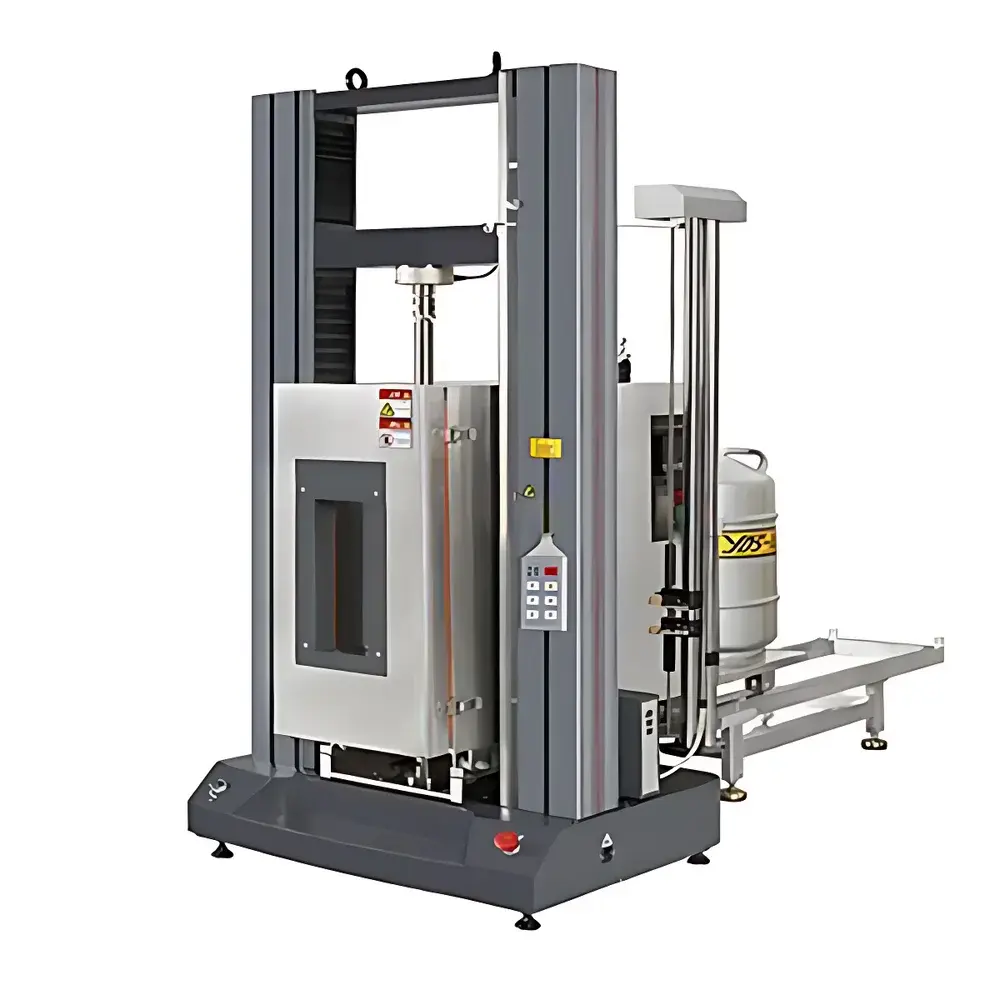
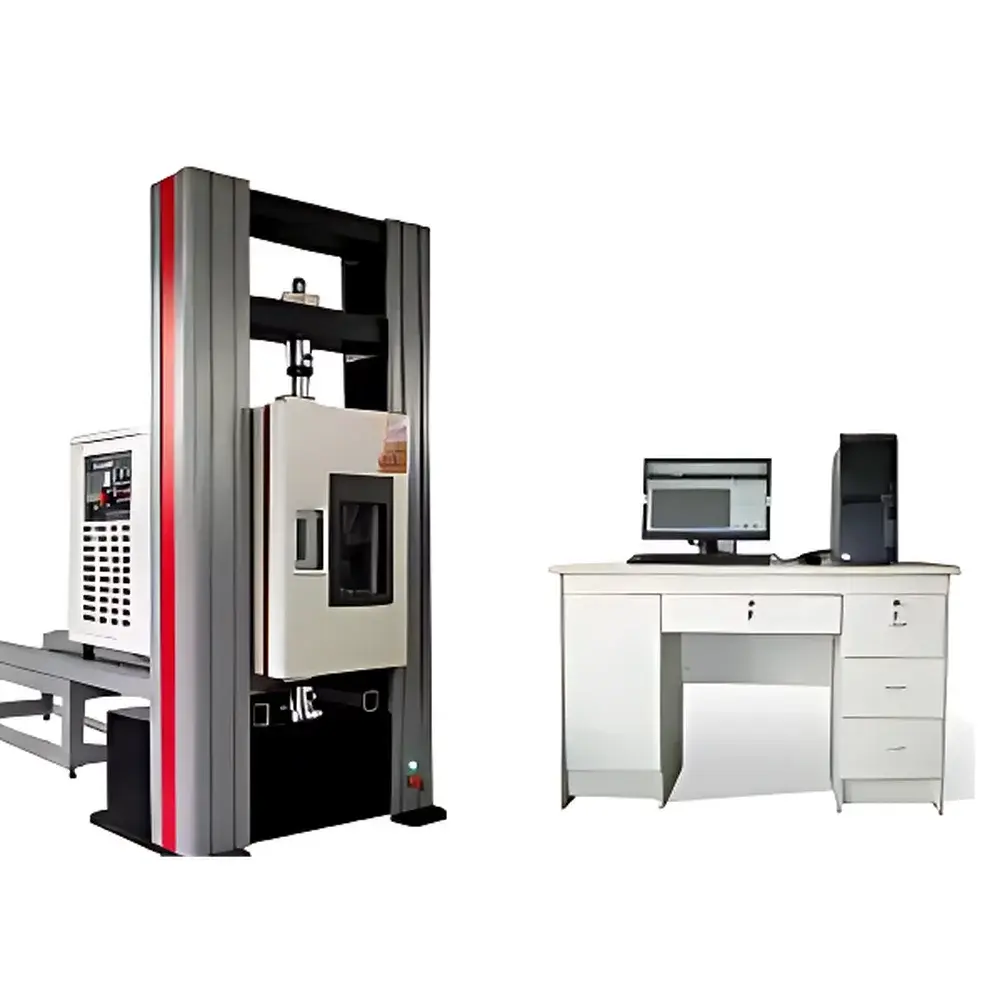
Tuofeng TFW-167 Microcomputer-Controlled High-Low Temperature Universal Testing Machine
| Brand | Tuofeng |
|---|---|
| Origin | Shanghai, China |
| Manufacturer Type | Direct Manufacturer |
| Product Category | Domestic |
| Model | TFW-167 |
| Instrument Type | Electromechanical Universal Testing Machine |
| Max Test Load | 5 kN / 10 kN / 20 kN / 50 kN / 100 kN |
| Accuracy Class | 0.5 |
| Force Measurement Range | 0.4–100% FS |
| Force Indication Error | ±0.5% of reading |
| Force Resolution | 1/500,000 of full scale, unsegmented |
| Deformation Measurement Range | 0.2–100% FS |
| Deformation Error | ±0.5% of reading |
| Deformation Resolution | up to 1/300,000 |
| Displacement Error | ±0.5% of reading |
| Column Spacing (internal) | 840 mm |
| Crosshead Travel (standard) | 1000 mm |
| Host Dimensions (W×D×H) | 1250 × 560 × 2400 mm |
| Power Supply | AC 220 V / 50 Hz, ±10%, 750 W |
| Host Weight | ~380 kg |
| Environmental Chamber Temp Range | −40 °C to +100 °C |
| Chamber Internal Dimensions (W×D×H) | ~360 × 300 × 500 mm |
| Heating Power | 1.5 kW |
| Temp Uniformity (100 mm axial) | ±2 °C |
| Temp Stabilization Time | ≤5 min (both above and below 0 °C) |
| Control Method | Programmable PID temperature controller with Pt100 sensors |
Overview
The Tuofeng TFW-167 Microcomputer-Controlled High-Low Temperature Universal Testing Machine is an electromechanical universal testing system engineered for precision mechanical property evaluation under controlled thermal conditions. It integrates a high-rigidity dual-column load frame with a programmable environmental chamber capable of sustained operation from −40 °C to +100 °C. The system operates on the principle of servo-controlled displacement actuation, where a precision ball-screw-driven crosshead applies calibrated tensile, compressive, flexural, shear, peel, or tear loads to specimens while synchronized force, displacement, and strain data are acquired in real time. This architecture enables compliance with static mechanical testing standards including ISO 6892-1 (tensile testing of metals), ASTM D638 (plastics), ASTM D790 (flexural properties), ISO 179 (impact-modified plastics), and GB/T 228.1—2021 (Chinese national standard for metallic materials). Its modular design supports both ambient and thermally conditioned testing without hardware reconfiguration, making it suitable for comparative material qualification across temperature-dependent performance envelopes.
Key Features
- High-accuracy force measurement system compliant with ISO 7500-1 Class 0.5, featuring a resolution of 1 part in 500,000 of full scale and no range switching required across the entire test envelope.
- Integrated environmental chamber with programmable PID control, Pt100 temperature sensing at multiple zones, and thermal uniformity of ±2 °C over a 100 mm axial zone—validated per ASTM E2202 and ISO 11357-2.
- Robust dual-column frame with 840 mm internal width and 1000 mm vertical travel, optimized for compatibility with standard high/low-temperature fixtures and extensometers.
- Microcomputer-based control system running on Windows OS, supporting real-time closed-loop control modes (load, displacement, strain, or stress rate) with configurable ramp-hold profiles.
- Automatic calculation and reporting of standardized mechanical parameters: ultimate tensile strength, yield strength (0.2% offset), Young’s modulus, elongation at break, compressive yield stress, flexural modulus, peel strength, and tear resistance.
- Modular software architecture compliant with GLP/GMP documentation requirements—supports user-defined test templates, electronic signatures, audit trails, and 21 CFR Part 11–ready data export (CSV, PDF, XML).
Sample Compatibility & Compliance
The TFW-167 accommodates a broad spectrum of specimen geometries and material classes—including metallic alloys (e.g., stainless steels, aluminum, titanium), engineering polymers (PA, PC, PEEK), elastomers, composites (CFRP, GFRP), ceramics, adhesives, thin films, and textile laminates. Specimen mounting utilizes standardized wedge-action grips, pneumatic clamps, or custom fixtures compatible with ISO 26203-compliant high-temperature tensile holders. All test procedures align with internationally recognized metrological frameworks: traceability to NIST or CNAS-accredited calibration standards; force transducer verification per ISO 376; and displacement verification via laser interferometry. The system meets mechanical safety requirements per ISO 12100 and electrical safety per IEC 61000-6-2/6-4, with integrated leakage protection, overcurrent cutoff, and emergency stop circuitry.
Software & Data Management
The embedded Windows-based test software provides a deterministic, low-latency acquisition environment with sampling rates up to 1 kHz for force and displacement channels. It features multi-curve overlay capability (e.g., stress–strain, load–displacement, modulus–temperature), automatic identification of characteristic points (yield onset, necking initiation, fracture), and customizable report generation with embedded metadata (operator ID, calibration certificate IDs, environmental chamber log files). Raw data files are stored in vendor-neutral HDF5 format, enabling third-party post-processing in MATLAB, Python (NumPy/Pandas), or commercial CAE tools. Audit trail functionality records all parameter changes, test starts/stops, and user login/logout events with timestamp and IP address. Optional modules support statistical process control (SPC) charting, Weibull analysis for failure probability modeling, and integration with LIMS via RESTful API.
Applications
This system serves as a primary characterization tool in R&D laboratories and quality assurance departments for temperature-dependent mechanical behavior assessment. Typical use cases include: evaluating low-temperature embrittlement in aerospace aluminum alloys per AMS 2369; validating polymer sealant performance at −40 °C for automotive battery enclosures; measuring creep-recovery response of thermoplastic elastomers at elevated temperatures per ISO 899-1; quantifying interlaminar shear strength degradation in carbon fiber prepregs after thermal cycling; and certifying medical-grade silicone tubing compliance with ISO 1798 under simulated body temperature conditions. It is widely deployed in national metrology institutes, third-party testing labs accredited to ISO/IEC 17025, and corporate material science divisions requiring reproducible, auditable mechanical data across climate-controlled conditions.
FAQ
What temperature stability is guaranteed during extended high-temperature tests (e.g., 100 °C for 2 hours)?
The chamber maintains ±2 °C uniformity over the central 100 mm test zone for durations exceeding 120 minutes, verified by independent thermocouple mapping per ASTM E2202 Annex A3.
Can the system perform closed-loop strain control using an extensometer inside the chamber?
Yes—optional high-temperature clip-on extensometers (up to 300 °C) or non-contact video extensometry modules integrate seamlessly with the control loop for ISO 527-2 or ASTM D3039 compliant testing.
Is the software validated for regulated environments such as pharmaceutical packaging testing?
The base software includes 21 CFR Part 11–compliant features (electronic signatures, audit trail, role-based access); full validation packages—including IQ/OQ/PQ protocols—are available upon request.
What maintenance intervals are recommended for the environmental chamber compressor and heating elements?
Compressor oil and filter replacement every 2,000 operating hours; heating element resistance verification annually; full chamber calibration (temperature and force) recommended biannually per ISO/IEC 17025.
Does the system support automated test sequences across multiple temperature setpoints?
Yes—the programmable controller allows multi-step thermal-mechanical profiles (e.g., equilibrate at −20 °C → apply load → ramp to +80 °C → hold → unload), fully scriptable via the test software interface.



