
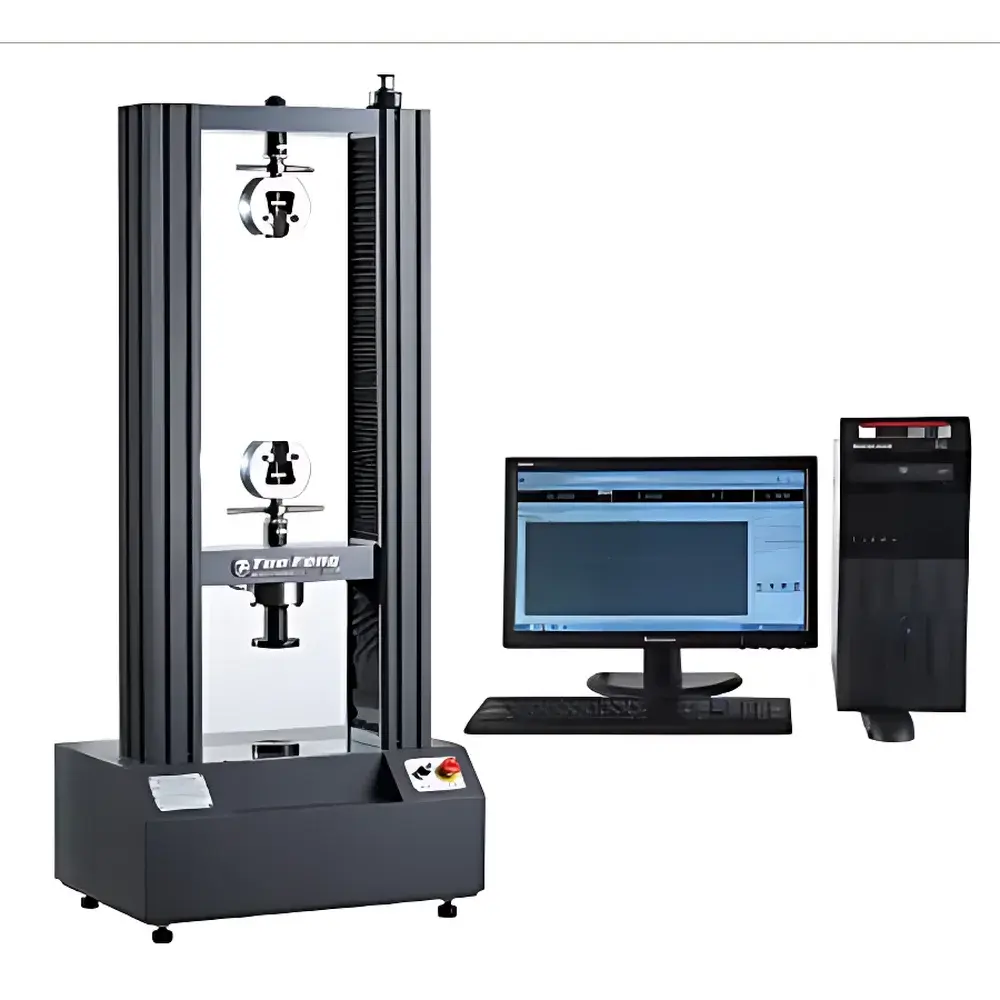
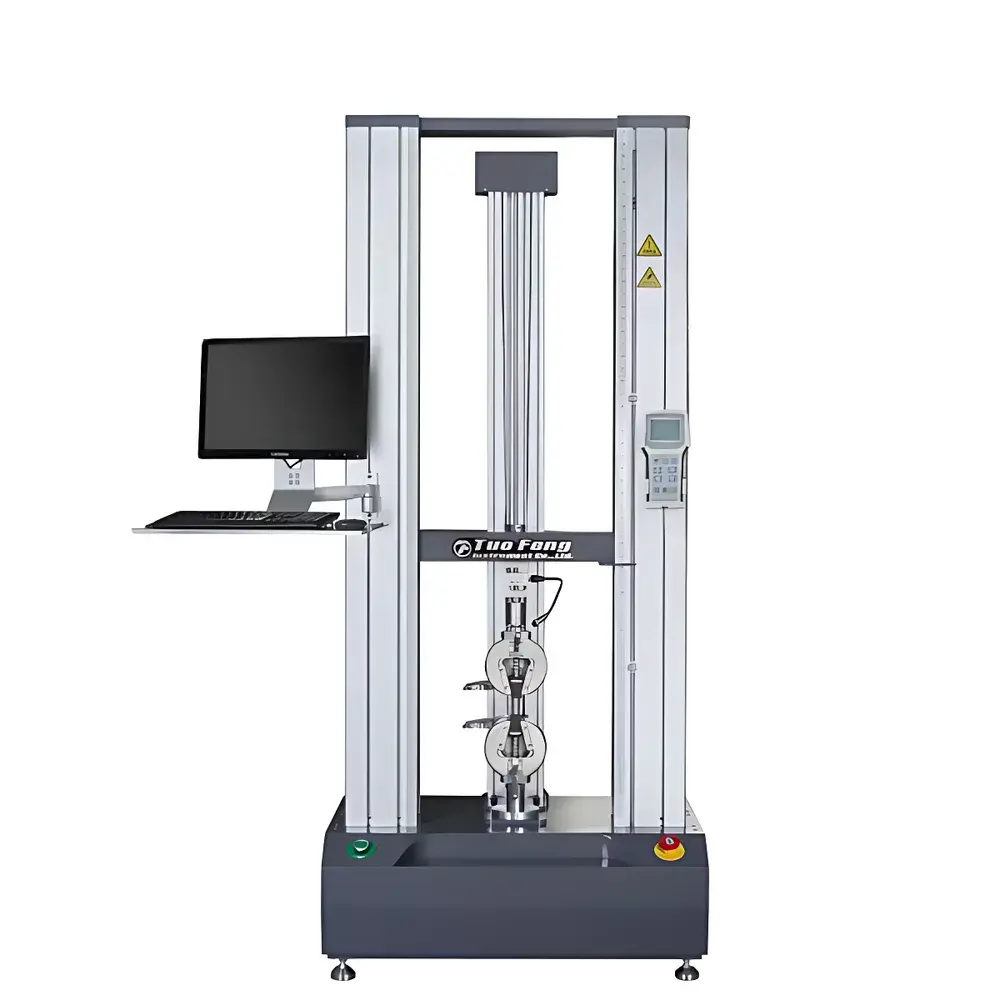
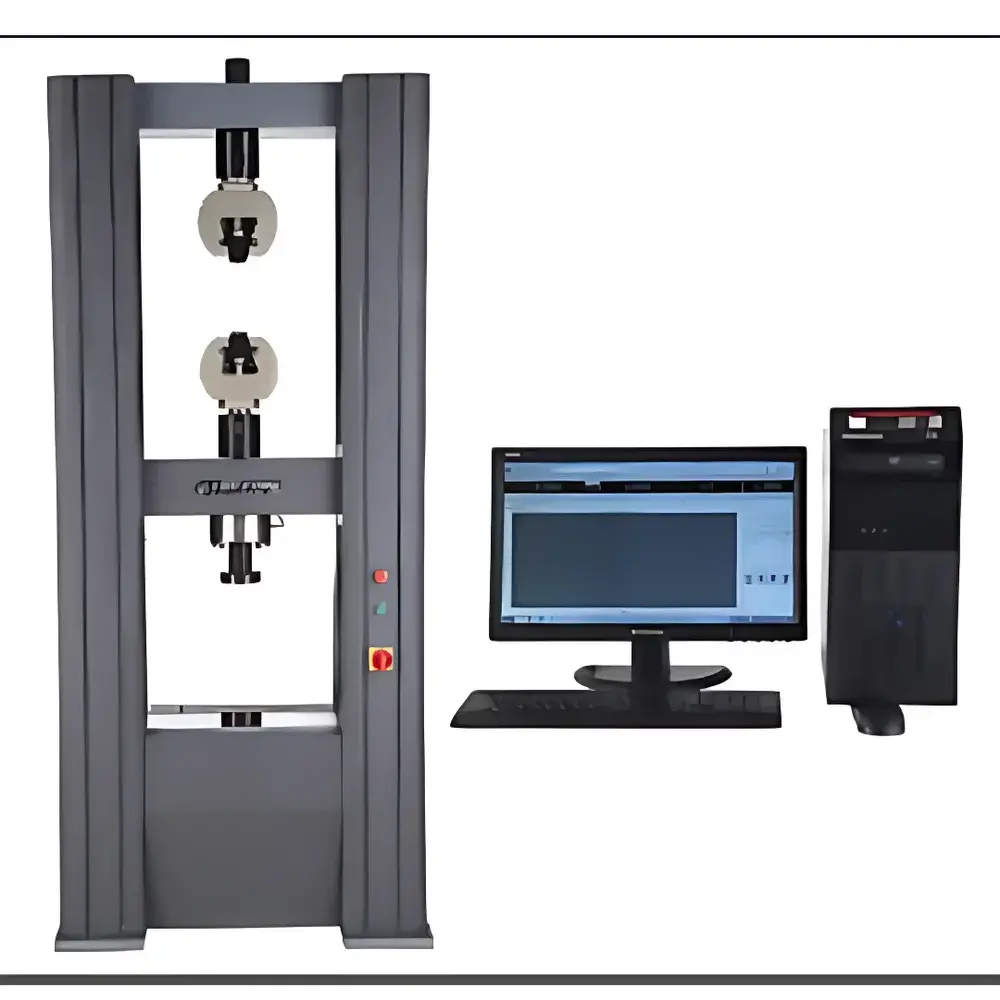
Tuofeng TFW-183 Microcomputer-Controlled Electronic Universal Testing Machine
| Brand | Tuofeng |
|---|---|
| Origin | Shanghai, China |
| Manufacturer Type | Direct Manufacturer |
| Instrument Type | Electronic Universal Testing Machine |
| Model | TFW-183 |
| Compliance | GB/T 16491–2008, JJG 475–2008 |
| Load Capacity | 183 kN (configurable from 5 kN to 200 kN) |
| Accuracy Class | 0.5 |
| Effective Force Range | 0.2%–100% of full scale |
| Force Measurement Accuracy | ±0.005% of reading |
| Resolution | 1 part in ±500,000 full-scale counts (single-range, no auto-ranging) |
| Drive System | Imported servo motor with precision worm-gear reducer |
| Lead Screw | High-precision preloaded ball screw |
| Test Width (standard) | 600 mm (customizable up to 1100 mm) |
| Stroke (standard) | 800 mm (extendable) |
| Speed Range | 0.001–500 mm/min (infinitely variable, programmable) |
| Displacement Measurement | Optical encoder |
| Displacement Accuracy | ±0.005% of reading |
| Strain Measurement | Optional clip-on extensometer or large-deformation extensometer |
| Strain Accuracy | ±0.005% of reading |
| Safety Protection | Dual electronic limit switches, emergency stop button, overload protection (>110% F.S.), automatic return after test |
| Crosshead Control | Dual-speed (fast/slow) motorized vertical adjustment with jog function |
| Power Supply | 220 V AC, 1.5 kW |
| Dimensions (W×D×H) | 1000 × 700 × 2000 mm |
| Weight | ~450 kg |
Overview
The Tuofeng TFW-183 Microcomputer-Controlled Electronic Universal Testing Machine is a high-precision static mechanical testing system engineered for the quantitative evaluation of tensile, compressive, flexural, shear, tear, peel, and puncture properties of metallic, polymeric, composite, ceramic, and elastomeric materials. It operates on the principle of controlled displacement or load application via a closed-loop servo-controlled electromechanical actuation system, enabling accurate force–displacement–time data acquisition under standardized quasi-static loading conditions (typically ≤1 Hz). Designed to meet stringent metrological requirements for R&D laboratories and quality control environments, the TFW-183 complies with ISO 7500-1 (Class 0.5), ASTM E4, ASTM E8/E8M, ASTM D638/D695/D790/D1876/D3330, and GB/T 16491–2008. Its rigid monolithic frame, preloaded ball-screw transmission, and high-resolution dual-channel signal conditioning architecture ensure long-term repeatability (<0.5% RSD over 100 cycles) and minimal thermal drift during extended testing sessions.
Key Features
- Class 0.5 force measurement accuracy per ISO 7500-1, validated across 0.2%–100% of full-scale capacity (183 kN standard configuration)
- Single-range, high-resolution analog-to-digital conversion: 1 part in ±500,000 full-scale counts — eliminating range-switching artifacts and ensuring consistent resolution at all loads
- Precision preloaded ball screw with zero-backlash transmission, coupled to an imported industrial servo motor and worm-gear reducer for smooth, low-noise motion control
- Dual-speed crosshead drive (fast positioning + fine-tuning jog mode) with programmable return-to-start functionality post-test
- Integrated safety architecture: hardware-based emergency stop, dual independent electronic limit switches, mechanical overload cutoff (>110% F.S.), and software-enforced operational bounds
- Modular extensometry support: compatibility with ASTM E83-compliant clip-on axial extensometers (e.g., 10–50 mm gauge length, ±0.5 µm resolution) and non-contact video extensometers for large-strain applications
Sample Compatibility & Compliance
The TFW-183 accommodates specimens ranging from thin polymer films (≥0.05 mm thick) to structural steel coupons (up to 40 mm thickness), with customizable jaw geometries (pneumatic, wedge, hydraulic, or custom-fabricated fixtures) for flat, round, threaded, or irregular cross-sections. Standard test widths (600 mm) and stroke (800 mm) are expandable to meet ASTM D3039 (composite tensile), ISO 6892-1 (metal tensile), or GB/T 228.1 requirements. All mechanical and electrical subsystems conform to CE machinery directive (2006/42/EC), EMC directive (2014/30/EU), and RoHS 2011/65/EU. Calibration traceability is maintained to national standards (e.g., NIM, NIST, PTB) via documented as-found/as-left reports issued with each factory calibration.
Software & Data Management
The embedded Windows-based testing software supports GLP/GMP-aligned operation with optional 21 CFR Part 11 compliance modules (electronic signatures, audit trails, user role management, and immutable data archiving). It enables multi-mode control: constant rate of extension (CRE), constant rate of loading (CRL), load-hold, displacement-hold, and cyclic ramp-hold protocols. Real-time plotting includes synchronized force–time, stress–strain, force–displacement, displacement–time, and extension–time curves. Calculated outputs include tensile strength, yield strength (0.2% offset), Young’s modulus, elongation at break, Poisson’s ratio, compressive strength, flexural modulus, tear strength (ASTM D624), peel adhesion (ASTM D903), and bond strength (ASTM D1002). Raw data exports to CSV, Excel, or XML; report templates comply with ISO/IEC 17025 documentation requirements. Software updates are delivered remotely with version-controlled release notes and validation documentation.
Applications
This system serves as a primary mechanical characterization platform in accredited materials testing labs, automotive Tier-1 suppliers (e.g., tensile validation of brake hoses, seatbelt webbing, and battery enclosure composites), aerospace OEMs (ASTM D5528 Mode I interlaminar fracture toughness), medical device manufacturers (ISO 14243 hip simulator component fatigue pre-screening), and academic research groups studying viscoelasticity of hydrogels or creep behavior of thermoplastics. Routine use spans QC release testing of extruded aluminum profiles (GB/T 6892), qualification of recycled PET fibers (ISO 5079), and failure analysis of solder joints in electronics packaging (IPC-TM-650 2.6.12).
FAQ
What international standards does the TFW-183 support out-of-the-box?
It natively supports test method execution and reporting for ASTM E8/E8M, ASTM D638, ISO 6892-1, ISO 527-1, GB/T 228.1, GB/T 1040.1, and JIS Z2241 — with parameter presets, calculation logic, and pass/fail criteria embedded per standard.
Can the system be integrated into an existing LIMS or MES environment?
Yes — via OPC UA or TCP/IP socket interface; raw channel data (force, displacement, extensometer) and metadata (operator ID, sample ID, test method) are streamable in real time with configurable polling intervals and JSON/XML payload formatting.
Is third-party calibration certification available?
Tuofeng provides optional UKAS-accredited calibration certificates (per ISO/IEC 17025) issued by partner labs, including uncertainty budgets traceable to CIPM MRA signatories.
What is the warranty coverage and service response time?
Standard warranty: 24 months parts-and-labor; extended service contracts include quarterly preventive maintenance, remote diagnostics, and <72-hour onsite response for critical failures in APAC regions.
Does the software support multi-user audit trails required for FDA-regulated environments?
Yes — when configured with the Part 11 Add-on Module, it enforces electronic signatures, immutable audit logs (user actions, parameter changes, result modifications), and role-based access control (administrator, technician, reviewer) compliant with 21 CFR Part 11 Subpart B.
Related Products



