
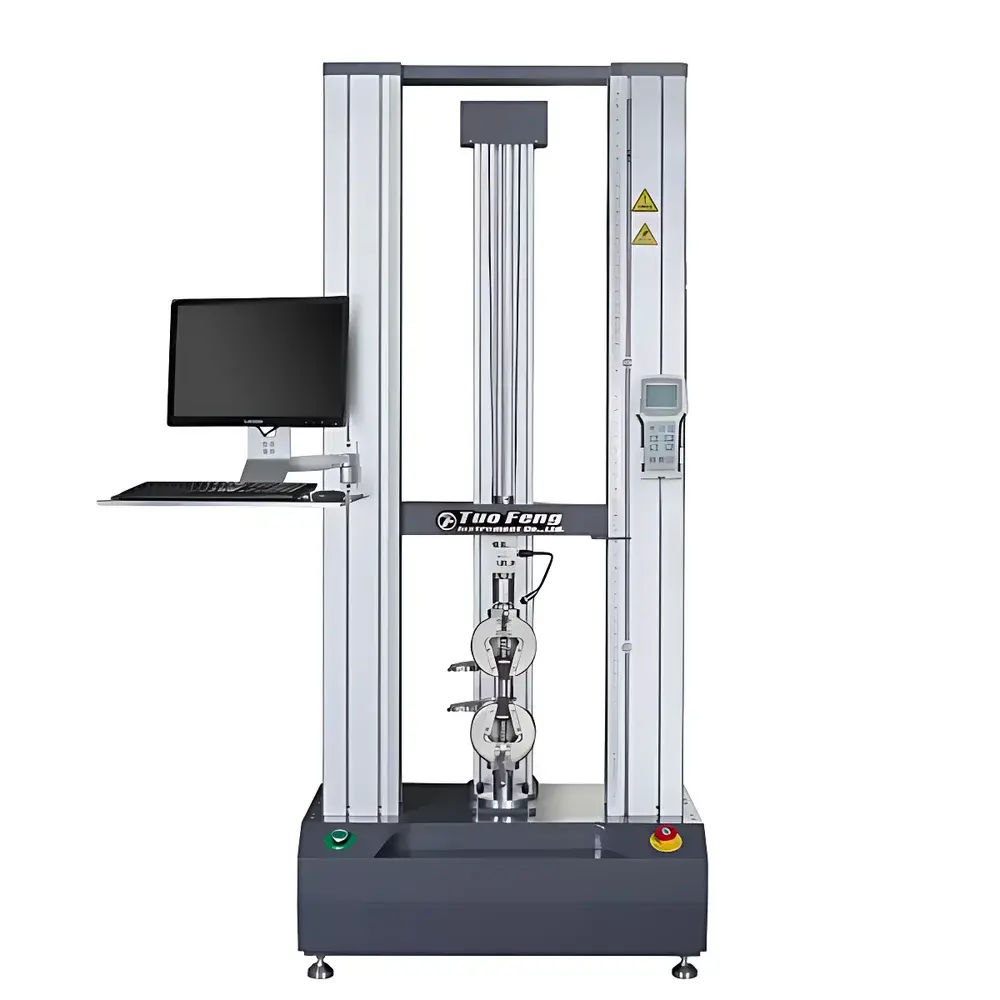
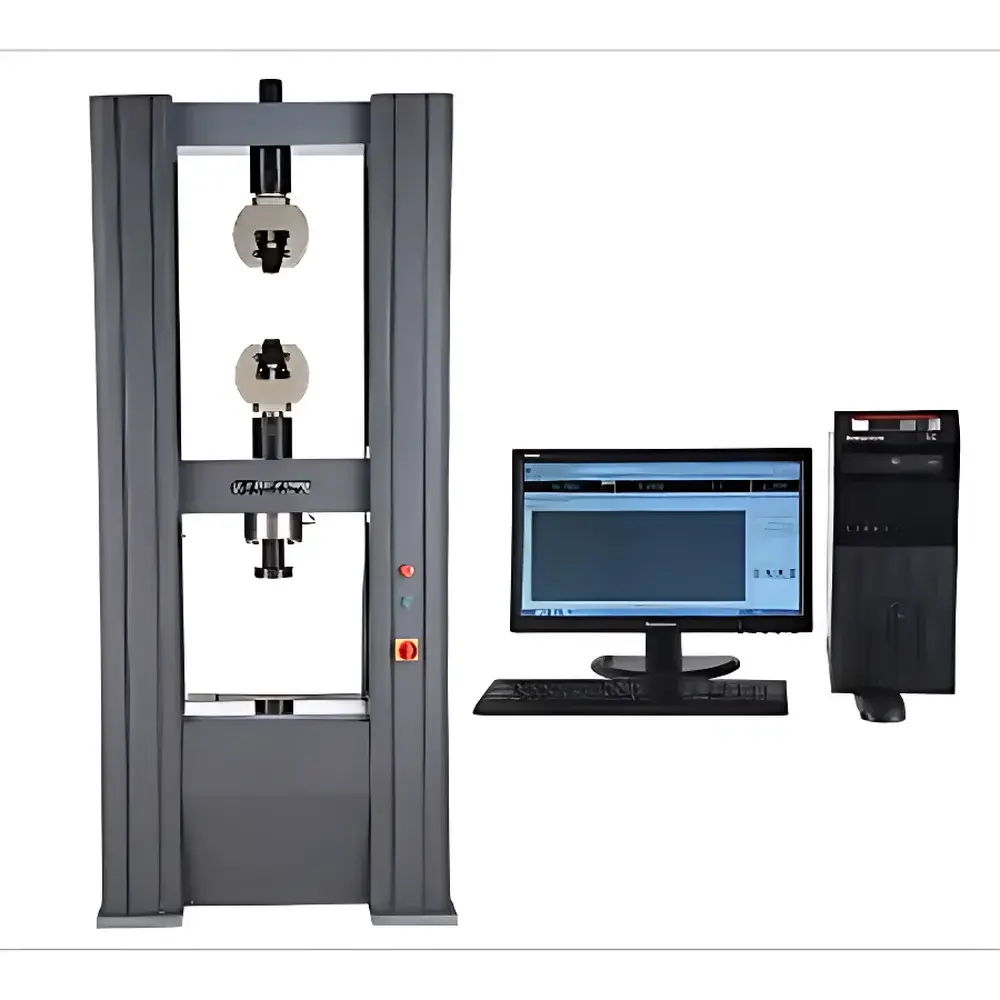
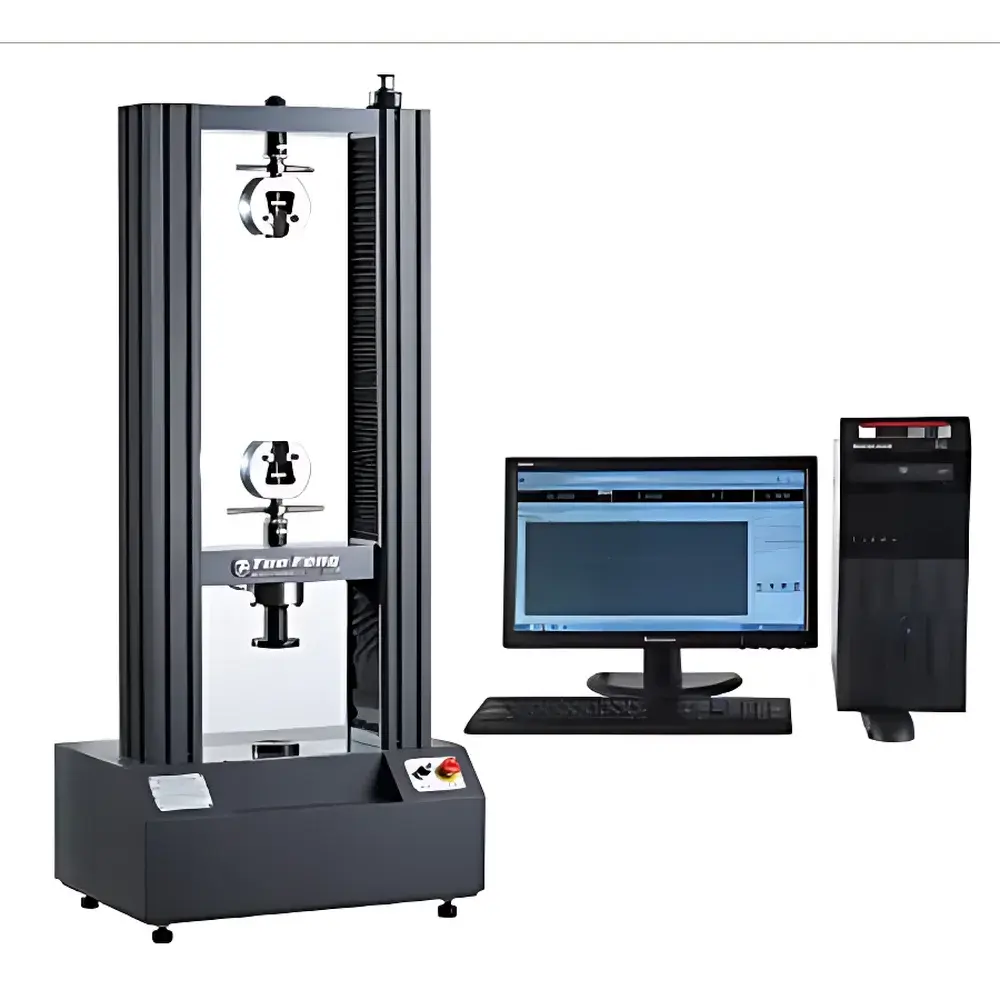
Tuofeng TFW-185 Microcomputer-Controlled Universal Testing Machine
| Brand | Tuofeng |
|---|---|
| Origin | Shanghai, China |
| Manufacturer Type | Direct Manufacturer |
| Instrument Type | Electromechanical Universal Testing Machine |
| Model | TFW-185 |
| Max Test Load | 185 kN (customizable from 5–200 kN) |
| Accuracy Class | ISO 7500-1 / ASTM E4 Class 0.5 |
| Effective Force Range | 0.2–100% of full scale |
| Force Measurement Accuracy | ±0.005% of reading |
| Load Cell Resolution | 1 part in ±500,000 full-scale codes (single-range, no auto-ranging) |
| Drive System | Imported servo motor with precision worm-gear reducer |
| Lead Screw | High-accuracy preloaded ball screw |
| Effective Test Width | 600 mm (expandable) |
| Stroke | 800 mm (extendable) |
| Speed Range | 0.001–500 mm/min (infinitely variable, closed-loop controlled) |
| Displacement Measurement | Optical encoder |
| Displacement Accuracy | ±0.005% of reading |
| Strain Measurement | Optional extensometer (clip-on or non-contact) or large-deformation system |
| Strain Accuracy | ±0.005% of reading |
| Safety Protection | Dual electronic limit switches, emergency stop button, overload cutoff (>110% FS), automatic return after test |
| Crosshead Control | Dual-speed (fast/slow) motorized vertical adjustment with jog function |
| Software Compliance | Supports ASTM E8/E9/E21/E292, ISO 6892-1, GB/T 228.1–2021, GB/T 16491–2008, JJG 475–2008, DIN 50105, JIS Z 2241, BS EN ISO 7500-1 |
Overview
The Tuofeng TFW-185 Microcomputer-Controlled Universal Testing Machine is an electromechanical static materials testing system engineered for high-fidelity mechanical property characterization across metallic, polymeric, ceramic, composite, and elastomeric specimens. It operates on the principle of controlled axial force application via a servo-driven ball-screw actuator, enabling precise displacement- or load-controlled loading protocols in tension, compression, bending, shear, peel, tear, and puncture configurations. The system conforms to international metrological and performance standards including ISO 7500-1 (Class 0.5), ASTM E4 (Class I), and GB/T 16491–2008, ensuring traceable force measurement integrity and repeatable mechanical response quantification. Its rigid monolithic frame, thermally stable load train, and zero-backlash transmission architecture minimize parasitic compliance and hysteresis—critical for accurate modulus determination and yield point detection in both ductile and brittle materials.
Key Features
- High-resolution force measurement: 1/500,000 internal resolution over full scale, with no range switching—maintaining consistent sensitivity from 0.2% to 100% of rated capacity (185 kN standard; scalable to 200 kN).
- True dual-closed-loop control: Simultaneous real-time regulation of load and displacement using independent PID algorithms, supporting advanced test modes including load hold, displacement hold, creep, stress relaxation, and cyclic loading.
- Modular extensometry integration: Compatible with clip-on axial extensometers (ASTM E83 Class B-1), video-based non-contact systems, and large-strain digital image correlation (DIC) modules for full-field strain mapping.
- Intelligent safety architecture: Triple-redundant protection—hardware-based emergency stop, software-enforced upper/lower travel limits, and dynamic overload cutoff at 110% of full-scale load—ensuring operator and equipment safety during unattended operation.
- Motorized crosshead with dual-speed actuation: Fast positioning (up to 500 mm/min) for setup efficiency and fine-adjustment mode (<0.1 mm/min) for specimen alignment and preload application.
- Thermally compensated load cell and encoder feedback: Minimizes drift under ambient temperature fluctuations (20 ± 5 °C operating range), meeting GLP-compliant environmental stability requirements.
Sample Compatibility & Compliance
The TFW-185 accommodates specimens ranging from thin films (0.05 mm thickness) to structural steel coupons (up to 80 mm diameter), with customizable fixtures for ASTM D638 tensile bars, ISO 527-2 injection-molded plaques, ASTM D790 flexural beams, ASTM D1876 T-peel assemblies, and ISO 1133 melt flow index adapters. It supports standardized test execution per ISO 6892-1 (tensile), ISO 14126 (compressive strength of composites), ASTM D3039 (composite tensile), ASTM D7264 (flexural), and GB/T 228.1–2021 (metallic materials). All hardware and firmware comply with electromagnetic compatibility (EMC) directive 2014/30/EU and low-voltage directive 2014/35/EU. Mechanical design satisfies ISO 12100 risk assessment criteria and includes CE marking documentation for EU market deployment.
Software & Data Management
The embedded Windows-based TestMaster Pro software provides full audit trail functionality compliant with FDA 21 CFR Part 11 (electronic signatures, user access levels, change history logging) and ISO/IEC 17025 data integrity requirements. It supports multi-language UI (English, Simplified/Traditional Chinese, German, French, Japanese), unit conversion across SI, imperial, and metric systems, and real-time plotting of up to six synchronized axes—including stress–strain, load–displacement, load–time, and strain–time. Raw data export is available in CSV, XML, and proprietary .TMD formats, with optional integration into LIMS platforms via OPC UA or TCP/IP socket interface. Automated report generation includes customizable templates conforming to ASTM E691 interlaboratory precision guidelines, and all test files are timestamped, digitally signed, and stored with SHA-256 checksum verification.
Applications
This system serves as a primary mechanical characterization platform in R&D laboratories and QC environments across aerospace (e.g., titanium alloy tensile certification per AMS 2300), automotive (high-strength steel sheet formability analysis per VDA 238-100), medical device manufacturing (ISO 14243-1 femoral stem fatigue simulation), polymer extrusion (PE pipe ring stiffness per ISO 9969), and additive manufacturing (in-situ monitoring of LPBF Ti-6Al-4V microtensile specimens). It is routinely deployed for validation of material specifications against MIL-STD-810G mechanical shock profiles, qualification of adhesive bonds per ASTM D1002, and accelerated aging studies involving sequential thermal–mechanical cycling per ASTM D6111.
FAQ
What standards does the TFW-185 support out-of-the-box?
It natively implements test methods per ASTM E8, ISO 6892-1, GB/T 228.1, DIN 50125, and JIS Z 2241—with configurable parameters for strain rate, hold duration, and failure criteria.
Can the system be integrated into an existing factory MES or PLM environment?
Yes—via optional OPC UA server module or RESTful API interface, enabling bidirectional data exchange with Siemens Opcenter, PTC Windchill, or SAP QM modules.
Is calibration traceability provided to national standards?
Each instrument ships with a NIST-traceable calibration certificate (issued by CNAS-accredited lab), covering force, displacement, and strain channels, valid for 12 months under normal usage conditions.
What maintenance intervals are recommended for long-term accuracy retention?
Preventive maintenance is scheduled every 12 months or 2,000 operational hours—covering ball-screw lubrication, encoder alignment verification, load cell zero-drift compensation, and safety circuit functional testing.
Does the software support multi-user role-based access control?
Yes—administrator, technician, and viewer roles with granular permissions for method editing, test execution, result approval, and audit log review, fully compliant with ISO/IEC 17025 Clause 7.10.2.
Related Products



