
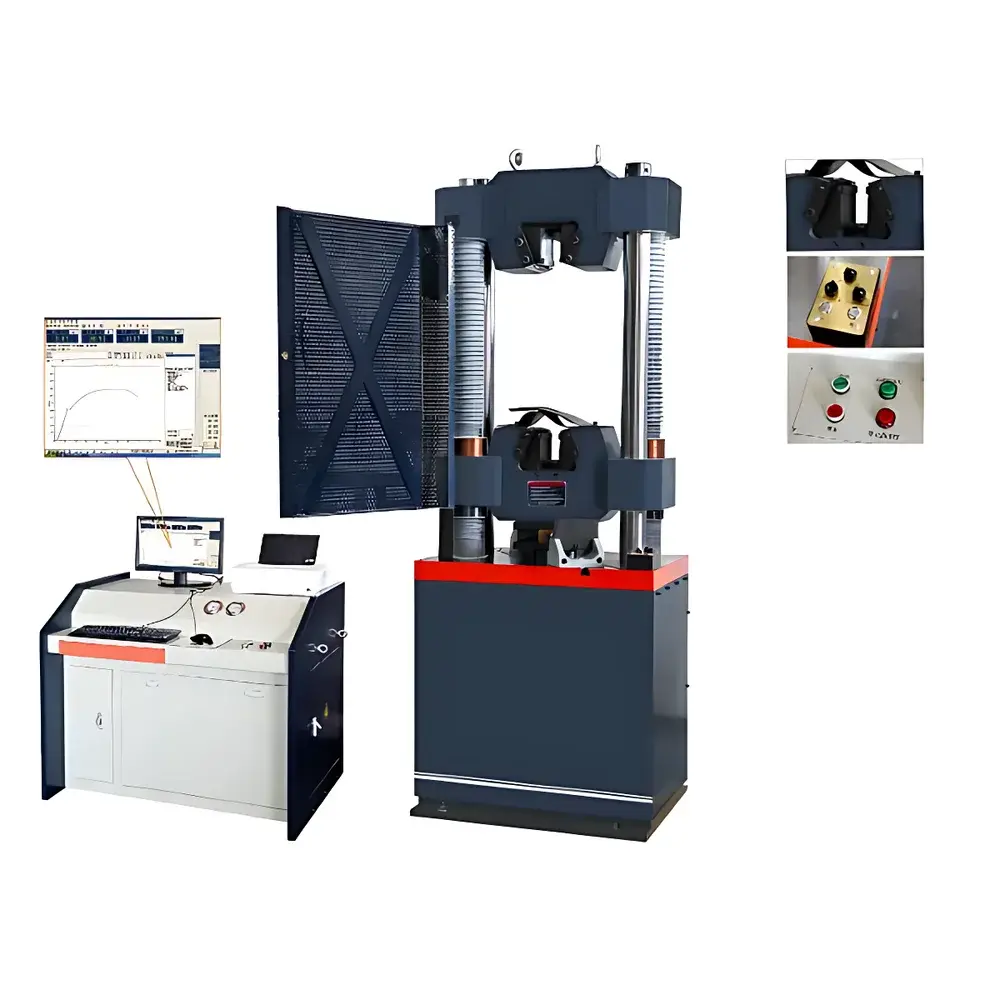
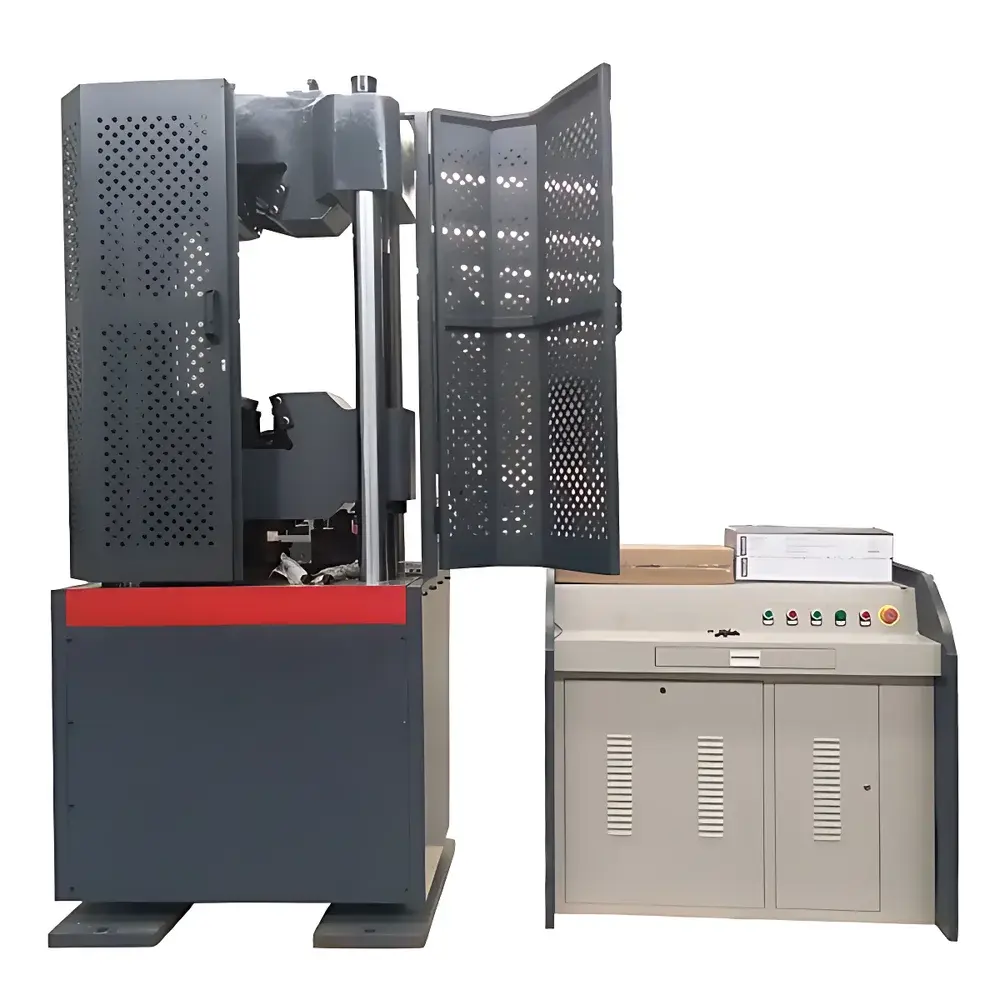
Tuofeng TFW-236 Microcomputer-Controlled Electro-Hydraulic Servo Universal Testing Machine
| Brand | Tuofeng |
|---|---|
| Origin | Shanghai, China |
| Manufacturer Type | Direct Manufacturer |
| Instrument Type | Electro-Hydraulic Servo Testing Machine |
| Model | TFW-236 |
| Key Features | Four-column frame, bottom-mounted hydraulic cylinder, dual-screw crosshead drive, full-digital multi-channel closed-loop control system with stress/strain/displacement triple-loop capability, ISO/ASTM-compliant test speed regulation, hydraulic wedge-type clamping, integrated HP commercial PC and inkjet printer |
| Compliance | Fully compliant with GB/T 228.1–2010, ASTM E4, ASTM E8, ISO 6892-1, EN 10002-1 |
Overview
The Tuofeng TFW-236 Microcomputer-Controlled Electro-Hydraulic Servo Universal Testing Machine is an industrial-grade static mechanical testing system engineered for high-accuracy tensile, compression, bending, and shear characterization of metallic and high-strength nonmetallic materials. It operates on the principle of servo-controlled hydraulic actuation, where a high-fidelity electro-hydraulic servo valve regulates oil flow into a bottom-mounted piston cylinder to deliver precise, programmable force and displacement profiles. The machine features a rigid four-column, two-screw load frame with optimized column spacing (585 mm) and vertical clearance (600 mm for tension, 500 mm for compression), ensuring geometric stability under loads up to 1000 kN. Its fully digital, multi-channel closed-loop control architecture supports simultaneous real-time feedback from load cells, extensometers, and linear displacement transducers—enabling true stress-, strain-, and position-controlled test modes with seamless, impact-free transitions between control schemes per ISO 16840 and ASTM E1012.
Key Features
- Four-column, two-screw, bottom-actuated frame design with reinforced cast-iron base and precision-ground guide surfaces for minimal deflection and long-term alignment stability.
- Electro-hydraulic servo system incorporating a high-response proportional servo valve, high-pressure filtration (≤5 µm), and a thermally stabilized oil reservoir—ensuring force linearity ≤±1% of reading across 2–100% of full scale.
- Triple-closed-loop control: independent, switchable control of engineering stress rate (MPa/s), true strain rate (%/s), and crosshead displacement rate (mm/min), all traceable to NIST-calibrated reference standards.
- Hydraulic wedge-type clamping mechanism with automatic pressure compensation, supporting round specimens Φ6–Φ40 mm and flat specimens up to 30 mm thick × 75 mm wide.
- Integrated displacement measurement via high-resolution rotary encoder (1/300,000 full-scale resolution) and optional clip-on or contactless extensometry for ASTM E8/E21-compliant strain acquisition.
- Dual-mode operation: manual local control via oil source console and full remote control via Windows-based software with role-based access (Administrator / Tester).
Sample Compatibility & Compliance
The TFW-236 accommodates standardized specimen geometries per ISO 6892-1, ASTM E8, and GB/T 228.1–2010—including round bars, flat plates, notched Charpy blanks (with optional bending fixtures), and shear coupons. Compression testing utilizes a φ160 mm hardened steel platen; three-point bending employs adjustable support rollers (max span 300 mm, roller width 140 mm). All mechanical components conform to ISO 7500-1 Class 1 accuracy requirements for force measurement systems. The system supports GLP/GMP-aligned audit trails, electronic signatures, and 21 CFR Part 11-compliant data integrity protocols when configured with optional validation packages.
Software & Data Management
The proprietary Tuofeng TestMaster™ software runs on an embedded HP ProDesk commercial PC and provides ISO 17025-aligned test workflow management. Users may create, import, or export test methods—including custom ramp-hold cycles, multi-step loading sequences, and conditional branching logic. Real-time data acquisition records ≥1,000 points/sec across all channels. Reporting follows open Excel (.xlsx) template architecture: users define column order, units, statistical functions (e.g., yield offset, uniform elongation, modulus slope), and pass/fail thresholds. All raw data files are stored in ASCII-delimited format with embedded metadata (operator ID, timestamp, calibration certificate IDs, environmental conditions), enabling third-party analysis in MATLAB, Python, or Minitab.
Applications
The TFW-236 serves quality control laboratories in aerospace component manufacturing (e.g., Ti-6Al-4V fasteners, Inconel turbine discs), automotive Tier-1 suppliers (high-strength steel chassis parts, aluminum EV battery enclosures), and national metrology institutes performing inter-laboratory comparisons. It is routinely deployed for mechanical property certification per ASME BPVC Section II, MIL-STD-810, and EN 10025 tensile reporting. Secondary applications include creep testing (with optional high-temperature furnace integration), fracture toughness pre-cracking (in compliance with ASTM E399), and cyclic loading protocol development for fatigue life modeling.
FAQ
What standards does the TFW-236 natively support for tensile testing?
It implements full compliance with GB/T 228.1–2010, ASTM E8/E21, ISO 6892-1:2019, and EN 10002-1, including automatic determination of Rp0.2, Rm, A5.65, and Agt.
Can the system be validated for regulated environments (e.g., FDA, ISO 17025)?
Yes—optional IQ/OQ/PQ documentation packages, calibration traceability to CNAS-accredited labs, and 21 CFR Part 11 audit trail modules are available upon request.
Is extensometer integration supported?
Yes—the control system accepts analog and digital inputs from LVDT, video, or laser extensometers; auto-zeroing and gauge length registration are software-configurable.
What maintenance intervals are recommended for the hydraulic system?
Oil analysis every 1,500 operating hours; full filter replacement and system flush every 3,000 hours; annual recalibration of load cell and displacement sensors per ISO 376.
Does the software allow batch processing of multiple specimens?
Yes—users can queue up to 99 specimens with unique IDs, apply identical or variant test methods, and generate consolidated summary reports with statistical grouping by lot, heat number, or treatment condition.



