
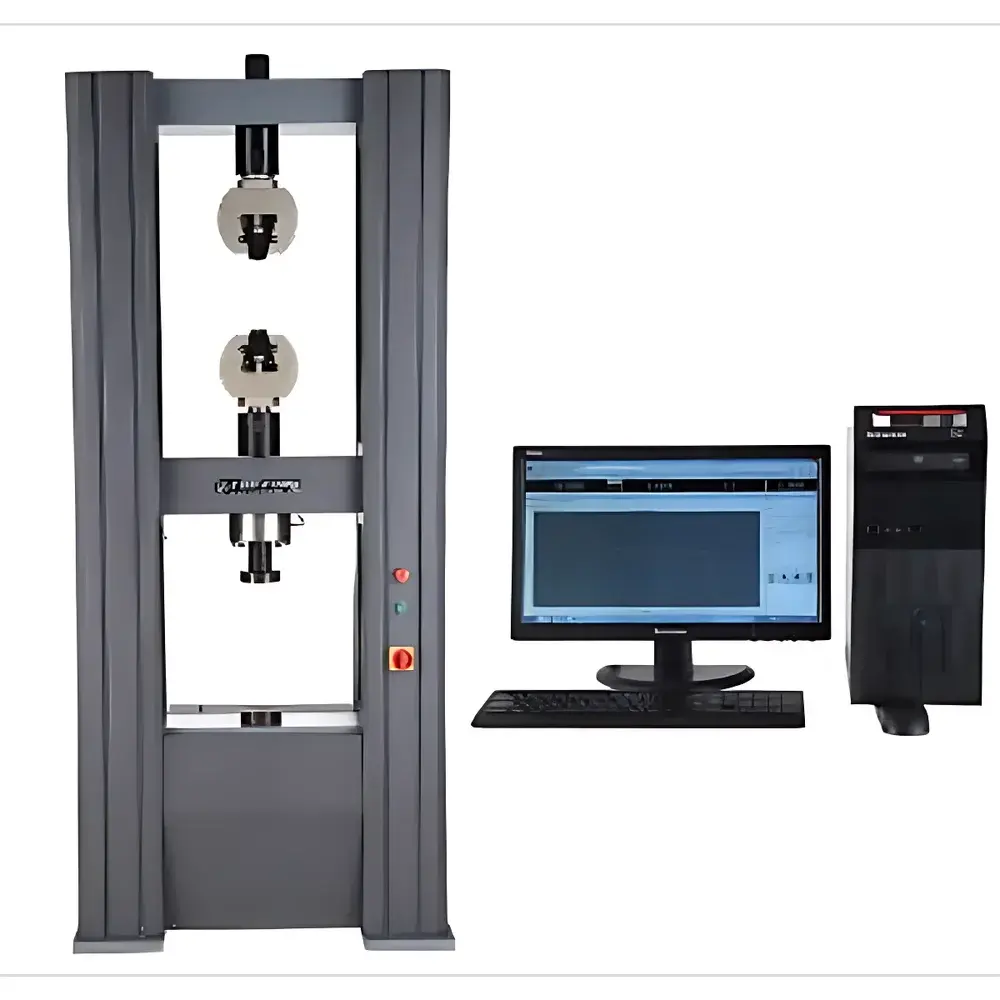
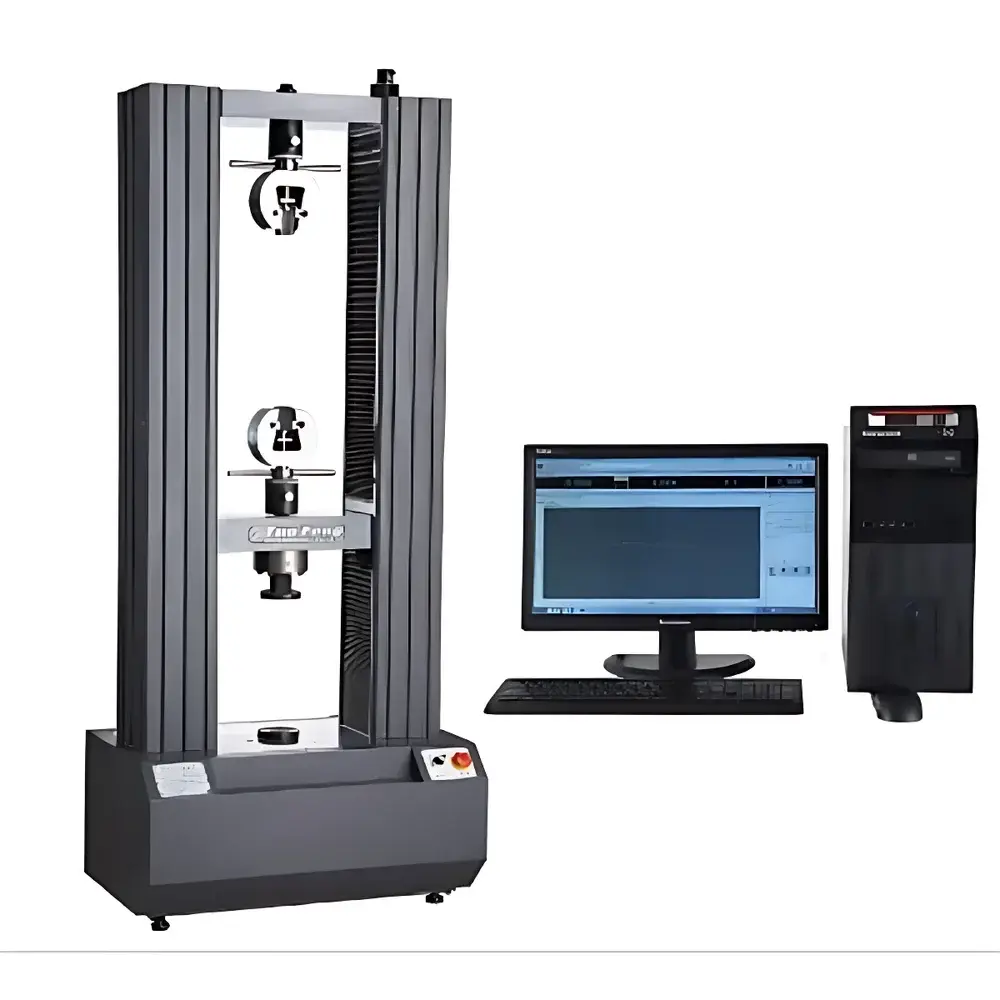
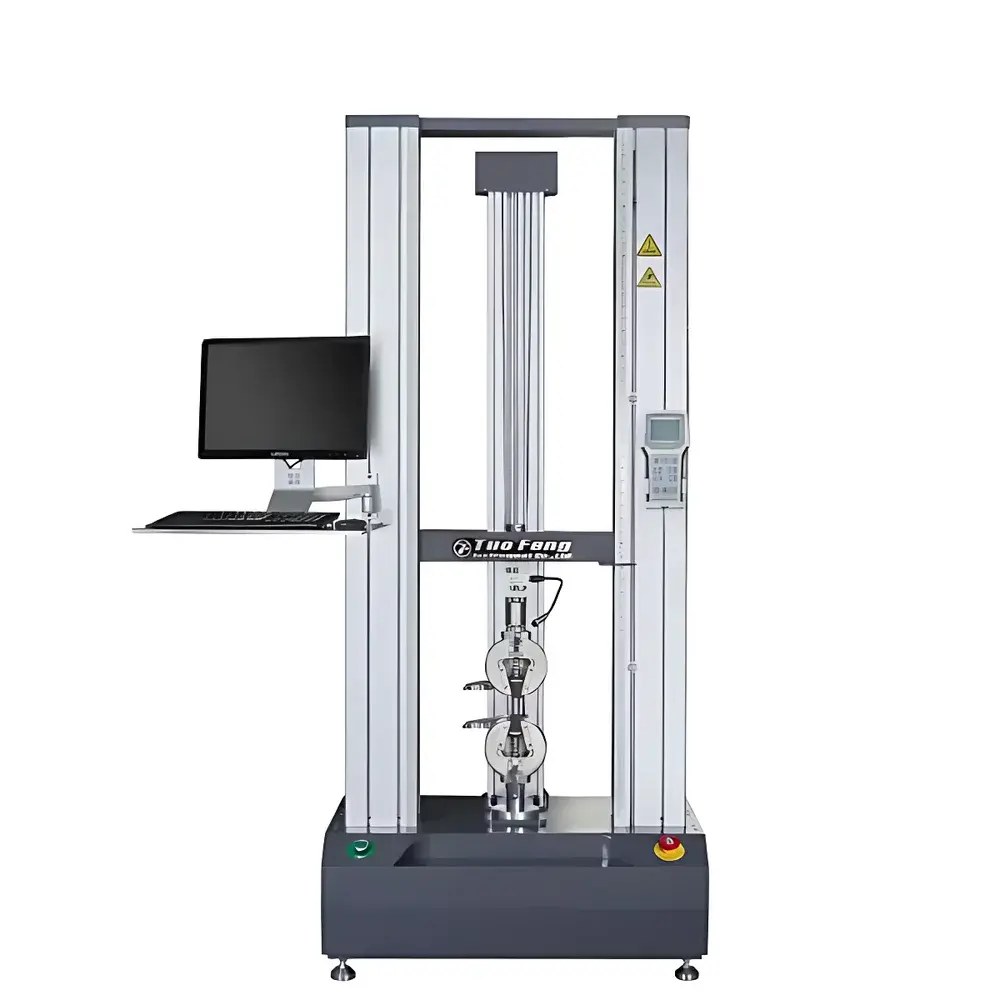
Tuofeng TFW-241 Microcomputer-Controlled Electronic Universal Testing Machine
| Brand | Tuofeng |
|---|---|
| Origin | Shanghai, China |
| Manufacturer Type | Direct Manufacturer |
| Product Category | Domestic |
| Model | TFW-241 |
| Instrument Type | Electronic Universal Testing Machine |
| Standards Compliance | GB/T 16491-2008, JJG 475-2008 |
| Max Test Load | 24 kN |
| Accuracy Class | 0.5 |
| Effective Force Range | 0.2–100% of Full Scale |
| Force Measurement Accuracy | ±0.005% of reading |
| Force Resolution | 1/500,000 full-scale codes (no range switching, constant resolution) |
| Drive System | Imported servo motor with worm gear reducer |
| Lead Screw | High-precision preloaded ball screw |
| Effective Test Width | 400 mm (customizable) |
| Stroke | 800 mm (extendable) |
| Speed Range | 0.001–500 mm/min (infinitely variable) |
| Displacement Measurement | Optical encoder |
| Displacement Accuracy | ±0.005% of reading |
| Strain Measurement | Optional extensometer or large-deformation sensor |
| Strain Accuracy | ±0.005% of reading |
| Safety Protection | Electronic limit switches, emergency stop, overload protection (10% over capacity), dual-speed motorized crosshead control |
| Software | Multi-language (EN/CN/TC), multi-unit support, real-time curve display (load–time, load–displacement, stress–strain, etc.), automatic parameter calculation per ASTM/ISO/GB standards, batch comparison, audit-ready data export, GLP-compliant reporting |
Overview
The Tuofeng TFW-241 is a microcomputer-controlled electronic universal testing machine engineered for high-fidelity mechanical property characterization of metallic, polymeric, composite, and ceramic materials. It operates on the principle of controlled uniaxial force application via a precision servo-driven electromechanical actuation system, enabling quantitative measurement of tensile strength, compressive yield, flexural modulus, tear resistance, peel adhesion, and bond strength under standardized loading conditions. Designed to meet the metrological rigor required in R&D laboratories and quality control environments, the TFW-241 conforms to GB/T 16491–2008 (Chinese national standard for electronic UTM design), JJG 475–2008 (verification regulation), and supports method implementation aligned with ISO 6892-1, ASTM E8/E9/E21, DIN 50125, JIS Z 2241, and BS EN 10002-1. Its 0.5-class accuracy rating—verified across the full 0.2–100% force range—ensures traceable, repeatable results suitable for regulatory submissions and inter-laboratory comparisons.
Key Features
- High-resolution force transduction with ±0.005% reading accuracy and 1/500,000 full-scale digital resolution—no auto-ranging, eliminating step-change errors.
- Preloaded high-precision ball screw assembly coupled with an imported servo motor and worm-gear reduction drive, delivering smooth, low-backlash motion control from 0.001 to 500 mm/min.
- Dual-speed motorized crosshead with programmable return logic: rapid repositioning (up to 500 mm/min) for throughput optimization and fine-tuned approach (0.001 mm/min) for precise alignment and preload establishment.
- Integrated safety architecture including electronic end-limit detection, hardware emergency stop circuitry, and automatic overload cutoff at 110% of rated capacity.
- Modular fixture interface supporting standardized grips (tensile, compression platens, bend fixtures) and custom tooling for specialized bond strength tests—including lap-shear, pull-off, and substrate-adhesive interface evaluation per ASTM D1002, ISO 4587, and GB/T 2790.
- Real-time synchronization of load, displacement, and optional strain signals—enabling true engineering stress–strain derivation with minimal interpolation error.
Sample Compatibility & Compliance
The TFW-241 accommodates specimens ranging from thin films (<0.1 mm thickness) to structural components (up to 24 kN ultimate load), with customizable test width (standard 400 mm, extendable to 600 mm) and vertical stroke (800 mm base, expandable). It supports compliance-critical workflows in regulated sectors: raw material qualification per ISO 9001, medical device component validation under ISO 13485, construction material certification per GB 50210, and aerospace fastener testing per AMS 2750. All hardware and firmware are designed to support GLP/GMP documentation requirements—including user access control, electronic signature capability, and audit trail generation for force/displacement/time-stamped events. Data integrity aligns with FDA 21 CFR Part 11 principles when deployed with validated software configuration.
Software & Data Management
Tuofeng’s proprietary WinTest Pro software runs natively on Windows OS and provides fully configurable test sequences—including load-controlled, displacement-controlled, and closed-loop strain-controlled protocols. Users may define multi-step procedures with hold segments, ramp rates, and conditional termination criteria (e.g., “stop at 5% strain” or “hold at 10 kN for 60 s”). The interface supports real-time overlay of up to four independent curves (e.g., stress–strain + load–time + displacement–time), automatic calculation of >20 mechanical parameters per test (tensile strength, Young’s modulus, elongation at break, yield offset, bond strength index), and batch statistical summaries (mean, SD, CV%, min/max). Export formats include CSV, XLSX, PDF reports with embedded metadata (operator ID, timestamp, calibration certificate ID), and image-capturable graphical output. Software updates are provided free of charge for the instrument’s operational lifetime, with version-controlled release notes and change logs available upon request.
Applications
- Adhesion performance evaluation of structural adhesives, sealants, and coatings using ASTM D3359 (cross-hatch), ASTM D4541 (pull-off), and ISO 4624.
- Mechanical validation of building materials: cementitious composites (GB/T 17671), polymer-modified mortars (EN 1504-3), and tile adhesive bond strength (EN 12004).
- Characterization of biomedical polymers: suture tensile strength (ISO 10993-12), hydrogel compression modulus, and drug-eluting stent strut fatigue behavior.
- Quality assurance of automotive elastomers: dynamic bonding strength of EPDM gaskets, vulcanized rubber tear resistance (ASTM D624), and composite laminate interlaminar shear (ASTM D2344).
- Research-grade deformation analysis of nanocomposites and 3D-printed thermoplastics, where high-resolution displacement tracking enables accurate Poisson’s ratio determination and viscoelastic modeling inputs.
FAQ
What standards does the TFW-241 support out-of-the-box?
The system includes preconfigured test methods for GB/T 228.1, ASTM E8, ISO 6892-1, ASTM D638, and GB/T 1447—fully editable to accommodate lab-specific SOPs or emerging standard revisions.
Can the TFW-241 perform creep or stress-relaxation tests?
Yes—via WinTest Pro’s time-dependent protocol editor, users can define sustained load or displacement holds for durations up to 999 hours, with automated data logging at user-defined intervals and real-time deviation alerts.
Is third-party calibration certification included?
Each unit ships with a factory-issued calibration certificate traceable to CNAS-accredited reference standards; optional UKAS/NIST-traceable recalibration services are available annually.
How is data security ensured during long-term deployment?
WinTest Pro supports Windows Active Directory integration, role-based permission tiers (Operator, Supervisor, Administrator), encrypted local database storage, and configurable auto-backup to network drives or cloud repositories compliant with ISO/IEC 27001 policies.
What is the lead time for custom fixture development?
Standard grip modifications are delivered within 10 business days; fully engineered custom fixtures (e.g., ASTM D1002 lap-shear jigs with alignment pins) require 25–30 days following mechanical drawing approval.
Related Products



