
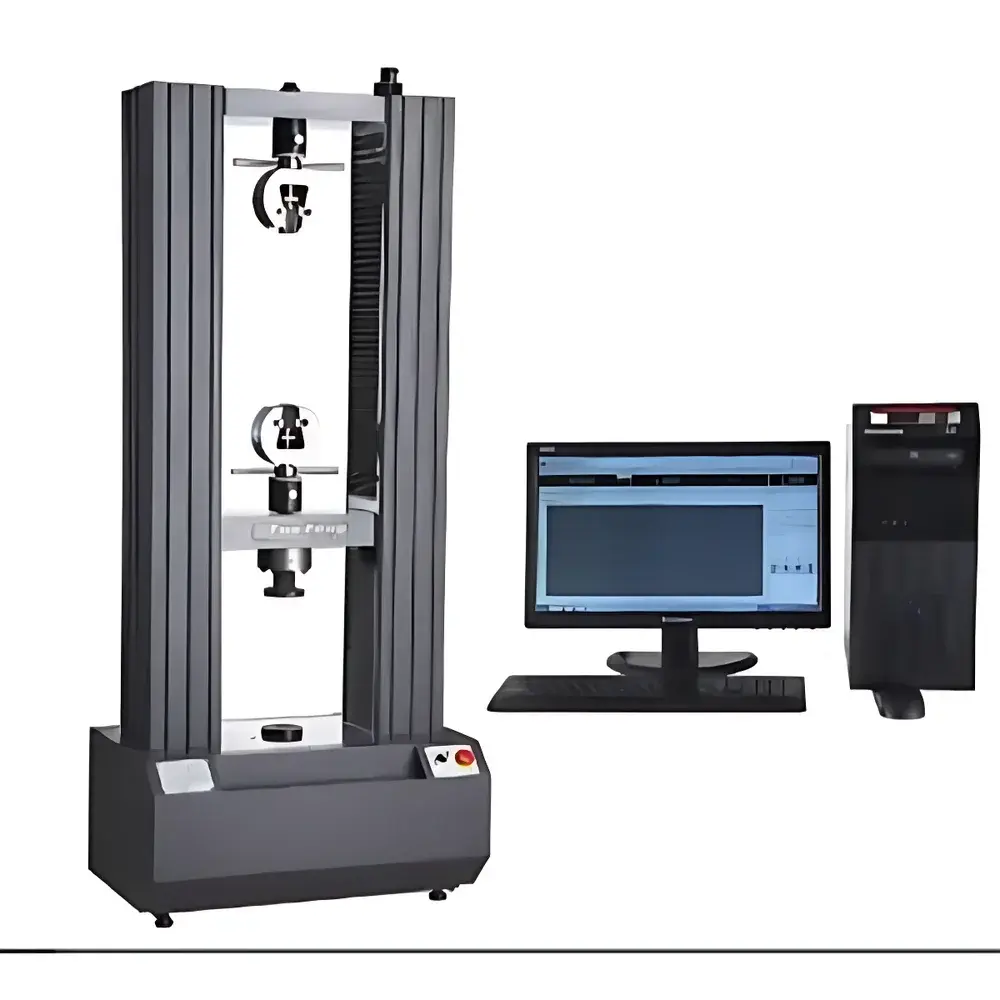
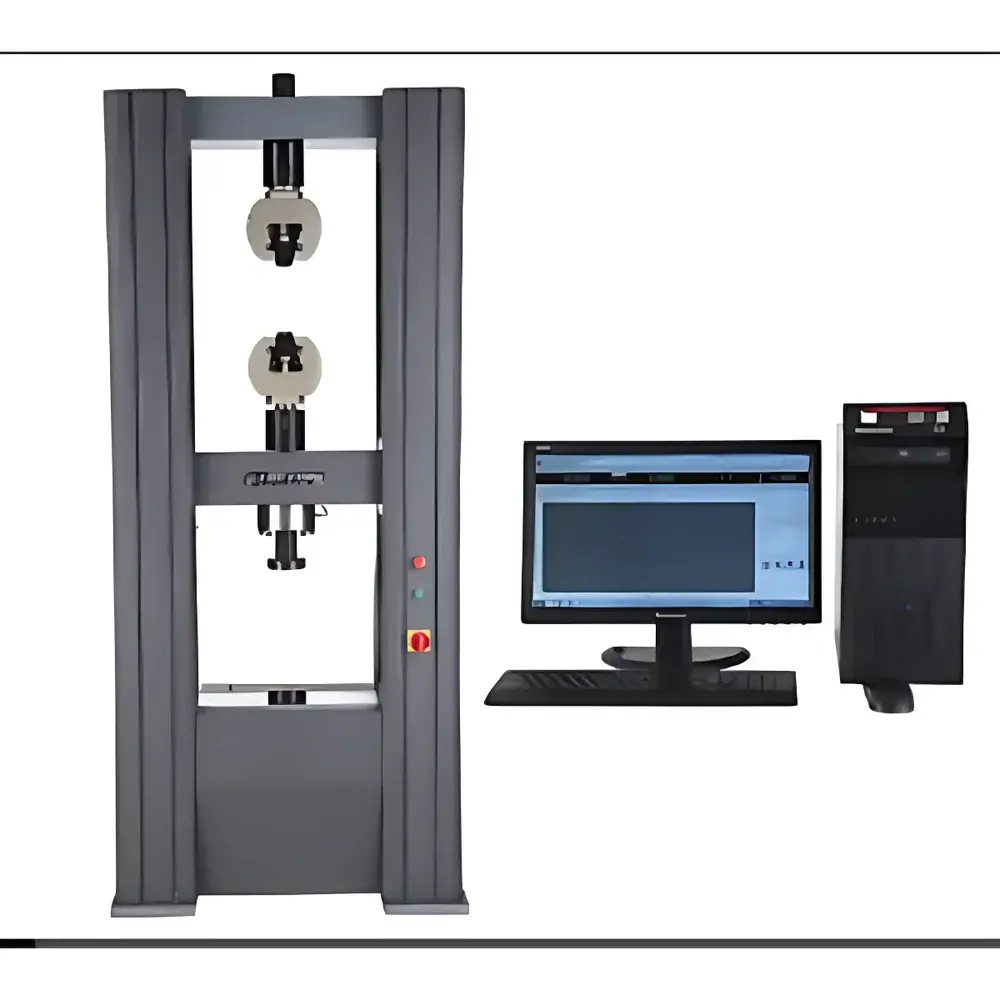
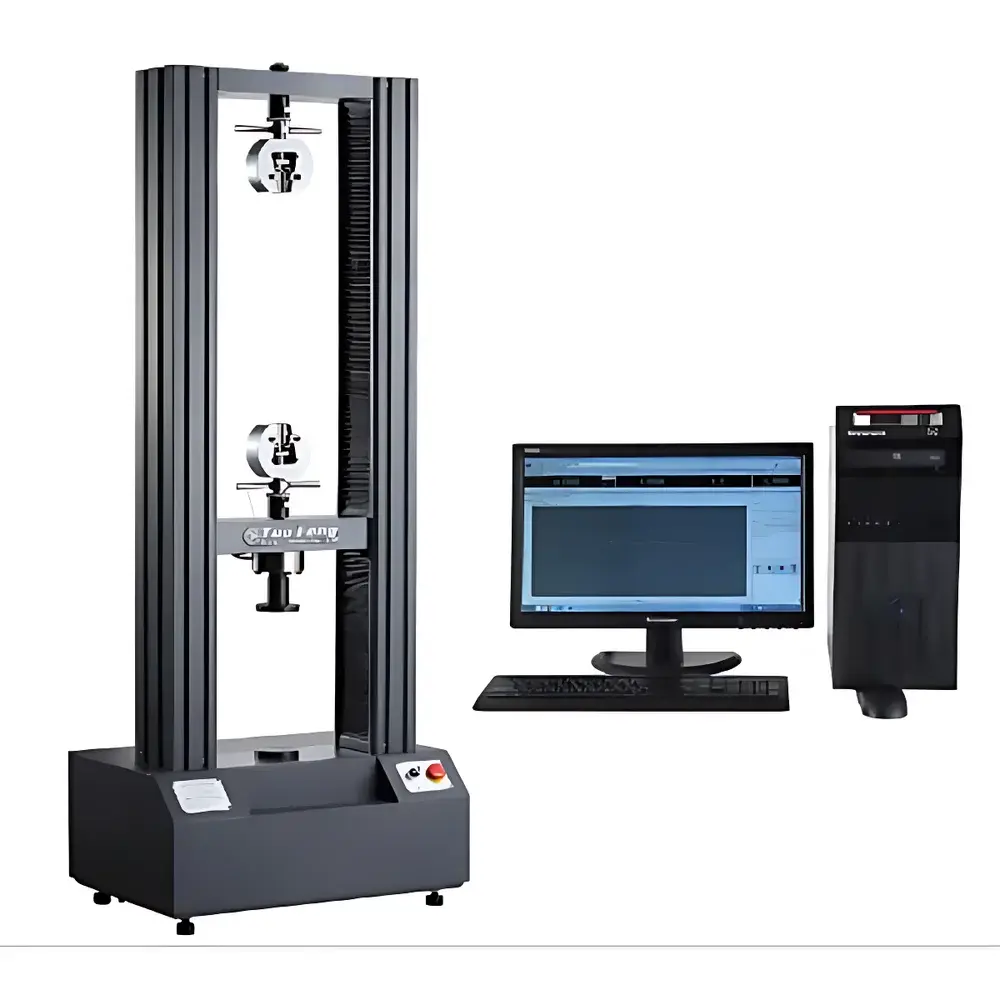
Tuofeng TFW-265 Microcomputer-Controlled Electromechanical Universal Testing Machine with Slow Strain Rate Tensile (SSRT) Capability
| Brand | Tuofeng |
|---|---|
| Origin | Shanghai, China |
| Manufacturer Type | Direct Manufacturer |
| Model | TFW-265 |
| Instrument Type | Electromechanical Universal Testing Machine |
| Standards Compliance | GB/T 16491-2008, JJG 475-2008, ASTM E8/E21/E143, ISO 6892-1, DIN 50125, JIS Z 2241 |
| Max Test Load | 200 kN |
| Accuracy Class | 0.5 |
| Effective Force Range | 0.2–100% of full scale |
| Force Measurement Accuracy | ±0.005% of reading |
| Force Resolution | 1/500,000 full-scale code (single-range, no auto-ranging) |
| Drive System | Imported servo motor + precision worm gear reducer |
| Lead Screw | High-precision preloaded ball screw |
| Effective Test Width | 600 mm (customizable) |
| Stroke | 800 mm (extendable) |
| Speed Range | 0.001–500 mm/min (infinitely variable, closed-loop controlled) |
| Displacement Measurement | Optical encoder, accuracy ±0.005% of reading |
| Strain Measurement | Optional extensometer (clip-on or non-contact) or large-deformation transducer, accuracy ±0.005% of reading |
| Safety Protection | Dual electronic limit switches, emergency stop button, overload protection (>110% FS), automatic return function |
| Software | Windows-based, multi-language (EN/CN-TR), compliant with FDA 21 CFR Part 11 audit trail and user access control (configurable), GLP/GMP-ready data integrity features |
Overview
The Tuofeng TFW-265 is a high-precision electromechanical universal testing machine engineered for static mechanical property evaluation under controlled strain rate conditions—including dedicated Slow Strain Rate Tensile (SSRT) testing per ASTM G129 and ISO 7539-7. It operates on the principle of closed-loop servo-controlled displacement and load actuation, enabling precise regulation of strain rate down to 1 × 10⁻⁷ s−1—critical for assessing environmental assisted cracking (EAC), stress corrosion cracking (SCC), and hydrogen embrittlement susceptibility in metallic alloys, weldments, and high-strength steels. The system integrates a rigid dual-column frame, high-resolution force transduction (0.5-class accuracy), and thermally stable kinematic architecture to ensure long-duration test repeatability and minimal thermal drift during extended SSRT protocols lasting up to 1,000 hours.
Key Features
- 0.5-class accuracy certified force measurement system with ±0.005% reading uncertainty across 0.2–100% of 200 kN full scale
- Single-range, high-resolution analog-to-digital conversion (1/500,000 code) eliminating range-switching artifacts during low-strain-rate transitions
- Imported industrial servo drive coupled with preloaded ball screw transmission ensures sub-micron positioning resolution and velocity stability < ±0.1% of setpoint over full speed range (0.001–500 mm/min)
- Dual-mode strain acquisition: optional high-accuracy clip-on extensometers (ASTM E83 Class B-1) or non-contact video extensometry (VEM) for gauge length tracking without specimen contact
- Integrated safety architecture: hardware-level emergency stop, dual independent electronic travel limits, real-time overload cutoff (>110% FS), and programmable soft stops for automated test termination
- Modular crosshead design accommodating custom SSRT environmental cells (e.g., autoclave-compatible fixtures, electrochemical potentiostat integration ports, inert gas purging manifolds)
Sample Compatibility & Compliance
The TFW-265 accommodates standard tensile specimens per ASTM E8/E21 (flat and round), ISO 6892-1, and GB/T 228.1, with optional custom grips for notched, pre-cracked, or threaded specimens used in fracture mechanics and SCC studies. Its 600 mm test width and 800 mm stroke support extended gauge lengths required for low-strain-rate compliance. The system meets national and international metrological standards: GB/T 16491-2008 (Chinese verification specification for UTM), JJG 475-2008 (calibration regulation), and is fully compatible with ISO/IEC 17025-accredited laboratory workflows. All mechanical and software functions are traceable to NIST-traceable reference standards via third-party calibration certificates.
Software & Data Management
Tuofeng TestSuite™ v5.2 is a Windows-based, 21 CFR Part 11-compliant platform supporting role-based user authentication, electronic signatures, and immutable audit trails for all test parameter changes, data exports, and report generations. It enables direct implementation of SSRT test profiles—including ramp-hold sequences, constant extension rate (CER), and potential-controlled straining in conjunction with external potentiostats. Real-time plotting includes synchronized stress–strain, load–time, and crack-opening displacement (COD) vs. time curves. Data export formats include CSV, XML, and PDF/A-2a for long-term archival. Raw channel data (load, displacement, extensometer output) is stored at ≥1 kHz sampling rate with timestamped metadata, ensuring full reproducibility for regulatory submissions or inter-laboratory comparisons.
Applications
- Slow strain rate tensile testing of pipeline steels (X65–X100), stainless alloys (304, 316, duplex), and nickel-based superalloys (Inconel 625, 718) in simulated service environments (H2S, CO2, chloride solutions)
- Mechanical property benchmarking per ASTM D638 (plastics), D3039 (composites), D790 (flexural), and ISO 527 series
- Quality control of structural adhesives, elastomeric seals, and coated substrates using peel, shear, and lap-shear protocols
- Research-grade characterization of powder metallurgy compacts, additive-manufactured lattice structures, and ceramic matrix composites under monotonic and cyclic loading
- Validation of constitutive models (e.g., Johnson–Cook, Gurson–Tvergaard–Needleman) through high-fidelity stress–strain data acquisition
FAQ
Does the TFW-265 support true slow strain rate testing below 10−6 s−1?
Yes—the system achieves strain rates as low as 1 × 10⁻⁷ s−1 using closed-loop displacement control with active thermal compensation and ultra-low-speed servo tuning.
Can the software generate ASTM G129-compliant SSRT reports automatically?
Yes—TestSuite™ includes preconfigured report templates aligned with ASTM G129 Annex A1, including time-to-failure, reduction-in-area, and ductility ratio calculations with statistical confidence intervals.
Is third-party calibration and ISO/IEC 17025 accreditation support available?
Yes—Tuofeng provides factory calibration certificates traceable to CNAS-accredited labs; optional on-site verification and uncertainty budget documentation are available upon request.
What environmental chamber interfaces are supported for in-situ SSRT testing?
Standard RS-485 and analog I/O ports enable seamless integration with commercial autoclaves, electrochemical workstations (e.g., BioLogic SP-300), and gas flow controllers for dynamic atmosphere control.
How is data integrity ensured during multi-day SSRT tests?
Continuous write-caching with redundant storage buffers, power-fail recovery mode, and SHA-256 hash-verified data logging prevent corruption or loss—even during unscheduled power interruptions.



