
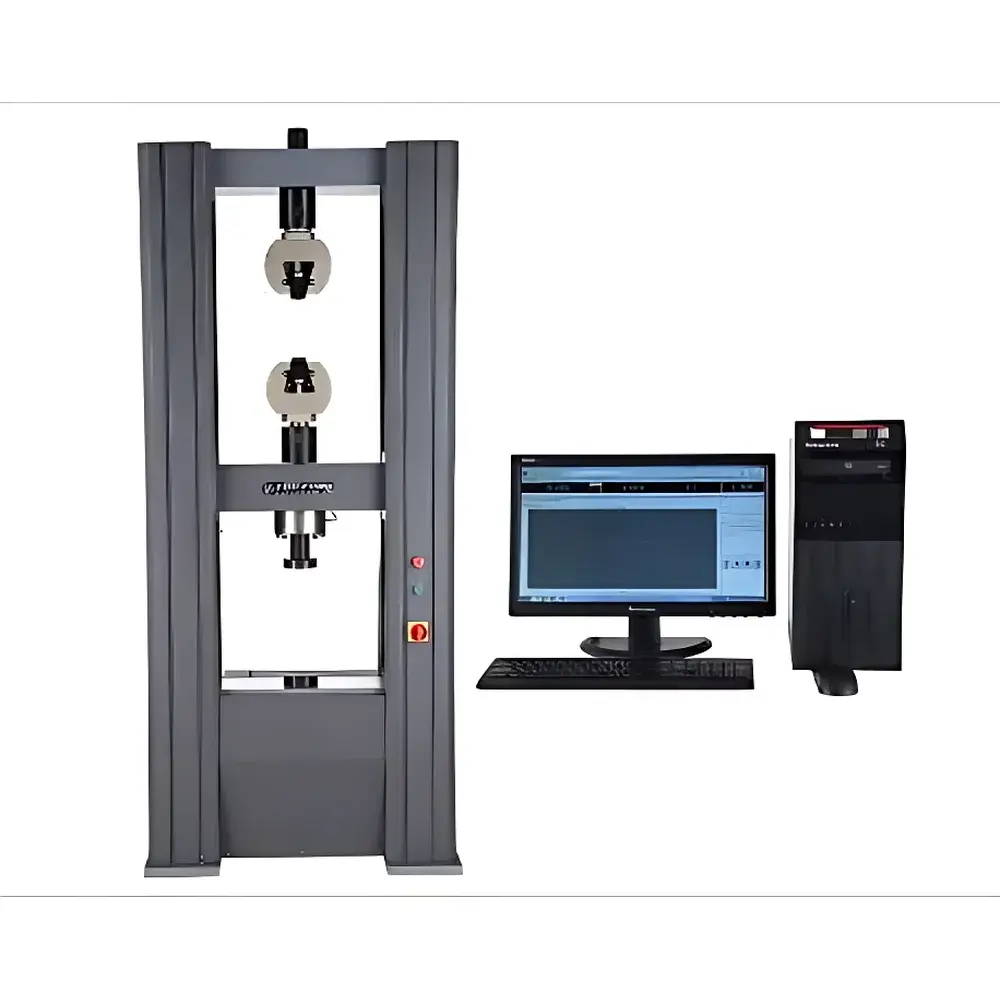
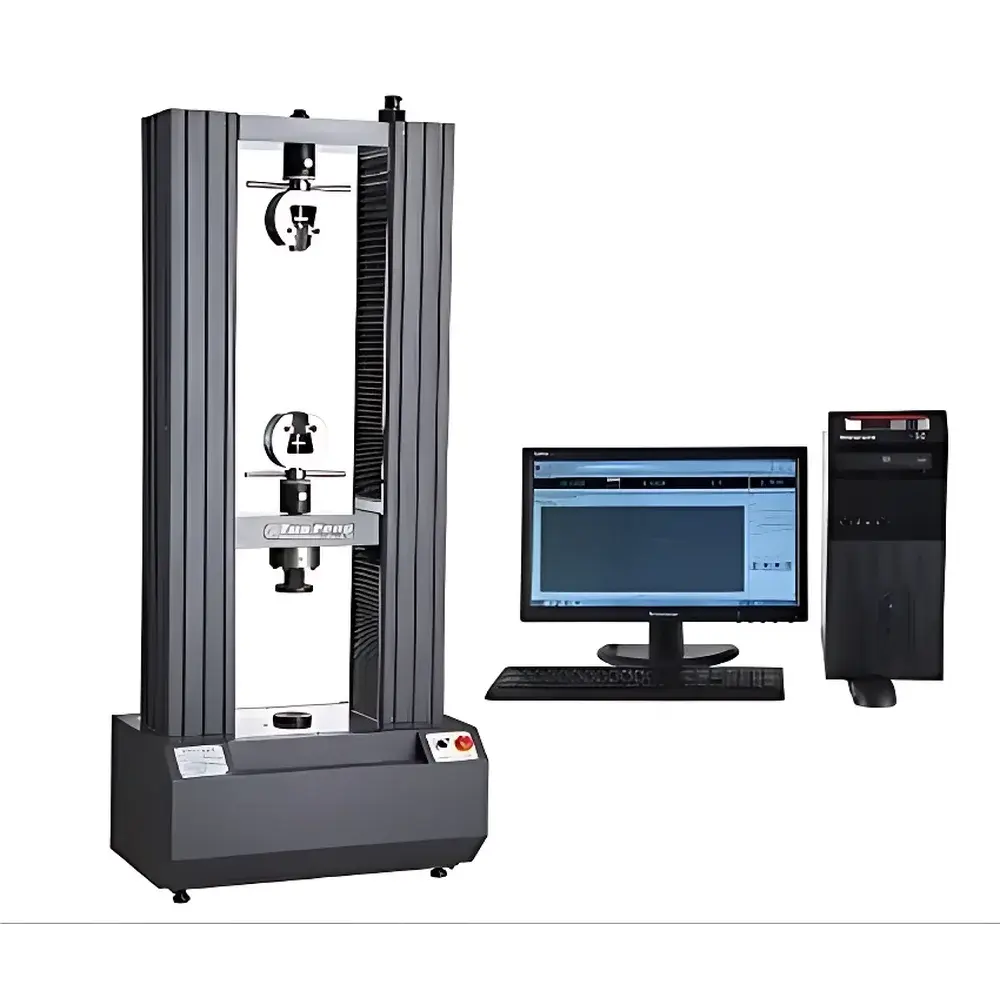
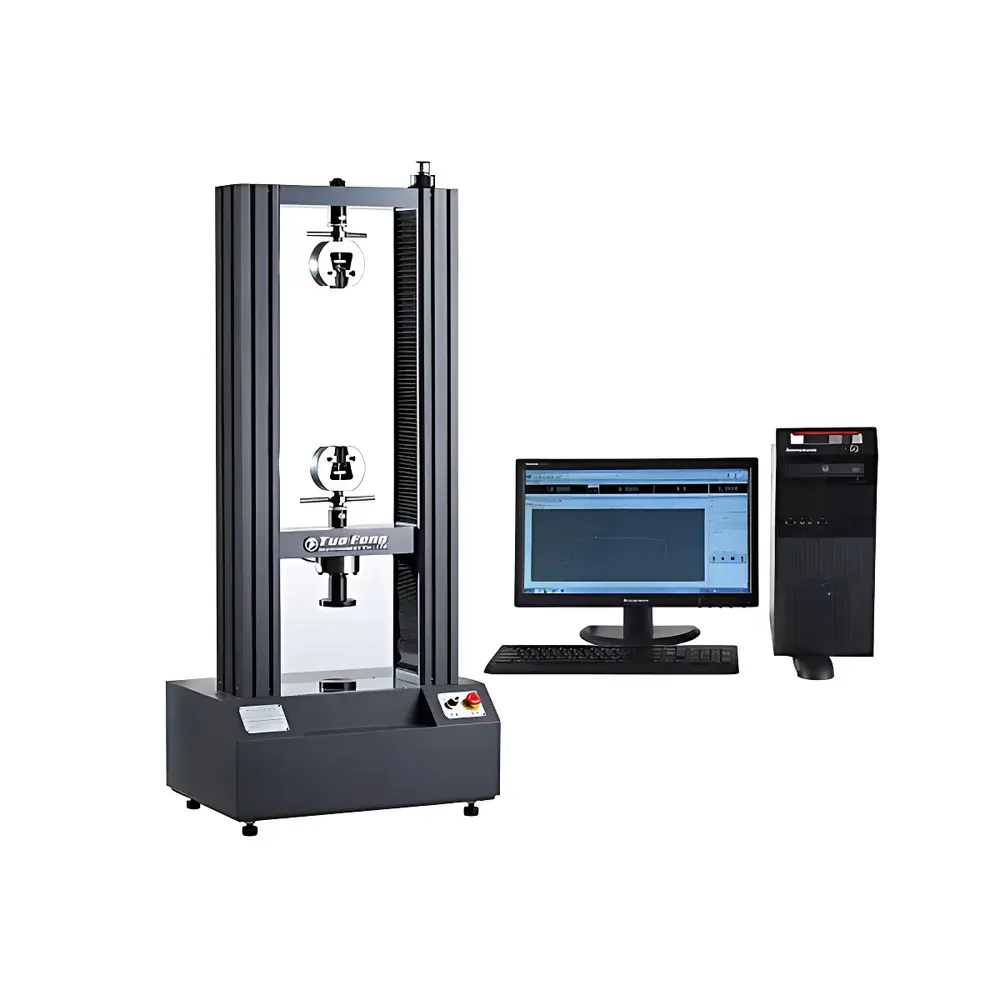
Tuofeng TFW-42 Dual-Column Microcomputer-Controlled Electronic Universal Testing Machine
| Brand | Tuofeng |
|---|---|
| Origin | Shanghai, China |
| Manufacturer Type | Direct Manufacturer |
| Instrument Type | Electromechanical Universal Testing Machine |
| Model | TFW-42 |
| Max Test Load | 42 kN (typical configuration within TFW-S series) |
| Accuracy Class | ISO 7500-1 / ASTM E4 Class 0.5 |
| Compliance | GB/T 16491–2008, JJG 475–2008, ISO 6892-1, ASTM E8/E9/E21/E292, EN 10002-1 |
| Control System | Closed-loop servo motor + precision ball screw |
| Test Speed Range | 0.001–500 mm/min (infinitely variable) |
| Force Resolution | 1/500,000 full scale (no range switching) |
| Displacement & Strain Accuracy | ±0.005% of reading |
| Effective Test Width | 400 mm (expandable to 600 mm) |
| Vertical Travel | 800 mm (extendable) |
| Safety Protection | Dual electronic limit switches, emergency stop, overload cutoff (>110% F.S.), automatic return function |
| Software | Multi-language (EN/CN/TC), GLP-compliant audit trail, CFR 21 Part 11 ready (optional), real-time multi-curve plotting (load-time, stress-strain, displacement-time, etc.), automated parameter calculation per ISO 527, ASTM D638/D790/D1709/D903, and GB/T standards |
Overview
The Tuofeng TFW-42 is a dual-column, microcomputer-controlled electromechanical universal testing machine engineered for high-fidelity mechanical property characterization of metallic, polymeric, composite, and ceramic materials. Based on closed-loop servo control architecture and calibrated force transduction via high-stability load cells, the system implements quasi-static uniaxial loading in accordance with ISO 7500-1 Class 0.5 and ASTM E4 Class 0.5 accuracy requirements. Its modular mechanical design—featuring imported servo motors, precision-ground ball screws, and rigid cast-iron frame construction—ensures long-term dimensional stability, minimal deflection under load, and reproducible test conditions across thousands of cycles. The TFW-42 serves as a foundational platform for R&D laboratories, quality control departments, and third-party certification bodies requiring traceable, standards-aligned mechanical data generation.
Key Features
- Dual-column structural rigidity optimized for axial alignment and lateral stability during high-force compression and tensile tests
- Full-scale force resolution of 1 part in 500,000 without range switching—enabling seamless transition from low-force peel or film tensile to high-load metal yield testing
- Infinitely variable crosshead speed (0.001–500 mm/min) with dynamic response time <20 ms for precise strain-rate control in creep, relaxation, and rate-dependent material studies
- Integrated dual-safety architecture: hardware-based emergency stop circuitry, programmable software limits, and mechanical overload cutoff at 110% of rated capacity
- Motorized crosshead with dual-speed positioning (fast jog + fine adjustment) and auto-return functionality to pre-test origin upon cycle completion
- Modular extensometry support—including clip-on electronic extensometers (ASTM E83 Class B-1) and non-contact video extensometers—for compliant strain measurement per ISO 9513 or ASTM E83
Sample Compatibility & Compliance
The TFW-42 accommodates specimens ranging from thin polymer films (≥0.05 mm thick) to structural steel coupons (up to 40 mm thickness), with optional custom fixtures for ASTM D638 Type I–V, ISO 527-2, GB/T 1040, ASTM D790 flexural bars, ASTM D1709 tear propagation, and ASTM D903 peel configurations. All mechanical and software functions comply with national and international metrological and procedural standards, including GB/T 16491–2008 (Chinese standard for UTM design), JJG 475–2008 (verification regulation), ISO 6892-1 (tensile testing of metals), ASTM E8/E9 (tension/compression of metallic materials), ASTM D638/D790/D1709/D903 (polymer-specific methods), and EN 10002-1. Calibration certificates are NIST-traceable and include uncertainty budgets per ISO/IEC 17025 requirements.
Software & Data Management
The embedded Windows-based test software provides full GLP compliance: user-level access control, electronic signatures, audit trail logging (with timestamped operator actions, parameter changes, and result modifications), and CFR 21 Part 11 readiness when configured with digital signature modules. Real-time visualization includes synchronized multi-axis plots (load vs. time, stress vs. strain, displacement vs. time), automatic detection of yield point, ultimate tensile strength, modulus, elongation at break, and secant modulus. Data export supports CSV, XML, and PDF report generation with embedded metadata (test ID, operator, calibration date, environmental conditions). Raw data files retain full-resolution encoder and load cell traces for retrospective reanalysis. Firmware and software updates are delivered remotely with version-controlled release notes and backward-compatible file format preservation.
Applications
The TFW-42 supports standardized mechanical testing across diverse industrial sectors: tensile and compressive evaluation of aerospace aluminum alloys (per AMS 2355), flexural analysis of carbon-fiber-reinforced polymers (per ASTM D7264), peel strength quantification of medical device adhesive laminates (per ISO 11607-2), tear resistance of packaging films (per ASTM D1938), bond strength of powder metallurgy sintered compacts (per MPIF Standard 40), and modulus determination of elastomeric seals used in automotive powertrain systems. It is routinely deployed in university materials science labs for undergraduate mechanics instruction and graduate-level constitutive modeling validation, as well as in ISO/IEC 17025-accredited testing facilities performing contract work for CE marking, FDA 510(k), or ASME BPVC Section II material qualification.
FAQ
What standards does the TFW-42 support out-of-the-box?
The system ships pre-configured test methods for ISO 6892-1, ASTM E8, ASTM D638, ASTM D790, GB/T 228.1, and GB/T 1040. Additional methods can be added via software module import.
Is the force sensor calibrated and certified?
Yes—each unit includes a factory calibration certificate traceable to NIM (China National Institute of Metrology) with uncertainty reporting per ISO/IEC 17025 Annex A.
Can the system interface with LIMS or MES platforms?
It supports OPC UA and TCP/IP-based data streaming for integration into laboratory information management systems (LIMS) and manufacturing execution systems (MES) using configurable JSON or XML payloads.
What is the warranty and service coverage?
Tuofeng provides a 24-month comprehensive warranty covering parts, labor, and on-site calibration verification; extended service contracts include annual performance verification and preventive maintenance.
Are third-party extensometers supported?
Yes—the controller features analog and digital input channels compatible with major OEM extensometers (e.g., MTS, Zwick, Instron) meeting ASTM E83 or ISO 9513 specifications.



