
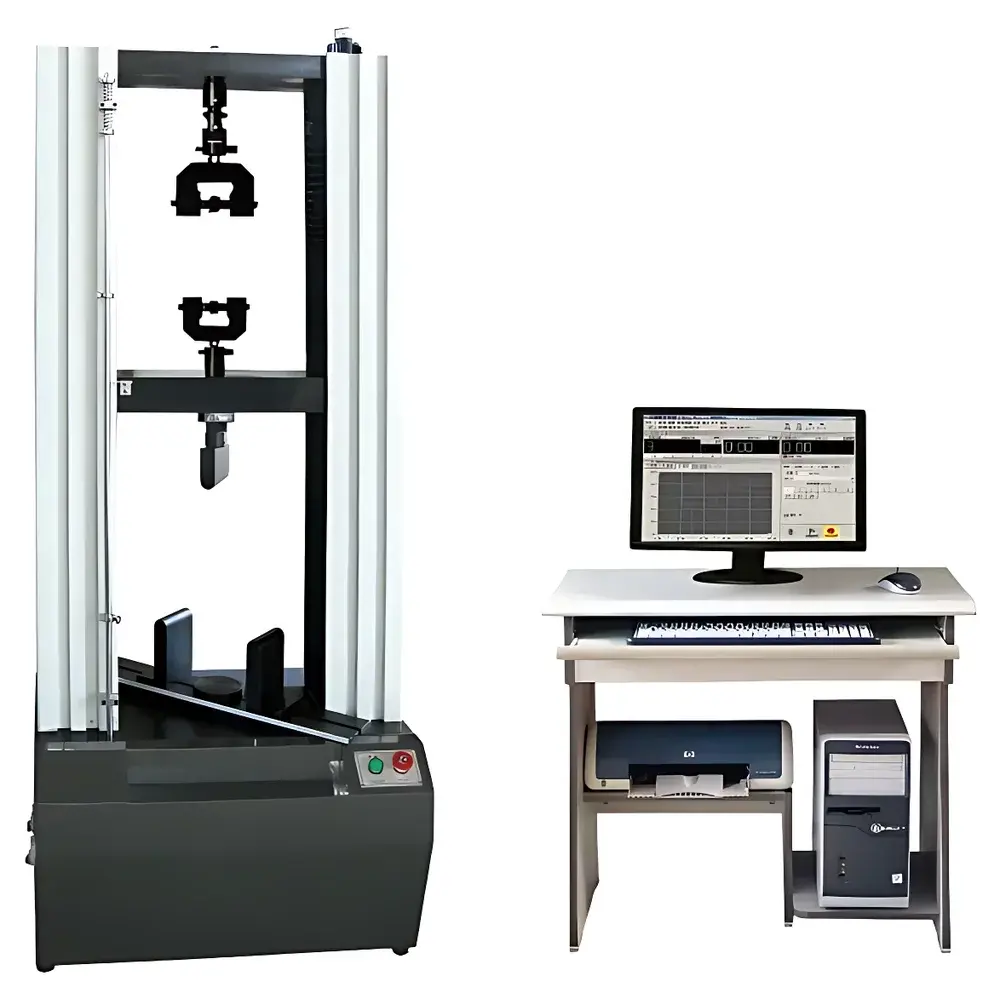
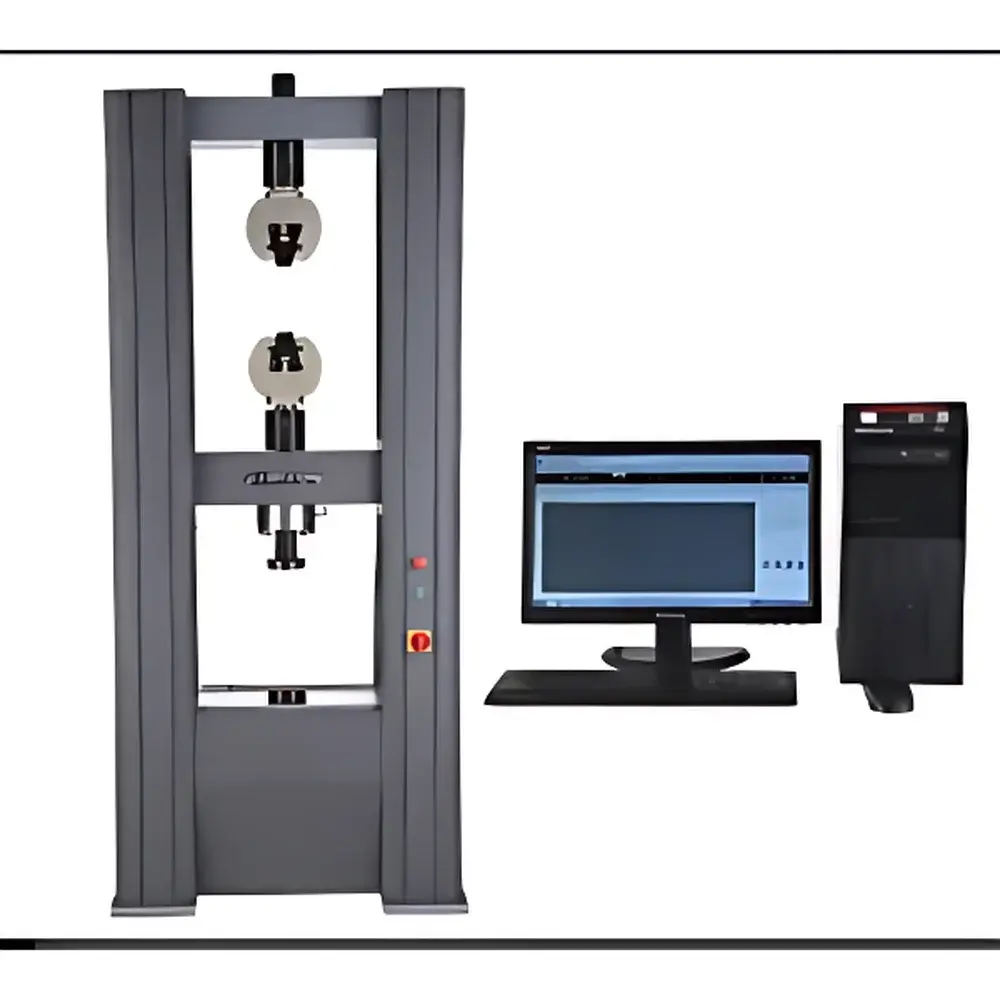
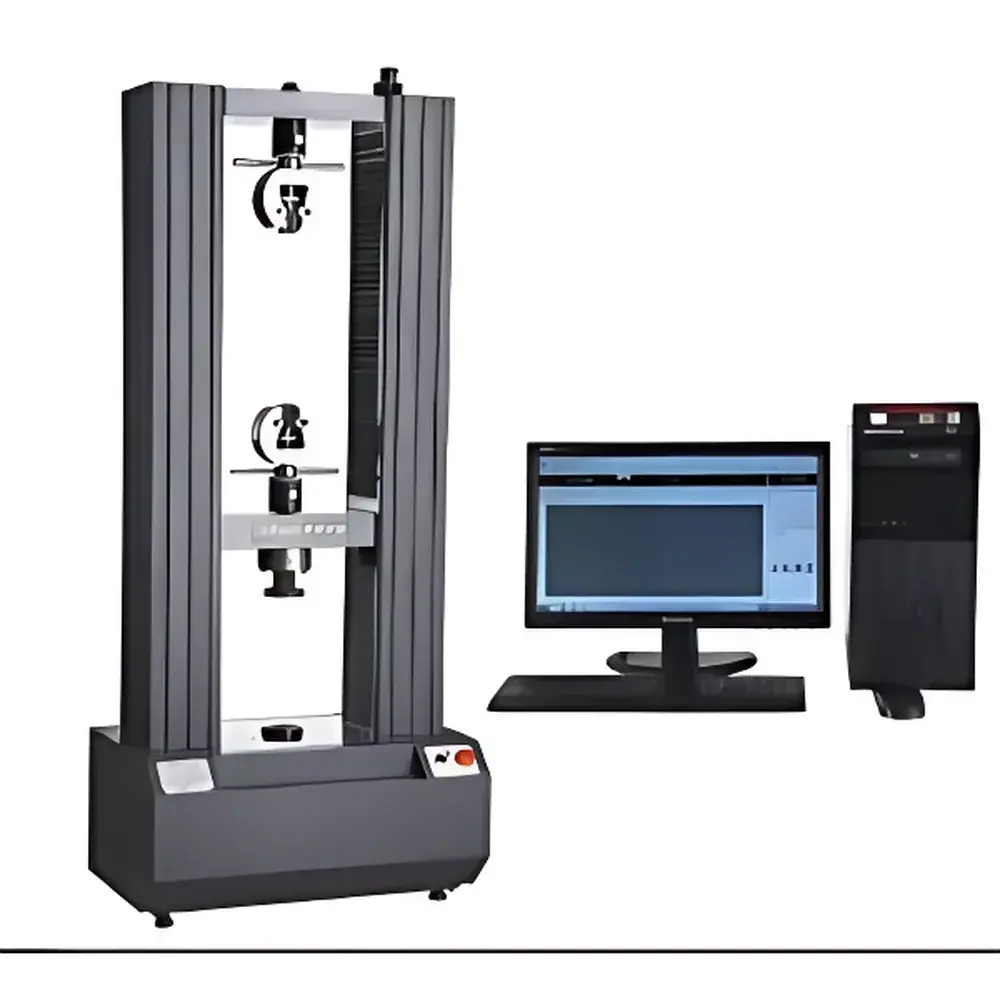
TuoFeng TFW-50S Computer-Controlled Universal Testing Machine for Wood-Based Panels
| Brand | TuoFeng |
|---|---|
| Origin | Shanghai, China |
| Manufacturer Type | Direct Manufacturer |
| Region of Origin | Domestic (China) |
| Model | TFW-50S |
| Quotation | Upon Request |
| Max. Test Load | 50 kN |
| Load Measurement Range | 0.4%–100% of Full Scale |
| Load Accuracy | ±0.5% of Indicated Value |
| Crosshead Speed | 0.01–500 mm/min (infinitely variable) |
| Test Width | 400 mm |
| Tensile Travel | 800 mm |
| Dimensions (W×D×H) | 760 × 500 × 1750 mm |
| Weight | 500 kg |
Overview
The TuoFeng TFW-50S Computer-Controlled Universal Testing Machine is an engineered solution designed specifically for mechanical property evaluation of wood-based panel materials—including plywood, particleboard, medium-density fiberboard (MDF), oriented strand board (OSB), and laminated veneer lumber (LVL). Built upon a rigid dual-column frame architecture with high-stiffness load train components, the system operates on the principle of controlled uniaxial force application under displacement or load control modes. It complies with core international test standards including ISO 16978 (wood-based panels — determination of modulus of elasticity in bending), ISO 16979 (determination of internal bond strength), EN 319 (determination of tensile strength perpendicular to the plane), and ASTM D1037 (standard test methods for evaluating properties of wood-base fiber and particle panel materials). The machine integrates precision load cell feedback, high-resolution encoder-based position sensing, and real-time closed-loop servo control to ensure repeatability and traceability across production QC and third-party certification environments.
Key Features
- Full Chinese-language menu interface with intuitive navigation—optimized for operators in domestic manufacturing and inspection laboratories without requiring advanced programming literacy.
- Real-time graphical display of stress–strain curves, elastic modulus evolution, and characteristic yield/peak points during testing.
- Automated calculation and reporting of standardized mechanical parameters: static bending strength (MOR), modulus of elasticity (MOE), surface bonding strength, internal bond strength (IB), surface glue bond strength, and tensile strength perpendicular to the plane.
- Programmable mechanical limit switches and software-defined displacement boundaries to prevent over-travel and protect both specimen integrity and actuator longevity.
- Automatic zero-point calibration and return-to-start functionality after each test cycle—reducing manual intervention and operator-induced variability.
- Infinitely variable crosshead speed control from 0.01 to 500 mm/min, enabling compliance with diverse standard test protocols that specify distinct loading rates (e.g., 2 mm/min for IB tests per EN 319 vs. 10 mm/min for MOR per ISO 16978).
- Multi-sensor calibration support: accommodates up to three calibrated load cells (e.g., 5 kN, 20 kN, 50 kN), allowing seamless transition between low-force surface adhesion tests and high-load structural bending evaluations on a single platform.
Sample Compatibility & Compliance
The TFW-50S accepts standard specimen geometries defined in ISO, EN, and ASTM panel testing standards—such as 20 mm × 50 mm × 500 mm strips for MOR/MOE, 50 mm × 50 mm squares for IB, and 25 mm × 75 mm coupons for surface bonding assessments. Its 400 mm test width and 800 mm vertical travel accommodate full-thickness commercial panels up to 32 mm thick. All test procedures align with GLP-aligned documentation requirements: audit trails record operator ID, timestamp, calibration status, environmental conditions (if integrated with optional hygrothermal sensors), and raw force/displacement data at ≥100 Hz sampling rate. Data export supports CSV and XML formats compatible with LIMS integration and FDA 21 CFR Part 11–compliant electronic signature workflows when paired with validated software modules.
Software & Data Management
The proprietary TuoFeng TestSuite v3.x software provides ISO/IEC 17025–oriented test method templates, customizable report generation (PDF/Excel), and built-in uncertainty estimation per GUM principles. Raw data files retain full metadata—including sensor serial numbers, calibration expiration dates, and environmental monitoring logs. Version-controlled test methods can be locked against unauthorized modification; user access levels are configurable (operator, supervisor, administrator) with password-protected parameter editing rights. Audit logs capture all critical actions: test initiation, result approval, calibration events, and firmware updates—ensuring full traceability for accreditation audits.
Applications
- Quality assurance in continuous production lines of engineered wood manufacturers.
- Third-party certification testing for CE marking (EN 13986), CARB ATCM compliance, and JIS A 5908 verification.
- R&D validation of adhesive formulations, resin content optimization, and fiber orientation effects on mechanical performance.
- Forensic analysis of field-failure specimens in construction litigation cases involving delamination or flexural collapse.
- Educational use in university materials science labs for hands-on instruction in composite mechanics and standardization frameworks.
FAQ
Does the TFW-50S comply with ASTM D1037 and ISO 16978?
Yes—the system’s control algorithms, load cell accuracy (±0.5%), and displacement resolution meet the minimum metrological requirements specified in both standards.
Can test data be exported to external LIMS or ERP systems?
Yes—via configurable ODBC drivers and structured CSV/XML outputs with embedded metadata fields required for automated ingestion.
Is remote calibration verification supported?
Calibration certificates include NIST-traceable reference values; remote verification is enabled through encrypted firmware-signed diagnostic routines accessible via secure VPN.
What maintenance intervals are recommended for long-term accuracy?
Load cell and encoder recalibration is advised annually or after 10,000 test cycles; mechanical alignment checks should occur quarterly per ISO 7500-1 Class 1 verification protocol.



