
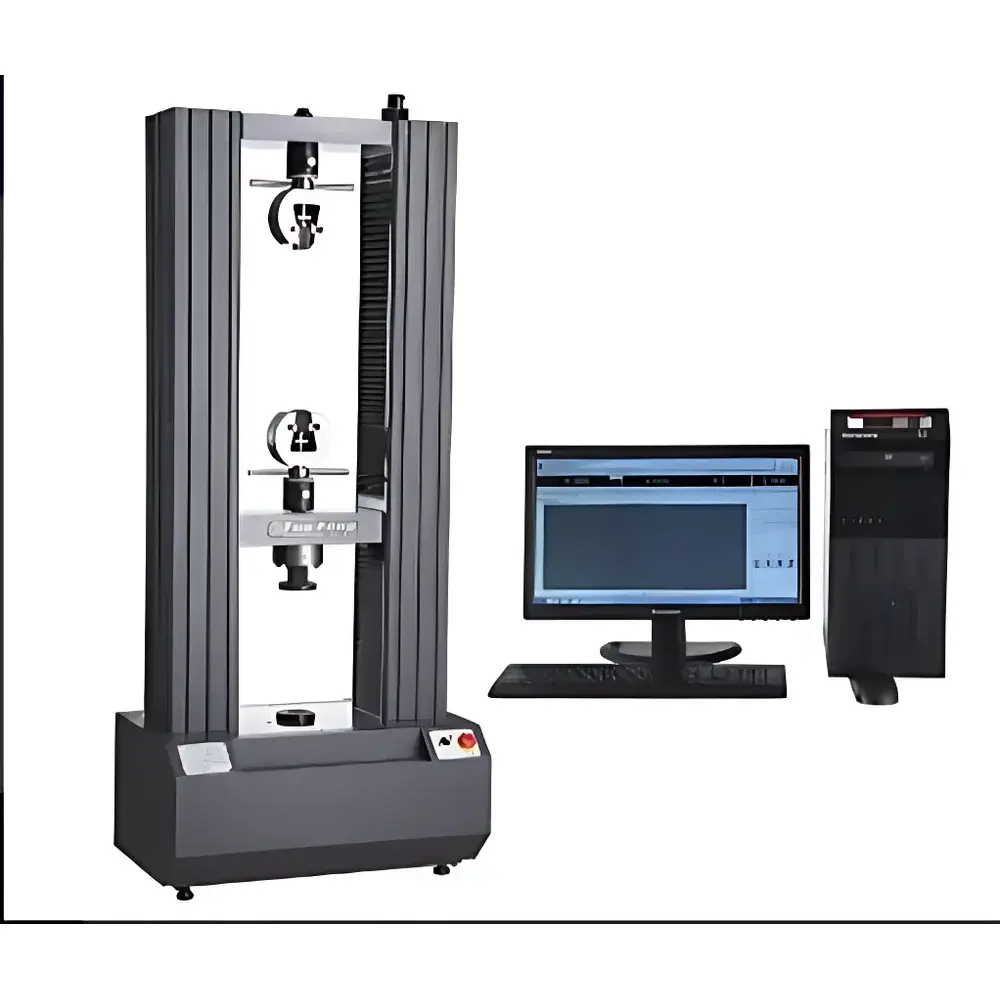
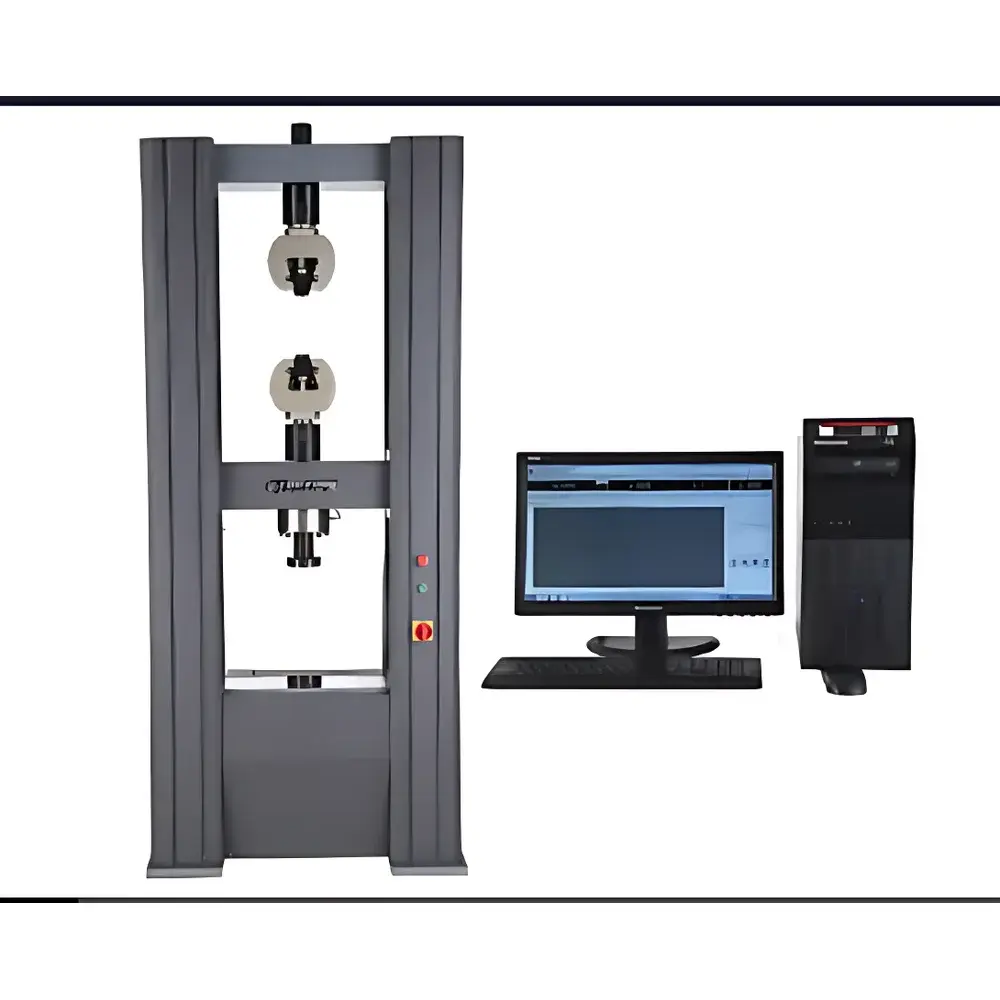
Tuofeng TFW-78 Microcomputer-Controlled Electromechanical Tensile Testing Machine
| Brand | Tuofeng |
|---|---|
| Origin | Shanghai, China |
| Manufacturer Type | Direct Manufacturer |
| Model | TFW-78 |
| Instrument Type | Electromechanical Universal Testing Machine |
| Maximum Test Load | 200 kN |
| Force Measurement Range | 1 kg to 200 kN (0.2%–100% of full scale) |
| Force Accuracy | ±0.5% of reading |
| Crosshead Travel | 1000 mm |
| Displacement Resolution | 0.001 mm |
| Control System | Windows-based microcomputer control with multi-mode test programming (load-controlled, displacement-controlled, time-controlled) |
| Compliance | GB/T 16491–2008, JJG 475–2008, ASTM E4, ASTM E8, ISO 6892-1, ISO 7500-1, DIN 51221, JIS Z 2241, BS EN ISO 6892-1 |
Overview
The Tuofeng TFW-78 is a high-precision electromechanical universal testing machine engineered for static mechanical property characterization of metallic, polymeric, composite, and elastomeric materials under uniaxial loading conditions. Based on the principle of controlled displacement actuation via servo-motor-driven ball-screw transmission, it delivers stable, repeatable force application across its full 200 kN capacity range. The system adheres to international metrological traceability standards—calibrated per ISO 7500-1 Class 0.5—and supports rigorous compliance workflows required in regulated environments including GLP, GMP, and ISO/IEC 17025-accredited laboratories. Its modular architecture enables seamless integration of extensometers, environmental chambers, and custom fixtures for standardized tensile, compression, bending, shear, tear, peel, and puncture testing.
Key Features
- High-resolution load measurement with ±0.5% accuracy over 0.2–100% FS, achieved through temperature-compensated load cell technology and 24-bit analog-to-digital conversion.
- Ultra-fine displacement resolution of 0.001 mm, supported by optical encoder feedback and dual-speed crosshead positioning (fast approach + precision test speed).
- Wide speed range: 0.001–500 mm/min, continuously adjustable without gear shifting—enabling both quasi-static creep tests and high-rate dynamic response evaluation.
- Robust mechanical design featuring preloaded high-precision ball screws, rigid cast-iron frame, and dual-column structural symmetry to minimize deflection and ensure axial alignment within ±0.02 mm/m.
- Integrated safety architecture: electronic limit switches, emergency stop circuitry, overload protection (110% FS cutoff), and programmable soft limits prevent mechanical damage and operator hazard.
- Modular fixture interface compatible with standardized wedge-action grips, pneumatic clamps, bend fixtures, and custom tooling per ASTM D638, ISO 527, ISO 37, and ASTM D1876 specifications.
Sample Compatibility & Compliance
The TFW-78 accommodates specimens ranging from thin polymer films (≥0.05 mm thickness) to structural steel coupons (up to 60 mm width × 25 mm thickness). Its 400 mm standard test width (expandable to 600 mm) and 1000 mm vertical travel support ASTM D3039 composite coupon testing, ISO 527-2 multipurpose bars, and ASTM D638 Type I–V dogbone geometries. All hardware and firmware comply with GB/T 16491–2008 (Chinese national standard for electronic universal testers), JJG 475–2008 (verification regulation), and harmonized international standards including ASTM E4 (force verification), ASTM E8/E21 (tensile testing of metals), ISO 6892-1 (metallic materials), and ISO 527-1 (plastics). Calibration certificates are traceable to NIM (National Institute of Metrology, China) or equivalent national metrology institutes.
Software & Data Management
The proprietary Windows-based testing software provides full audit-trail capability compliant with FDA 21 CFR Part 11 requirements—including user-level access control, electronic signatures, and immutable test log archiving. It supports seven real-time display modes: load–time, load–displacement, stress–strain, displacement–time, strain–time, load–extension, and dual-curve overlay. Automated parameter extraction includes ultimate tensile strength (UTS), yield strength (0.2% offset), Young’s modulus, elongation at break, reduction in area, compressive yield, flexural modulus, tear propagation resistance, and peel adhesion energy. Data export formats include CSV, XML, PDF report templates, and direct SQL database logging. Software modules support batch processing, statistical analysis (mean, SD, CV%), comparative curve superposition, and customizable report generation per ISO/IEC 17025 clause 7.8.2.
Applications
The TFW-78 serves as a primary mechanical characterization platform in quality control labs, R&D centers, and third-party certification bodies. Typical use cases include: tensile validation of injection-molded PP/ABS automotive interior trim; compression testing of PU foam seating components per ISO 3386; peel strength assessment of pressure-sensitive adhesive tapes (ASTM D3330); flexural modulus determination of carbon-fiber-reinforced thermoplastics (ISO 178); and tensile property mapping of extruded HDPE pipes per ISO 6259. It is routinely deployed in aerospace material qualification (AMS 2750, MIL-STD-810), medical device polymer verification (ISO 10993-12), and wire-and-cable insulation mechanical screening (UL 1581, ICEA T-28-520).
FAQ
What standards does the TFW-78 support out-of-the-box?
It natively implements test methods from GB/T, ASTM, ISO, DIN, JIS, and BS standards—including automatic calculation of parameters defined in ASTM D638, ISO 527, ISO 6892-1, and ASTM E8.
Can the system be validated for GLP/GMP compliance?
Yes—the software includes 21 CFR Part 11-compliant audit trails, role-based permissions, electronic signature support, and calibration documentation management.
Is extensometer integration available?
Yes—both clip-on electronic extensometers (for modulus and yield measurement) and non-contact video extensometry systems can be interfaced via standard analog/digital I/O ports.
What is the warranty and service coverage?
Tuofeng provides a 24-month parts-and-labor warranty, lifetime technical support, and free software updates for the duration of ownership.
How is force calibration performed and verified?
Calibration follows ISO 7500-1 using certified deadweight standards traceable to NIM; verification reports include linearity, hysteresis, and repeatability data per load point.



