
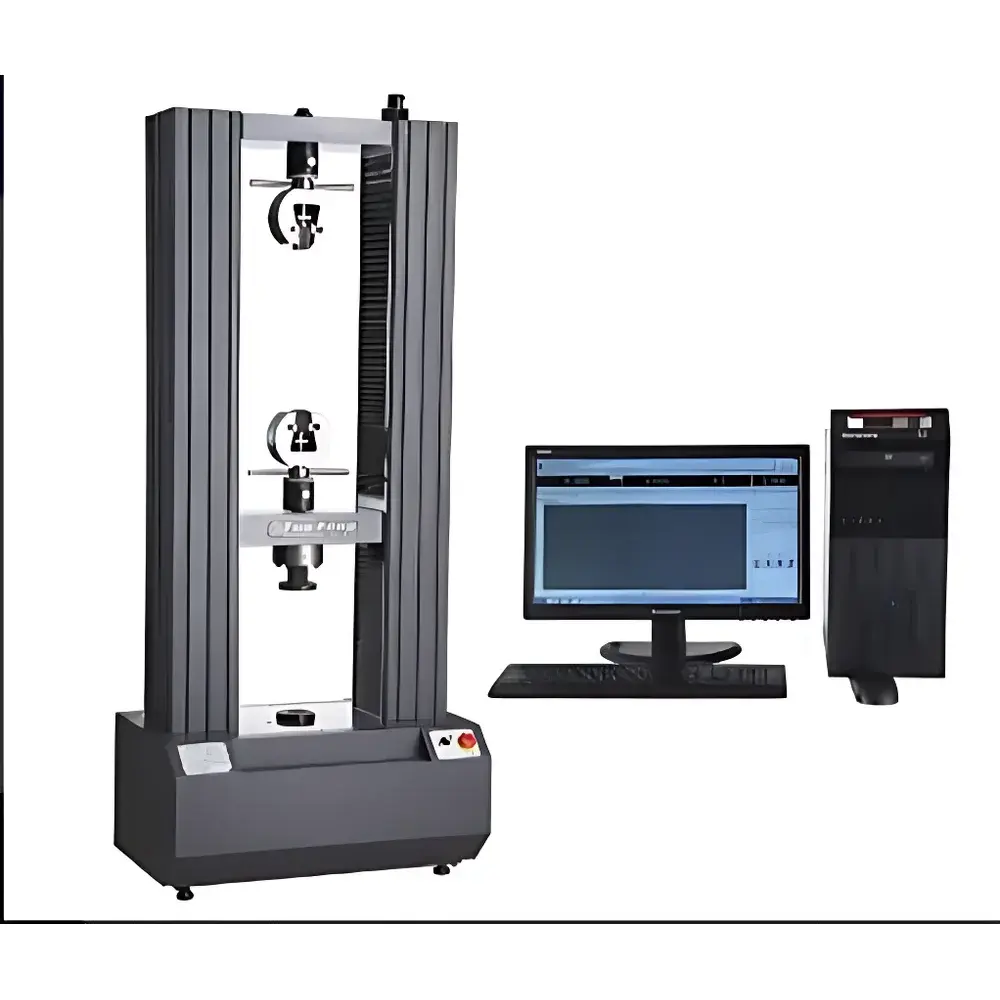
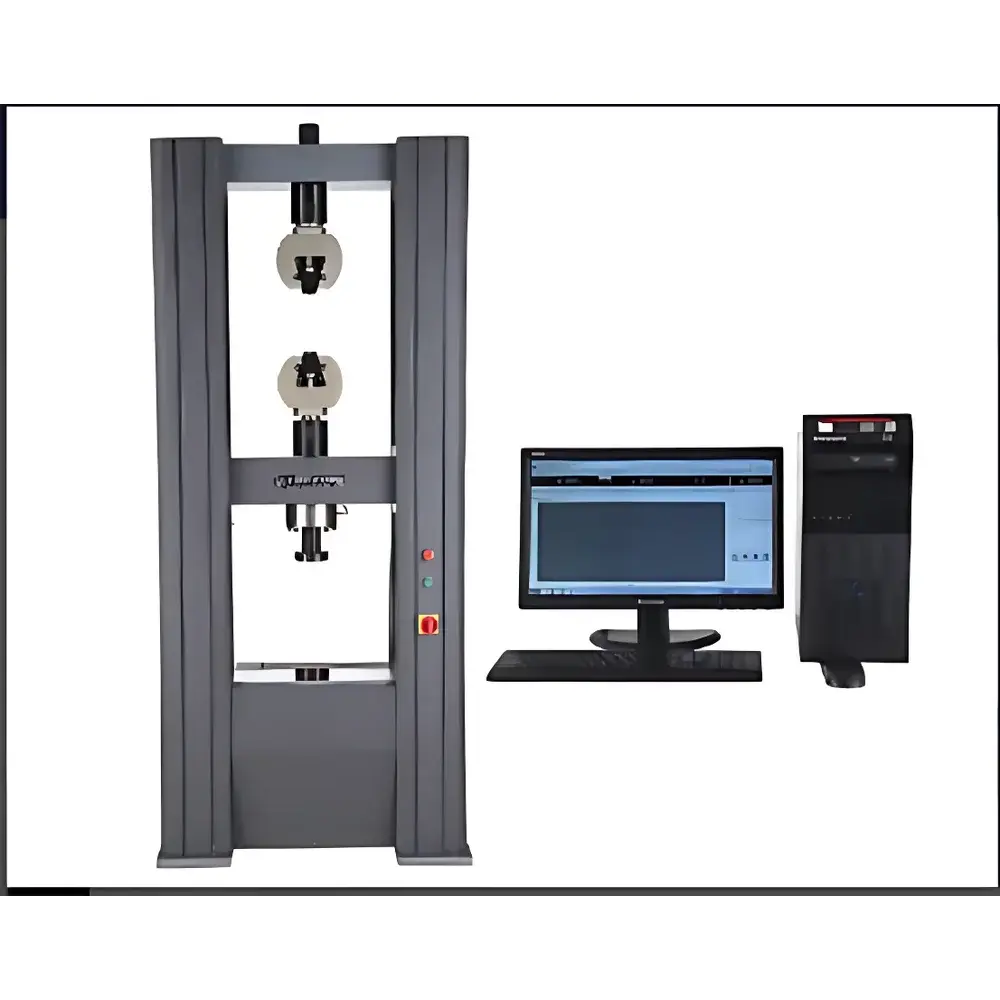
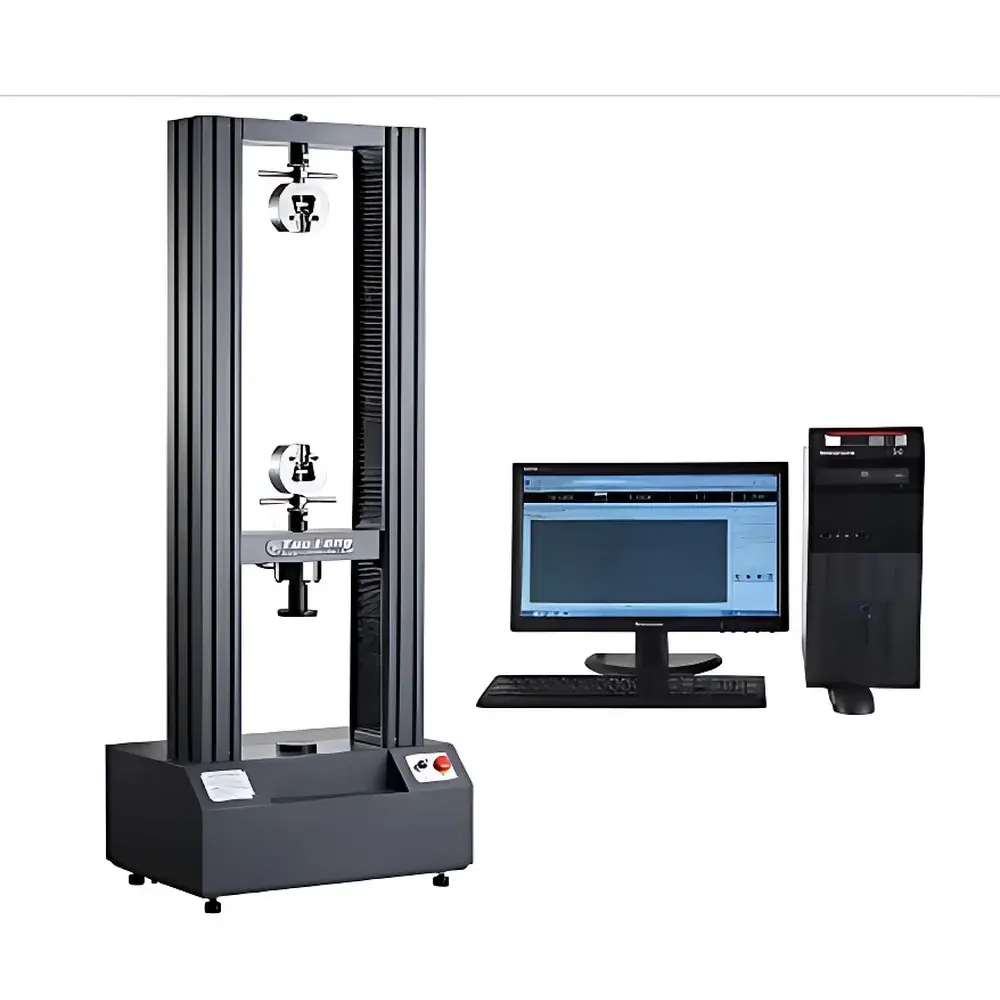
Tuofeng TFW-89 Universal Testing Machine for Wood and Composite Materials
| Brand | Tuofeng |
|---|---|
| Origin | Shanghai, China |
| Manufacturer Type | Direct Manufacturer |
| Instrument Type | Electromechanical Universal Testing Machine |
| Model | TFW-89 |
| Force Capacity | 10 kN (configurable up to 200 kN) |
| Accuracy Class | 0.5 |
| Effective Force Range | 0.2–100% of full scale |
| Force Measurement Accuracy | ±0.005% of reading |
| Resolution | 1 part in ±500,000 full-scale codes (no range switching) |
| Drive System | Imported servo motor with precision worm-gear reducer |
| Lead Screw | High-accuracy preloaded ball screw |
| Effective Test Width | 500 mm (customizable) |
| Max Stroke | 800 mm (extendable) |
| Speed Range | 0.001–500 mm/min (infinitely variable) |
| Displacement Measurement | Optical encoder, accuracy ±0.005% of reading |
| Strain Measurement | Optional extensometer or large-deformation transducer, accuracy ±0.005% of reading |
| Safety Protection | Electronic limit switches, emergency stop, overload protection (>110% FS), dual-speed motorized crosshead control |
| Software | Multi-language (EN/CN/TC), compliant with ASTM E4, ISO 7500-1, GB/T 16491-2008, JJG 475-2008, supports GLP/GMP audit trail configuration |
| Compliance | Meets requirements for ASTM D143, D1037, D1435, ISO 3133, ISO 13061 series, EN 338, EN 16351, and JIS Z 2101 for wood mechanical characterization |
Overview
The Tuofeng TFW-89 Universal Testing Machine is an electromechanical static testing system engineered for high-fidelity mechanical property evaluation of solid wood, engineered timber products (e.g., CLT, glulam, LVL), wood-based composites (MDF, particleboard, OSB), and hybrid bio-based structural materials. It operates on the principle of controlled uniaxial force application—via a precision servo-driven crosshead—and synchronized measurement of load, displacement, and optional strain—to determine fundamental mechanical parameters including modulus of elasticity (MOE), modulus of rupture (MOR), compressive strength parallel/perpendicular to grain, shear strength, cleavage resistance, and fastener embedment performance. Designed in strict accordance with GB/T 16491-2008 and calibrated per JJG 475-2008, the TFW-89 delivers Class 0.5 accuracy per ISO 7500-1 and meets traceability requirements for accredited laboratories conducting structural timber certification per EN 14080 or ASTM D198.
Key Features
- High-resolution force measurement system with ±0.005% reading accuracy and true 500,000-count resolution across full scale—eliminating range-switching artifacts critical for low-force wood failure detection.
- Dual-speed motorized crosshead control (fast approach + fine positioning) ensures rapid specimen alignment and precise strain-rate control down to 0.001 mm/min—essential for creep and relaxation studies per ASTM D198 Annex A5.
- Modular load frame architecture supporting interchangeable fixtures: four-point bending jigs (ASTM D143), compression platens with self-aligning spherical seats (ISO 3133), shear blocks (ASTM D143 Method B), and tensile grips with pneumatic or wedge-action clamping (ASTM D3500).
- Integrated safety suite: hardware-based emergency stop, programmable electronic limits, real-time overload cutoff at 110% of rated capacity, and automatic return-to-start post-test.
- Thermally stable cast-iron base and rigid column assembly minimize frame deflection (<0.02 mm/kN), ensuring compliance with ISO 7500-1 linearity and hysteresis specifications under sustained loading.
Sample Compatibility & Compliance
The TFW-89 accommodates specimens from standard 20 × 20 × 300 mm clear-wood samples (ISO 3133) to full-size 150 × 150 × 3000 mm glued laminated beams (EN 338). Its 500 mm test width and 800 mm stroke support both small-clear-specimen testing and large-section structural element evaluation. The system is validated for use with all major wood species (softwoods: spruce, pine, fir; hardwoods: oak, beech, maple) and engineered products meeting EN 16351 (CLT), EN 14080 (glulam), and ANSI A190.1 (NDS). Full compliance includes ASTM D143 (small clear specimens), ASTM D1037 (panel materials), ISO 13061-1 through -14 (physical and mechanical properties of wood), and JIS Z 2101 (Japanese structural timber standards). Calibration certificates are NIST-traceable and include uncertainty budgets per ISO/IEC 17025.
Software & Data Management
The Windows-based TFW Control Suite v4.2 supports multi-modal testing protocols—including force-controlled ramp, displacement-controlled creep, hold-at-load, and cyclic fatigue—with full audit trail capability compliant with FDA 21 CFR Part 11 when configured with electronic signatures and user access levels. Real-time plotting includes stress–strain, load–displacement, and time-dependent curves (e.g., constant-load creep per ASTM D2915). All raw data (load, position, time, extensometer output) are stored in open ASCII format for third-party analysis. Reporting modules generate ISO/IEC 17025-compliant certificates with embedded metadata: operator ID, calibration date, environmental conditions (optional hygrothermal sensor integration), and uncertainty propagation per GUM. Software updates are provided free of charge for the instrument’s operational lifetime.
Applications
- Mechanical grading of sawn timber per EN 338 and ASTM D1990 using MOE–MOR correlation models.
- Quality assurance of cross-laminated timber (CLT) panels under in-plane shear (EN 16351 Annex D) and out-of-plane bending (EN 16351 §6.3.2).
- Characterization of adhesive bond strength in finger-jointed lumber (ASTM D5266) and laminated veneer lumber (LVL) delamination resistance (ASTM D5516).
- Creep and recovery behavior assessment of wood-plastic composites (WPC) per ASTM D6662 at elevated RH and temperature.
- Fastener withdrawal and lateral loading tests per ASTM D1761 and EN 1382 for timber connection design validation.
- Development and verification of constitutive models for finite element simulation of timber structures (e.g., Abaqus, ANSYS).
FAQ
Does the TFW-89 comply with international timber testing standards?
Yes—it is fully validated for ASTM D143, ISO 13061 series, EN 338, EN 16351, and JIS Z 2101, with documented traceability to national metrology institutes.
Can the system perform long-term creep tests under constant load?
Yes—the software supports hold-at-load protocols up to 1000 hours with automatic data logging at user-defined intervals and thermal drift compensation.
Is strain measurement included as standard?
No—extensometers (clip-on or video-based) and large-deformation transducers are optional accessories calibrated per ISO 9513; they are recommended for MOE determination per ISO 13061-2.
What maintenance is required to sustain 0.5-class accuracy?
Annual recalibration by an ISO/IEC 17025-accredited provider is recommended; routine verification using certified reference load cells and gauge blocks is performed quarterly.
Can test methods be exported/imported between laboratories?
Yes—test method templates (.tmt files), calibration profiles, and report formats are fully portable and interoperable across TFW-series instruments.



