
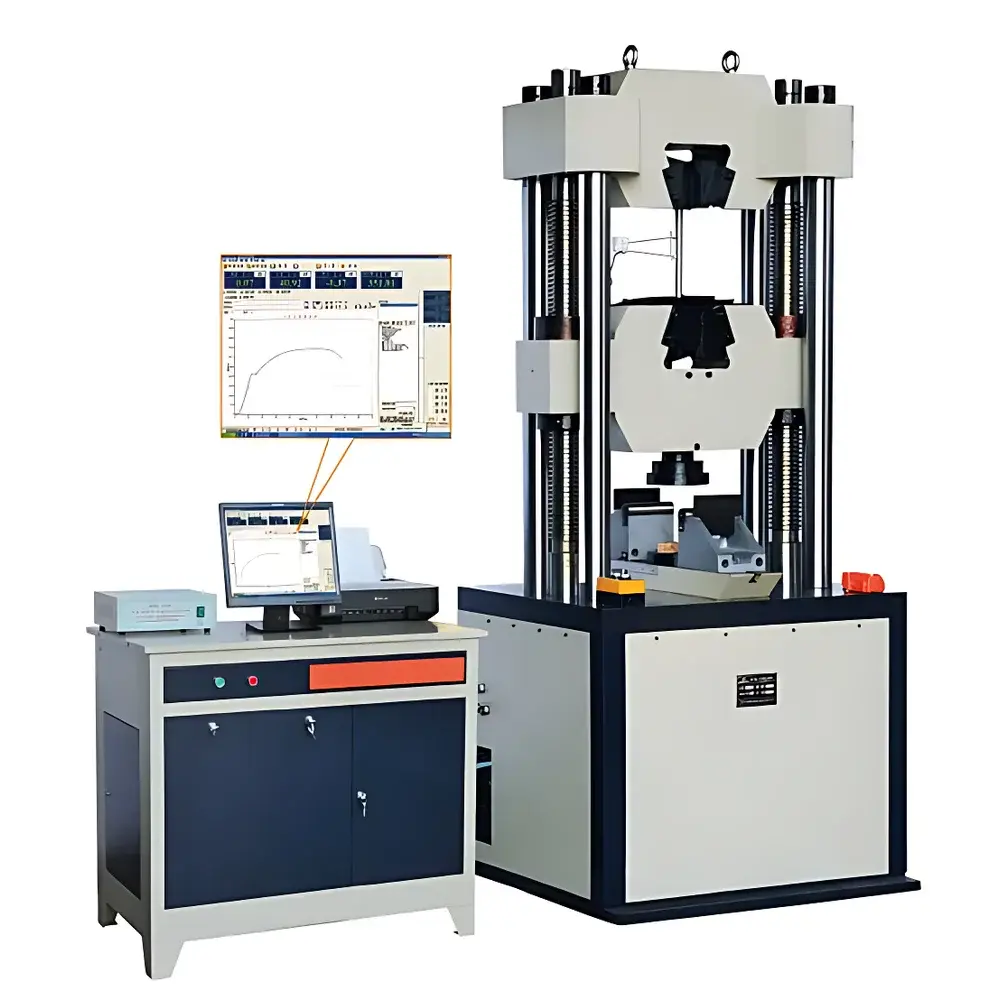
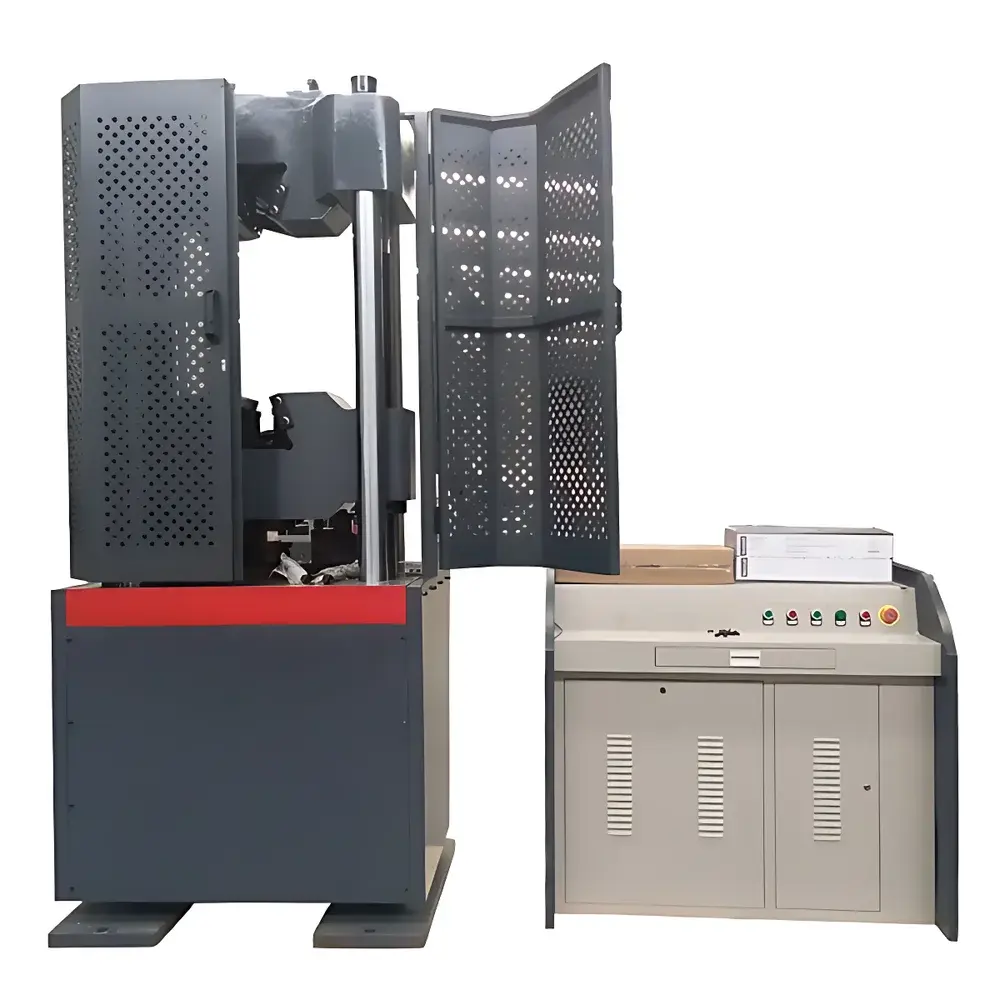
Tuofeng WAW-1000D Electro-Hydraulic Servo Universal Testing Machine
| Brand | Tuofeng |
|---|---|
| Origin | Shanghai, China |
| Manufacturer Type | Direct Manufacturer |
| Model | WAW-1000D |
| Test Force Capacity | 1000 kN |
| Force Measurement Range | 2–100% FS |
| Force Accuracy | ≤ ±1% of reading |
| Force Resolution | 0.01 kN |
| Displacement Resolution | 0.01 mm |
| Deformation Resolution | 0.01 mm |
| Max Tensile Space | 750 mm |
| Max Compression Space | 580 mm |
| Piston Stroke | 150 mm |
| Round Specimen Grip Range | Φ13–Φ40 mm |
| Flat Specimen Thickness Range | 0–15 mm |
| Flat Specimen Max Width | 75 mm |
| Compression Plate Size | 204 × 204 mm |
| Bend Span (Two-Point) | 450 mm |
| Bend Support Width | 140 mm |
| Bend Support Diameter | Φ40 mm |
| Max Piston Speed | 50 mm/min |
| Clamping Method | Automatic Hydraulic Clamping |
| Overall Dimensions (L×W×H) | 900 × 710 × 2200 mm |
| Control Cabinet Dimensions | 1000 × 700 × 1400 mm |
| Compliant Standards | GB/T 228.1–2021 (replacing GB 228–2002), ISO 6892-1, ASTM E8/E21, EN 10002-1 |
Overview
The Tuofeng WAW-1000D Electro-Hydraulic Servo Universal Testing Machine is a high-capacity, precision-engineered mechanical testing system designed for static tensile, compression, bending, and shear testing of metallic and non-metallic materials. Built on a robust oil-cylinder-underneath structural architecture, the machine delivers stable load application and high reproducibility across extended test cycles. Its core actuation principle relies on closed-loop electro-hydraulic servo control: a high-pressure hydraulic power unit—comprising a motor-driven axial piston pump, precision servo valve, differential pressure control manifold, and high-fidelity pressure transducers—enables real-time regulation of cylinder flow rate and direction. This architecture ensures strict adherence to programmed control modes including constant-rate force, constant-rate displacement, and constant-rate strain, essential for compliance with international mechanical testing protocols.
Key Features
- 1000 kN maximum test capacity with force measurement accuracy ≤ ±1% of reading over 2–100% full scale (FS), validated per ISO 7500-1 Class 1 requirements
- Oil-cylinder-underneath frame design optimizes gravitational alignment during tensile testing and simplifies specimen handling in compression and flexure configurations
- Motor-driven, chain-and-screw-driven crosshead positioning enables precise adjustment of test zones: up to 750 mm tensile space and 580 mm compression/bending clearance
- Automatic hydraulic clamping system with dual-range round-specimen grips (Φ13–Φ26 mm and Φ26–Φ40 mm) and flat-specimen jaws (0–15 mm thickness, 75 mm width)
- Dual-channel high-resolution measurement: displacement resolution 0.01 mm (via rotary encoder), deformation resolution 0.01 mm (via optional extensometer, e.g., YYU-25/50)
- Integrated safety interlocks: overload cutoff (>103% FS), upper/lower mechanical limit switches, and emergency stop circuit compliant with IEC 60204-1
Sample Compatibility & Compliance
The WAW-1000D accommodates standardized specimens per ASTM E8/E21 (metals), ISO 6892-1 (tensile), ISO 15630-1 (reinforcing steels), and GB/T 228.1–2021 (Chinese national standard, harmonized with ISO 6892-1). Compression plates (204 × 204 mm) and three-point bending fixtures (450 mm span, Φ40 mm rollers, 140 mm support width) meet dimensional tolerances specified in ISO 376 and ASTM E23. All force, displacement, and strain data acquisition pathways are traceable to national metrological standards; calibration certificates include uncertainty budgets aligned with ISO/IEC 17025 requirements. The system supports GLP-compliant audit trails when operated under controlled user privilege tiers (administrator/test operator).
Software & Data Management
The embedded Windows-based control software provides full test lifecycle management without third-party runtime dependencies. It features an open Excel-based reporting engine enabling customizable templates, formula-driven calculations (e.g., yield strength, modulus, elongation at break), and multi-specimen batch analysis. Real-time plotting includes synchronized force–displacement, stress–strain, force–time, and displacement–time curves with adjustable scaling and overlay functions. Data export supports CSV, XLSX, and XML formats for integration into LIMS or statistical process control (SPC) platforms. User access is governed by two-tier role-based permissions; all critical actions—including method modification, calibration update, and report finalization—are timestamped and logged with operator ID, satisfying FDA 21 CFR Part 11 electronic record requirements when configured with digital signature modules.
Applications
This system serves as a primary mechanical characterization tool in metallurgical R&D labs, construction materials QA/QC departments, aerospace component certification facilities, and academic mechanics laboratories. Typical use cases include: tensile property evaluation of structural steel grades (Q345, S355JR), compressive strength testing of concrete cylinders and ceramic tiles, flexural modulus determination of polymer composites per ISO 178, and high-force shear testing of welded joints or adhesive bonds. Its stability under sustained loading makes it suitable for creep pre-conditioning steps prior to dynamic testing on complementary systems.
FAQ
What standards does the WAW-1000D comply with for tensile testing?
It fully supports GB/T 228.1–2021, ISO 6892-1:2019, ASTM E8/E21, and EN ISO 10002-1, with programmable test profiles matching standard-defined ramp rates, hold periods, and failure detection logic.
Is the system compatible with external extensometers?
Yes—it includes analog and digital inputs for commercially available clip-on or non-contact extensometers (e.g., video-based or laser interferometric), with automatic channel synchronization and unit conversion.
Can test methods be exported and shared across multiple machines?
All test definitions—including control parameters, step sequences, pass/fail criteria, and report layouts—are stored as portable XML files and can be imported/exported without version dependency.
What maintenance intervals are recommended for the hydraulic power unit?
Oil filtration and level verification every 500 operating hours; full hydraulic oil replacement and servo valve inspection every 2,000 hours or annually, whichever occurs first, per ISO 4406:2022 cleanliness class requirements.
Does the software support automated pass/fail evaluation against specification limits?
Yes—users define upper/lower tolerance bands per output parameter (e.g., yield strength ≥ 350 MPa); results are color-coded and flagged in reports with deviation magnitude and statistical confidence indicators.



