
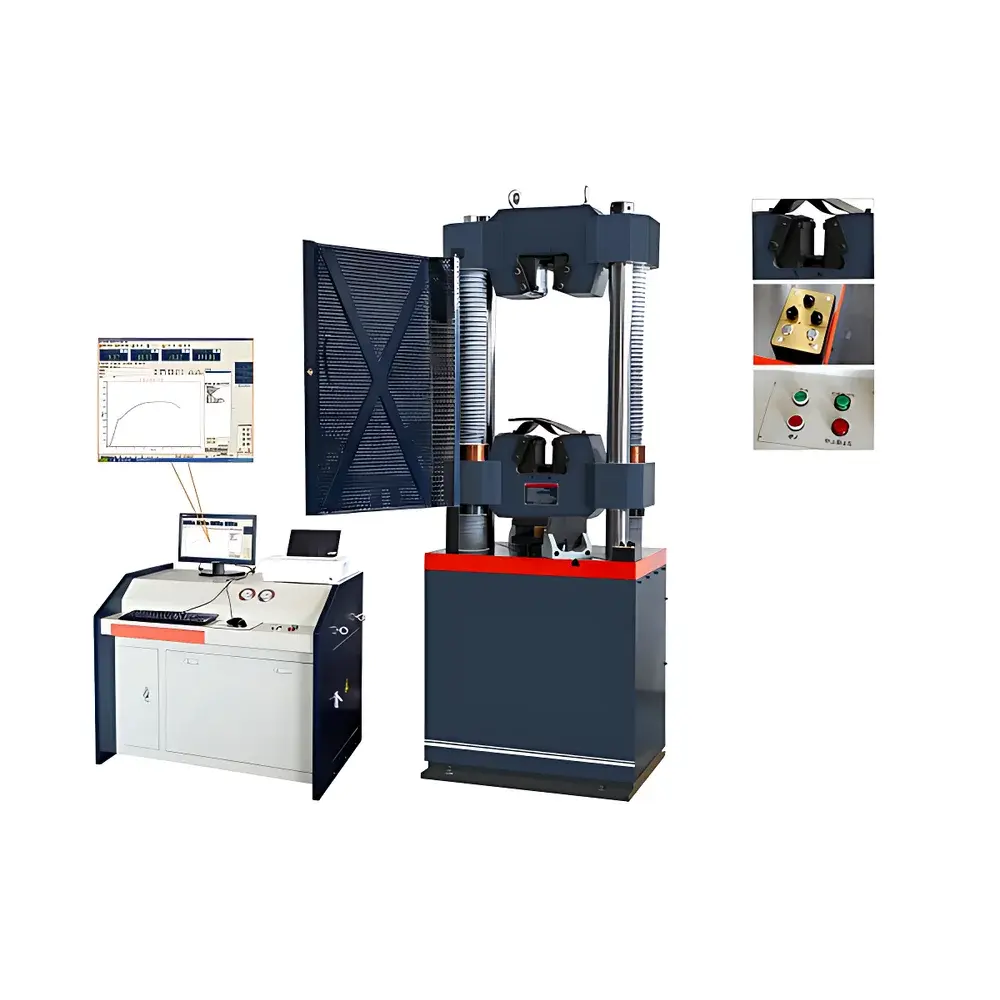
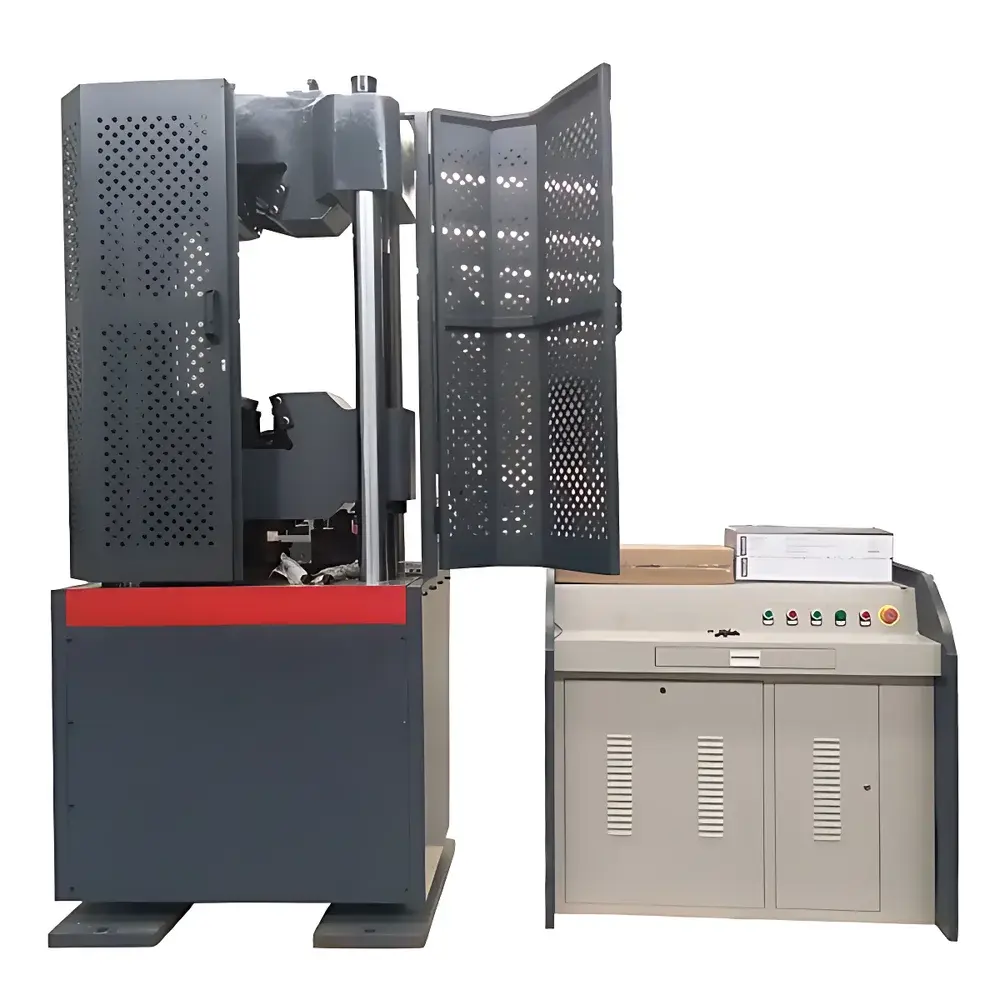
TuoFeng WAW-600D Microcomputer-Controlled Electro-Hydraulic Servo Universal Testing Machine
| Brand | TuoFeng |
|---|---|
| Origin | Shanghai, China |
| Manufacturer Type | Direct Manufacturer |
| Model | WAW-600D |
| Instrument Type | Electro-Hydraulic Servo Testing Machine |
| Max Load Capacity | 600 kN |
| Force Measurement Range | 1–100% of full scale |
| Force Resolution | 0.01 kN |
| Force Accuracy | ±1% of indicated value |
| Displacement Measurement | Optical encoder |
| Displacement Accuracy | ±1% of indicated value |
| Displacement Resolution | 0.01 mm |
| Tensile Space | 550 mm |
| Compression Space | 550 mm |
| Round Specimen Gripping Diameter | Φ13–40 mm |
| Flat Specimen Gripping Thickness | 0–15 mm |
| Clamping Method | Automatic hydraulic clamping |
| Piston Stroke | 250 mm |
| Maximum Piston Speed | 70 mm/min |
| Bending Support Roller Spacing | 30–500 mm |
| Bending Support Roller Width | 140 mm |
| Maximum Allowable Deflection | 100 mm |
| Shear Specimen Diameter | Φ10 mm |
| Upper/Lower Compression Platens | 204 × 204 mm |
| Host Dimensions (L×W×H) | 740 × 580 × 2100 mm |
| Control Cabinet Dimensions | 500 × 400 × 1200 mm |
| Power Supply | 2.2 kW, 3-phase |
| Weight | 2600 kg |
Overview
The TuoFeng WAW-600D is a microcomputer-controlled electro-hydraulic servo universal testing machine engineered for high-precision mechanical property evaluation of metallic and high-strength non-metallic materials under static loading conditions. Its structural architecture follows a proven four-column, two-screw, bottom-mounted oil cylinder design — with tensile testing conducted in the upper zone above the fixed crosshead and compression/bending/shear tests performed in the adjustable space between the lower moving crosshead and the base table. The system operates on a closed-loop hydraulic actuation principle: a high-pressure pump driven by a three-phase motor delivers conditioned oil through precision filtration, pressure differential control valves, and a proportional servo valve. Real-time command signals from the digital controller modulate the servo valve’s orifice and flow direction, enabling precise regulation of piston displacement rate and load application profile per ASTM E4, ISO 7500-1, and GB/T 228.1–2010 requirements.
Key Features
- Triple-closed-loop control architecture supporting simultaneous or independent stress-, strain-, and displacement-based feedback regulation — with seamless, impact-free mode switching during test execution.
- Automatic hydraulic clamping system ensuring consistent gripping force across round (Φ13–40 mm) and flat (0–15 mm thick) specimens, minimizing slippage and premature failure at grips.
- Digital optical encoder for displacement measurement, delivering 0.01 mm resolution and ±1% full-scale accuracy aligned with ISO 9513 calibration standards.
- Modular multi-channel digital controller with embedded real-time OS, supporting up to 16 programmable test steps, user-defined ramp/hold/return profiles, and synchronized data acquisition at ≥1 kHz sampling rate.
- Robust mechanical frame rated for 2600 kg total mass and designed for long-term stability under cyclic loading; compliant with CE machinery directive (2006/42/EC) structural safety requirements.
- Integrated thermal management system for hydraulic oil, maintaining viscosity stability within ±5°C across ambient temperatures from 5°C to 40°C.
Sample Compatibility & Compliance
The WAW-600D accommodates standardized tensile bars (per ISO 6892-1, ASTM E8), compression cylinders (ASTM C39, ISO 7500-1), three-point bending specimens (ISO 178, ASTM D790), and shear coupons (ASTM D5379). Its force transducer is calibrated traceably to national metrology institutes (e.g., NIM China, PTB Germany), and system-level verification conforms to ISO 7500-1 Class 1 accuracy criteria. All software functions related to data integrity — including audit trails, electronic signatures, and version-controlled method storage — support GLP and GMP environments under FDA 21 CFR Part 11 readiness (when deployed with validated Windows OS configuration and domain-authenticated user roles).
Software & Data Management
The proprietary TuoTest v5.2 software provides a fully open, Excel-based reporting engine: users define custom templates using native Excel formulas and cell referencing, eliminating dependency on proprietary report compilers. Test methods, standard configurations (e.g., GB/T 228.1 Annex A/B/C), and step sequences are exportable/importable as XML files for inter-laboratory method harmonization. Role-based access control enforces strict separation between administrator (system configuration, calibration management) and operator (test execution, result review) privileges. Raw data is stored in binary .tdf format with embedded metadata (operator ID, timestamp, environmental conditions, calibration certificate IDs); ASCII export options include CSV and TXT with user-selectable delimiters and precision settings.
Applications
This system serves core mechanical characterization needs in metallurgical QA/QC labs, aerospace component certification facilities, construction material R&D centers, and third-party testing organizations. Typical use cases include yield strength and ultimate tensile strength determination of structural steels; compressive modulus and crushing strength analysis of high-performance concrete and composites; flexural rigidity assessment of polymer laminates; and shear strength validation of riveted or bolted joints. Its 600 kN capacity and wide stroke range (250 mm) also support large-scale fastener testing, weld qualification per AWS D1.1, and high-force fatigue pre-conditioning protocols when integrated with optional hydraulic pulsators.
FAQ
What standards does the WAW-600D comply with for force calibration?
It meets ISO 7500-1 Class 1 requirements and supports verification per ASTM E4 and GB/T 13634 — with factory calibration certificates traceable to NIM.
Can the system perform cyclic loading or low-cycle fatigue tests?
Yes, when equipped with optional servo-hydraulic pulsator modules and upgraded waveform generation firmware, it supports sinusoidal, triangular, and trapezoidal waveforms up to 5 Hz.
Is the software compatible with LIMS integration?
Yes — via configurable ODBC drivers and RESTful API endpoints for bidirectional data exchange with major LIMS platforms (e.g., LabWare, STARLIMS, Thermo SampleManager).
What maintenance intervals are recommended for the hydraulic system?
Oil replacement every 2,000 operating hours or biannually; filter elements every 1,000 hours; annual recalibration of load cell and displacement sensor recommended.
Does the system support remote diagnostics and firmware updates?
Yes — through secure TLS-encrypted Ethernet connection; remote access requires prior authorization and dual-factor authentication per ISO/IEC 27001-aligned IT policy.



