
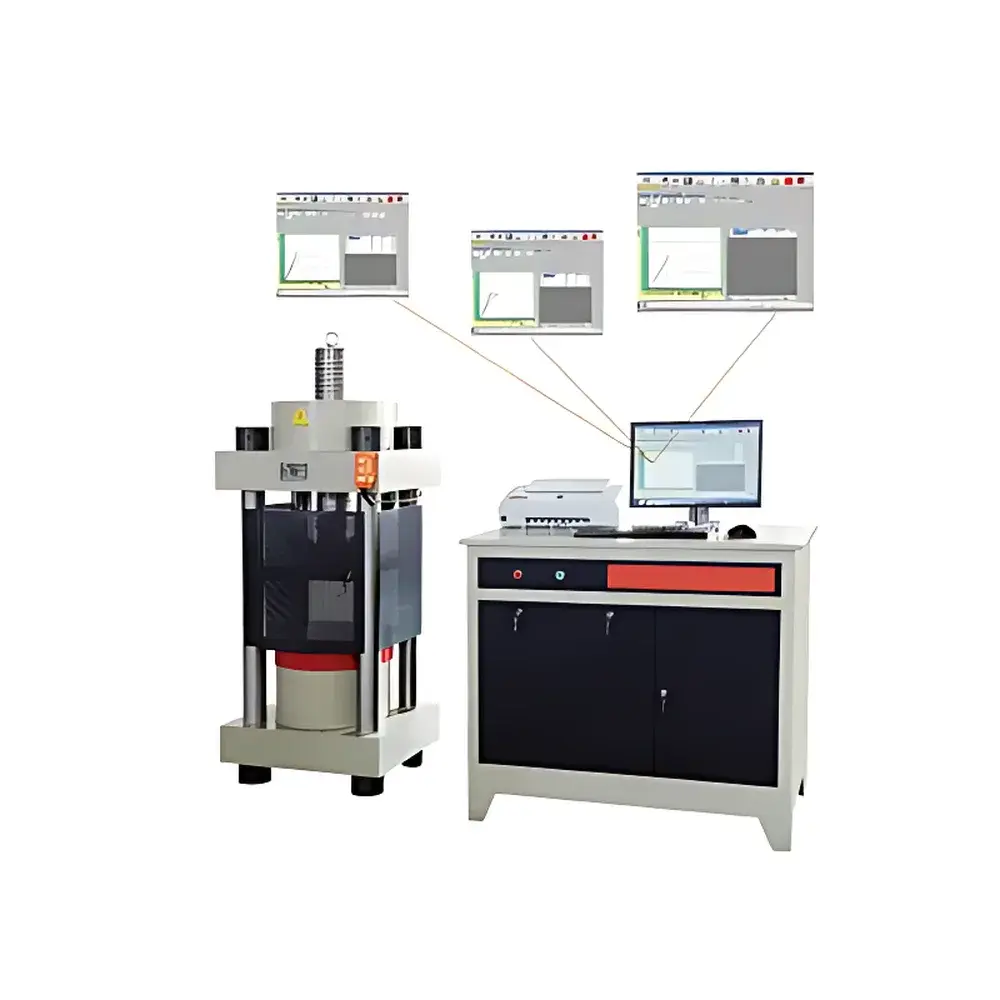
TuoFeng YAW-3000 Fully Automated Compression Testing Machine
| Brand | TuoFeng |
|---|---|
| Origin | Shanghai, China |
| Manufacturer Type | Direct Manufacturer |
| Model | YAW-3000 |
| Price Range | USD 7,000 – 14,000 (FOB Shanghai) |
| Max Test Load | 3000 kN |
| Load Application Rate | 0.2–100% of full scale |
| Platen Spacing (max) | 500 mm |
| Platen Dimensions | 500 × 500 mm |
| Load Measurement Range | 4–100% FS |
| Load Indication Error | ≤ ±1% of reading |
| Piston Stroke | 100 mm |
| Piston Diameter | Φ310 mm |
| Hydraulic System Pressure Rating | 40 MPa |
| Motor Power | 3-phase, 1.1 kW |
| Overall Dimensions (W×D×H) | 780 × 720 × 1950 mm |
| Net Weight | ~2500 kg |
Overview
The TuoFeng YAW-3000 Fully Automated Compression Testing Machine is a high-capacity, microprocessor-controlled hydraulic testing system engineered for precision compressive strength evaluation of construction materials—including concrete cubes, cement mortar prisms, bricks, autoclaved aerated concrete (AAC) blocks, and structural precast elements. It operates on the principle of servo-controlled hydraulic actuation, utilizing a digitally regulated electro-hydraulic servo valve to deliver closed-loop force control. This architecture enables both constant-rate load application (kN/s) and constant-stress-rate control (MPa/s), conforming to standardized test protocols defined in ASTM C39/C39M, ISO 7500-1, GB/T 2611, and EN 12390-3. The system integrates a high-fidelity signal conditioning path—featuring a wide-dynamic-range analog amplifier and 24-bit A/D conversion—ensuring continuous, unbroken load measurement across its full 4–100% full-scale range without range switching or gain adjustment.
Key Features
- Fully automated test sequence execution: specimen alignment detection, zero-load calibration, ramped loading, peak load capture, unloading, and report generation—all initiated with a single software command.
- Digital servo-valve-based hydraulic control with PID feedback architecture ensures stable, jitter-free load application and repeatability better than ±0.5% across repeated tests under identical conditions.
- Integrated real-time data acquisition system displays live load (kN), stress (MPa), displacement (mm), loading rate (kN/s), and time-stamped load–displacement curves on a high-resolution industrial touchscreen interface.
- Robust mechanical frame with rigid cast-iron base, reinforced steel columns, and precision-ground platens (500 × 500 mm, hardened and ground to Ra ≤ 0.8 µm) minimizes deflection and ensures uniform stress distribution.
- Self-contained hydraulic power unit: 40 MPa-rated gear pump, high-efficiency three-phase 1.1 kW motor, dual-stage filtration (suction + pressure line), and differential pressure monitoring for proactive maintenance alerts.
- Compliance-ready architecture supports audit trails, user-level access control (admin/operator/guest), electronic signatures, and configurable test method templates aligned with ISO/IEC 17025 laboratory requirements.
Sample Compatibility & Compliance
The YAW-3000 accommodates standard and non-standard specimens up to 500 mm in height and 500 mm in planar dimension, supporting cube sizes from 100 mm to 300 mm, cylindrical specimens up to Ø300 × 600 mm, and full-scale masonry units. Its 3000 kN capacity meets the upper limit requirements for testing high-strength concrete (up to C100), ultra-high-performance concrete (UHPC), and fiber-reinforced composites. The system complies with mechanical accuracy class 1 per ISO 7500-1 and is validated for use in accredited testing laboratories operating under CNAS, ILAC-MRA, and national metrological verification frameworks. All firmware and software modules are designed to support GLP/GMP-aligned documentation practices, including timestamped raw data logging, change history tracking, and exportable XML/CSV datasets traceable to individual test IDs.
Software & Data Management
The embedded Windows-based control software provides ISO 17025-compliant test management functionality: customizable test methods (e.g., “Concrete Cube @ 0.5 MPa/s”), automatic pass/fail evaluation against user-defined limits, multi-language UI (English, Spanish, Arabic, Vietnamese), and seamless integration with LIMS via TCP/IP or OPC UA. Raw load–displacement data is stored in binary format with millisecond-level time stamps and automatically archived with metadata (operator ID, environmental temperature/humidity, calibration certificate ID, equipment serial number). Reporting modules generate PDF reports compliant with ASTM E122, ISO 5725, and GB/T 228.1 formats—including statistical summaries (mean, SD, CV%), graphical overlays, and digital signature fields. Audit logs record all critical actions (calibration, parameter changes, report exports) with immutable timestamps and user attribution.
Applications
- Quality assurance testing of ready-mix and precast concrete in batch plants and third-party inspection labs.
- Structural material certification for infrastructure projects—bridges, dams, high-rises—requiring traceable, standards-compliant compression data.
- R&D evaluation of novel binders (geopolymers, alkali-activated materials), recycled aggregate concretes, and carbon-cured formulations.
- Calibration validation of field rebound hammers and ultrasonic pulse velocity devices using reference specimens tested on the YAW-3000.
- Accredited conformity assessment for CE marking, CCC certification, and ASTM/EN product declarations.
FAQ
What standards does the YAW-3000 comply with for force measurement accuracy?
It meets Class 1 accuracy per ISO 7500-1 (2018) and is verified annually using NIST-traceable deadweight standards.
Can the system be integrated into an existing laboratory network with centralized data management?
Yes—it supports Ethernet-based communication, OPC UA server mode, and scheduled FTP/SFTP uploads to central servers or cloud repositories.
Is remote diagnostics and firmware update capability available?
Yes, optional remote maintenance module enables secure TLS-encrypted connection for troubleshooting, log retrieval, and over-the-air updates.
Does the software support multi-user role-based permissions for ISO 17025 compliance?
Yes—administrator, technician, and viewer roles are configurable with password protection, session timeouts, and action-specific authorization matrices.
What is the recommended maintenance interval for the hydraulic system?
Hydraulic oil and filter replacement every 1,500 operating hours or 12 months (whichever occurs first); full system calibration every 12 months or after major component replacement.



