
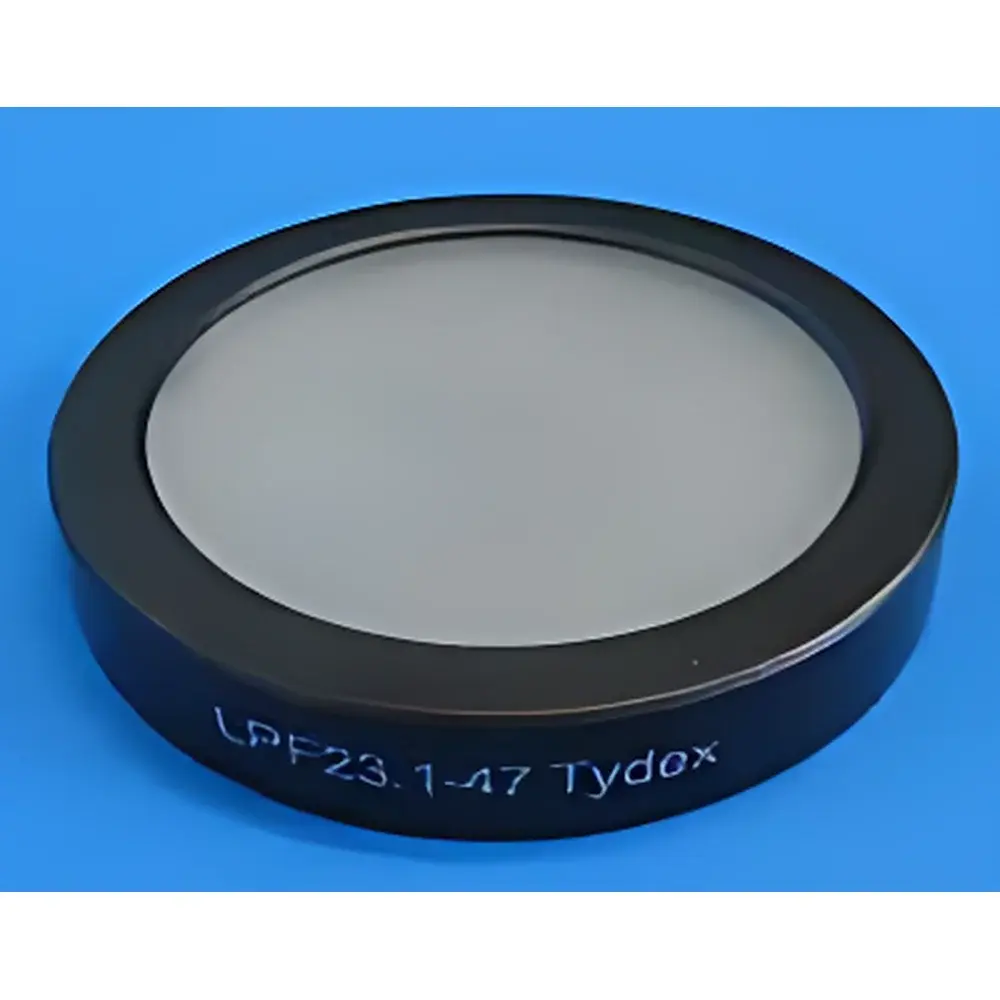
Tydex LPF Terahertz Low-Pass Filter Plate
| Origin | Russia |
|---|---|
| Manufacturer Type | Distributor |
| Origin Category | Imported |
| Model | LPF |
| Component Category | Optical Element |
| Price | USD 1,120 (est.) |
Overview
The Tydex LPF Terahertz Low-Pass Filter Plate is a precision-engineered optical component designed for spectral control in the 0.1–10 THz frequency range (3 mm – 30 µm wavelength). Based on multilayer dielectric interference and metallic mesh architectures, the LPF operates on the principle of evanescent wave cutoff and guided-mode rejection to achieve sharp spectral transition between high-transmission passband and deep-suppression stopband. Unlike broadband absorptive filters, this device maintains phase coherence and minimal group delay dispersion across its operational bandwidth—critical for time-domain spectroscopy (TDS), coherent imaging, and heterodyne detection systems. The filter is optimized for collimated or mildly convergent THz beams and is compatible with both pulsed (femtosecond-laser-pumped) and continuous-wave (CW) THz sources.
Key Features
- High-passband transmission (>85% average from 0.1–2.5 THz, depending on substrate and coating configuration)
- Deep stopband attenuation (<0.1% transmission above 3.0 THz, verified via Fourier-transform THz spectroscopy)
- Integrated aluminum mounting ring (M25.4 × 0.75 thread) enabling repeatable alignment and strain-free clamping in standard optomechanical mounts
- Substrate options include high-resistivity float-zone silicon (HRFZ-Si), quartz, or polyethylene—selected per application requirements for refractive index matching, absorption loss, and thermal stability
- No adhesive bonding between functional layers; all coatings are vacuum-deposited and ion-assisted for long-term environmental stability and laser-damage threshold >100 mJ/cm² (at 100 fs, 800 nm pump)
- Surface flatness λ/10 @ 633 nm (measured interferometrically), ensuring minimal wavefront distortion in imaging and interferometric setups
Sample Compatibility & Compliance
The LPF is suitable for integration into vacuum-compatible, cryogenic (4 K–300 K), and ambient laboratory environments. Its mechanical and thermal design conforms to ISO 10110-7 (optical element surface quality) and MIL-PRF-13830B (scratch-dig specification). While not a medical or safety-certified device, it complies with general-purpose optical component standards referenced in ASTM E1423 (Terahertz Spectroscopy Terminology) and supports traceable calibration workflows under GLP-aligned laboratory practices. No RoHS exemptions apply; all metallic layers use non-lead, non-cadmium alloys.
Software & Data Management
As a passive optical component, the LPF requires no embedded firmware or driver software. However, its spectral performance data—including measured transmittance curves (0.1–10 THz), angle-of-incidence dependence (0°–15°), and polarization sensitivity—are provided in standardized ASCII format (.txt) and MATLAB-compatible .mat files. These datasets are directly importable into common analysis platforms such as TeraView’s TeraPulse Analysis Suite, TOPTICA’s TeraScan Control, or custom Python-based pipelines using NumPy and SciPy. Full metrology reports include uncertainty budgets per GUM (Guide to the Expression of Uncertainty in Measurement) principles.
Applications
- Time-domain terahertz spectroscopy (THz-TDS) systems requiring clean separation of low-frequency phonon modes from high-frequency electronic resonances
- Active THz imaging setups where dynamic range optimization necessitates suppression of broadband noise above 3 THz
- Cryogenic detector front-ends (e.g., bolometer arrays, superconducting hot-electron bolometers) requiring out-of-band thermal load reduction
- Astronomical receiver chains for ground-based submillimeter observatories (e.g., ALMA Band 10 pre-filters)
- Material characterization of semiconductors, topological insulators, and 2D heterostructures under THz excitation
- Electro-optic sampling diagnostics in ultrafast accelerator beamlines and plasma diagnostics
FAQ
What is the maximum incident beam diameter supported by the standard LPF plate?
The standard aperture is Ø25.4 mm with clear aperture ≥ Ø22 mm. Custom diameters up to Ø50.8 mm are available upon request.
Can the LPF be used at 45° angle of incidence without significant shift in cutoff frequency?
Yes, but cutoff shifts to lower frequencies (~5–8% relative shift at 45°); full angular response data is included in the delivered metrology report.
Is the filter polarization-sensitive?
It exhibits <3% differential transmission between s- and p-polarizations below 2 THz; above 3 THz, polarization dependence increases due to mesh anisotropy—consult datasheet for TE/TM curves.
Does Tydex provide spectral calibration certificates traceable to NIST or PTB?
Yes—optional ISO/IEC 17025-accredited calibration is available through Tydex’s certified metrology partner in St. Petersburg, with uncertainty ≤ ±0.05 THz in cutoff frequency.
How should the LPF be cleaned to avoid damage to metallic mesh layers?
Use only nitrogen purge followed by lens-tissue wipe with spectroscopic-grade methanol; ultrasonic cleaning or solvents containing acetone or chlorinated hydrocarbons are strictly prohibited.




