
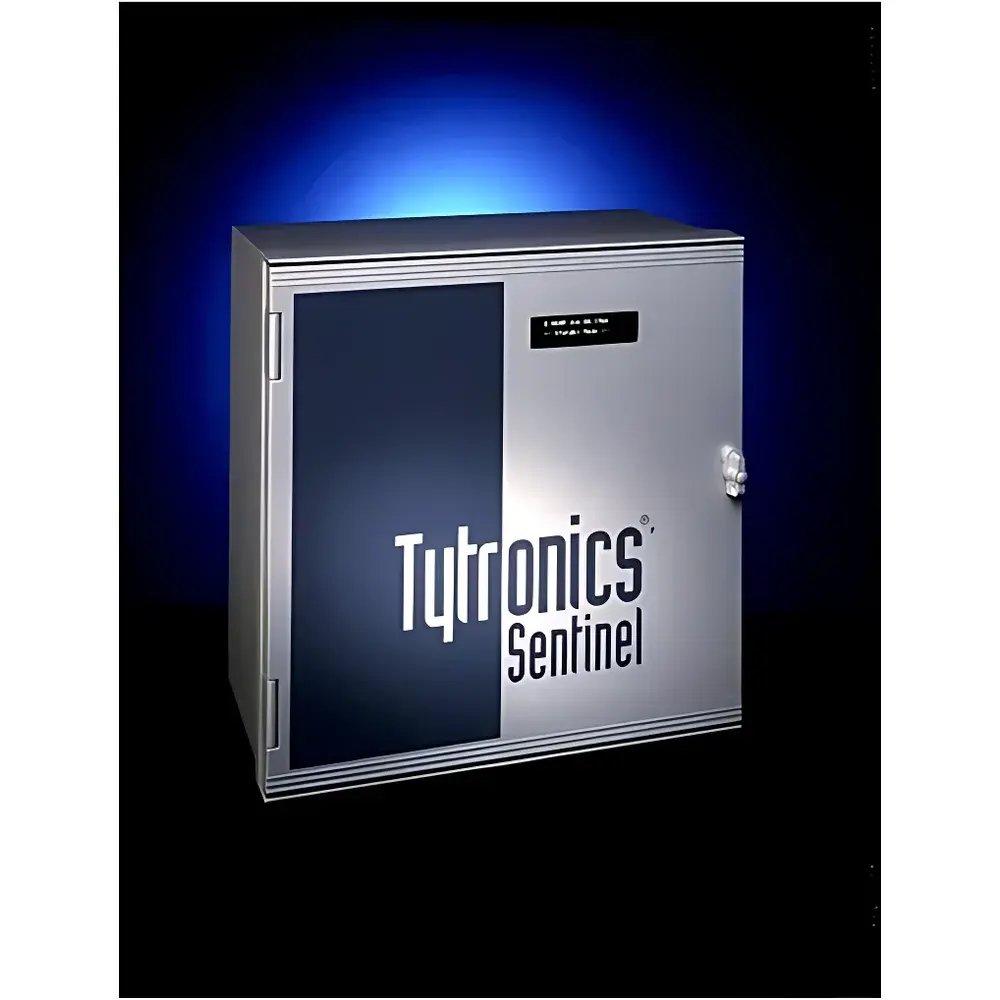
Tytronics Sentinel Total Manganese Online Monitor
| Origin | USA |
|---|---|
| Manufacturer Type | Authorized Distributor |
| Origin Category | Imported |
| Model | Sentinel Total Manganese Online Monitor |
| Instrument Type | Multi-Ion Analyzer |
| Measurement Principle | Colorimetric Analysis (Formaldehyde Oxime Complexation) |
| Range | Low: 0–25 ppb, High: 0–200 ppb |
| Accuracy | ±2% of reading or full scale |
| Resolution | 0.001 ppb |
| Repeatability | ±2% of reading or full scale |
| Cycle Time | 10 minutes |
| Sample Flow Rate | 50–900 mL/min |
| Sample Inlet | 1/4" compression fitting |
| Sample Temperature | 5–70 °C |
| Suspended Solids | ≤2% w/w, max particle size 1.27 mm |
| Sample Pressure | 0–50 psig |
| Effluent Outlet | 3/4" NPT male, atmospheric discharge |
| Alarm Outputs | User-programmable |
| Analog Output | 4–20 mA, programmable |
| Power Supply | 100–240 VAC, 50/60 Hz |
| Enclosure Rating | NEMA 4X (IP65) |
| Mounting | Wall-mounted with included hardware |
| Dimensions (W×H×D) | 387 mm × 406 mm × 210 mm |
| Weight | ~36 kg |
Overview
The Tytronics Sentinel Total Manganese Online Monitor is a precision-engineered, colorimetric analytical instrument designed for continuous, unattended measurement of total dissolved and suspended manganese in aqueous matrices. It operates on the well-established formaldehyde oxime method: under alkaline conditions, manganese ions (Mn2+ and higher oxidation states after digestion) react with formaldehyde oxime to form a stable, intensely colored red complex. Absorbance is measured at two discrete wavelengths—typically 520 nm and 620 nm—enabling robust compensation for turbidity, color interference, and optical fouling. This dual-wavelength photometric architecture ensures high specificity and long-term stability in demanding environmental applications, including drinking water intake, wastewater influent/effluent streams, industrial process water, and chemical manufacturing effluents.
Key Features
- Dual-wavelength optical system with temperature-stabilized LED sources and solid-state detectors for enhanced signal integrity and drift resistance
- Patented large-bore sample handling pathway (up to 1.27 mm particle tolerance) minimizes clogging and extends maintenance intervals in turbid or particulate-laden samples
- Integrated self-diagnostic suite—including reagent level monitoring, flow verification, lamp intensity tracking, and blank calibration validation—supports predictive maintenance and GLP-compliant operational logging
- Modular design with field-replaceable fluidic cartridges and plug-and-play optical modules reduces downtime and simplifies technician-level servicing
- Eight user-configurable relay outputs support integration with SCADA, PLCs, or local alarm panels; each output can be assigned to discrete fault conditions (e.g., low reagent, no flow, calibration failure)
- Flexible method programming: up to 10 independent analytical protocols per instrument, each with configurable digestion time, reagent dosing volume, mixing duration, and measurement delay
- Three distinct calibration modes—standard single-point, multi-point linear, and bracketed dynamic calibration—enable traceability alignment with ISO/IEC 17025 reference laboratories
Sample Compatibility & Compliance
The Sentinel is validated for use with raw surface water, clarified potable water, activated sludge effluent, and moderately aggressive industrial process streams. It accommodates suspended solids up to 2% w/w and particles ≤1.27 mm without pre-filtration, provided sample pressure remains within 0–50 psig and temperature stays between 5–70 °C. The system meets NEMA 4X (IP65) ingress protection requirements for outdoor or wet-location deployment. Its analog 4–20 mA output and bidirectional RS-232 interface support integration into EPA-compliant data acquisition systems. While not intrinsically certified for hazardous locations, its enclosure and material selection (316 stainless steel wetted parts, PFA and PVDF fluid paths) comply with ASTM D511-20 and ISO 11885 for manganese determination in water. The instrument’s calibration traceability, audit trail capability, and user-accessible event logs align with FDA 21 CFR Part 11 expectations for electronic records in regulated utilities.
Software & Data Management
Local operation is managed via an embedded 4.3-inch resistive touchscreen HMI running firmware v3.2+, supporting password-protected user roles (Operator, Technician, Administrator). All measurements, calibrations, alarms, and maintenance events are timestamped and stored internally for ≥90 days. Data export is supported via USB mass storage or RS-232 serial dump in CSV format. Optional Ethernet connectivity enables remote configuration and real-time telemetry through Modbus TCP or HTTP RESTful endpoints. The system logs all parameter changes, calibration actions, and fault resets with operator ID and digital signature—ensuring full auditability for ISO 9001, ISO 14001, and utility-specific QA/QC programs.
Applications
- Drinking water treatment plants: continuous monitoring at raw water intakes, post-coagulation, and final distribution points to verify compliance with WHO and US EPA secondary maximum contaminant levels (SMCL) of 0.05 mg/L (50 µg/L)
- Municipal wastewater facilities: tracking manganese removal efficiency across biological nutrient removal (BNR) and tertiary filtration stages
- Power generation cooling water circuits: early detection of corrosion-induced Mn release from carbon steel piping
- Chemical and pharmaceutical manufacturing: verifying manganese residuals prior to discharge to meet NPDES permit limits and avoid catalyst poisoning in downstream processes
- Environmental remediation sites: long-term unattended monitoring of plume migration in groundwater extraction wells
FAQ
What sample pretreatment is required prior to analysis?
No filtration or centrifugation is required for samples containing ≤2% suspended solids and particles ≤1.27 mm. However, samples with oil, grease, or heavy organic load may require optional UV digestion or acidification upstream to ensure complete Mn solubilization.
Can the instrument measure other metals simultaneously?
The Sentinel platform is configured for dedicated total manganese analysis. While it shares mechanical and software architecture with other Tytronics Sentinel analyzers (e.g., for Fe, Ni, Cu), simultaneous multi-ion measurement requires separate, parallel analyzers due to reagent incompatibility and wavelength-specific optical path design.
How often does the system require calibration verification?
Calibration verification using certified reference materials (CRMs) is recommended every 7 days for regulatory reporting applications, or every 30 days for process control use—per ASTM D859-22 guidelines for colorimetric metal analysis.
Is remote firmware update supported?
Yes—firmware updates can be deployed over Ethernet or via USB stick, with rollback capability and checksum validation to ensure integrity and prevent unauthorized modification.
What is the expected lifetime of the optical source and detector assembly?
LED light sources are rated for ≥50,000 hours of continuous operation; solid-state photodiodes exhibit negligible aging under normal thermal cycling. Routine verification using factory-supplied optical blanks is advised quarterly to confirm photometric linearity.
Related Products







