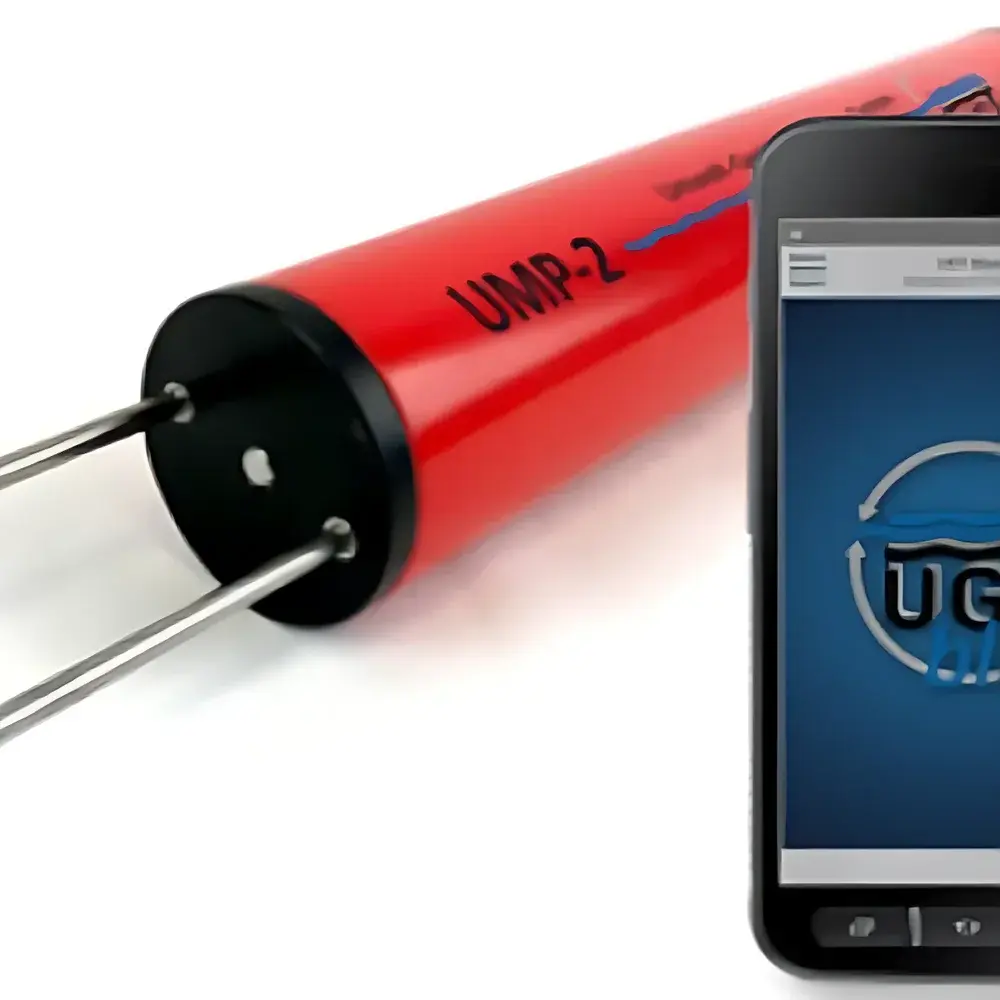
UGT UMP-2 Soil Moisture, Temperature & Electrical Conductivity Sensor
| Brand | UGT |
|---|---|
| Origin | Germany |
| Model | UMP-2 |
| Power Supply | 6–24 V DC |
| Current Consumption | 60 mA |
| Volumetric Water Content Range | 0–100 %vol |
| Accuracy (VWC) | ±2 %vol |
| Resolution (VWC) | 0.1 %vol |
| EC Range | 0.001–5 mS/cm (up to 40 mS/cm at reduced resolution) |
| EC Accuracy | ±1 % |
| Temperature Range | −40 to +60 °C |
| Temperature Accuracy | ±0.5 °C |
| Temperature Resolution | 0.01 °C |
| Output Signals | Three analog outputs (0–1 V for temperature, EC, and VWC respectively) + RS485 digital interface |
| Connector | M12 with 1.5 m integrated cable |
| Enclosure | Fully potted, IP68-rated |
| Installation | Direct burial or horizontal embedding |
Overview
The UGT UMP-2 is a tri-parameter soil sensor engineered for long-term, high-stability field monitoring of volumetric water content (VWC), soil temperature, and bulk electrical conductivity (EC). It operates on the principle of time-domain transmission (TDT) — a refined variant of time-domain reflectometry (TDR) — to measure the dielectric permittivity of soil, from which VWC is derived using calibrated empirical or physics-based models (e.g., Topp equation or site-specific calibrations). Unlike capacitance-based sensors susceptible to salinity drift, the UMP-2 employs a dedicated, isolated EC measurement module that operates independently of the dielectric sensing circuitry — eliminating cross-sensitivity between moisture and salinity readings. This decoupled architecture ensures metrological integrity in heterogeneous, saline, or clay-rich soils where conventional single-probe sensors exhibit significant bias. Designed for unattended operation in remote environmental stations, agricultural IoT networks, and ecological research plots, the UMP-2 features a fully potted stainless-steel housing rated IP68, enabling direct burial or horizontal installation without protective casings.
Key Features
- Tri-parameter simultaneous measurement: VWC, temperature, and bulk EC — each with independent transduction pathways
- Time-domain transmission (TDT) core technology for robust, low-drift VWC determination across diverse soil textures and salinities
- Dedicated EC module with dual-range capability: high-resolution mode (0.001–5 mS/cm) and extended range (up to 40 mS/cm at reduced resolution)
- Wide operating temperature range (−40 to +60 °C) with NIST-traceable thermal compensation for all parameters
- Low-power design (60 mA @ 12 V DC) compatible with solar-powered data loggers and battery-operated telemetry systems
- Hybrid output interface: three isolated 0–1 V analog channels (one per parameter) plus RS485 Modbus RTU for system integration
- M12 industrial connector with 1.5 m pre-terminated cable — optimized for rapid deployment and cable management in multi-sensor arrays
- IP68-rated epoxy-potted construction with stainless-steel probe body — suitable for permanent burial in saturated, frozen, or chemically aggressive soils
Sample Compatibility & Compliance
The UMP-2 is validated for use in mineral soils, organic substrates (e.g., peat, compost), and engineered growing media. Its geometry and signal processing minimize edge effects in coarse gravels and dense clays. While not certified to a specific ISO standard as a standalone device, its measurement methodology aligns with ISO 11274 (soil physical properties — determination of water retention curves) and ASTM D5859 (standard guide for in situ soil moisture measurement using electromagnetic methods). The RS485 interface supports Modbus RTU protocol, enabling seamless integration into SCADA, FAO WaPOR-compliant irrigation controllers, and USDA ARS networked observatories. For regulated environments (e.g., GLP-compliant agronomic trials), the analog outputs support traceable calibration via external reference standards; audit-ready calibration logs can be maintained through compatible data acquisition firmware.
Software & Data Management
The UMP-2 requires no embedded firmware updates or proprietary configuration tools. All parameters are factory-calibrated against NIST-traceable reference materials and shipped with individual calibration certificates. Analog outputs permit direct connection to Campbell Scientific CR1000X, HOBO RX3000, or Delta-T Devices GP2 loggers without signal conditioning. RS485 communication enables daisy-chaining up to 32 sensors on a single bus, with configurable slave IDs and baud rates (9.6–115.2 kbps). Raw data streams comply with Modbus function codes 03 (read holding registers) and 06 (preset single register), facilitating ingestion into Python-based data pipelines (e.g., Pandas + PyModbus), MATLAB instrument control toolboxes, or cloud platforms such as AWS IoT Core or Azure IoT Hub via gateway middleware. Timestamped, parameter-aligned records support ISO 8601-compliant metadata tagging for FAIR (Findable, Accessible, Interoperable, Reusable) data practices.
Applications
- Long-term eddy covariance and flux tower soil moisture networks (e.g., AmeriFlux, ICOS)
- Precision irrigation scheduling in viticulture, orchards, and row-crop agriculture
- Salinity monitoring in coastal aquifer recharge zones and reclaimed wastewater irrigation sites
- Soil hydrology modeling validation (e.g., HYDRUS-1D, SWAP, or CLM5)
- Permafrost thaw detection in Arctic and alpine tundra ecosystems
- Regulatory compliance reporting for EU Nitrates Directive and US EPA NPDES stormwater permits
- Controlled-environment phenotyping platforms integrating with automated watering and nutrient delivery systems
FAQ
Does the UMP-2 require soil-specific calibration?
Yes — while factory-calibrated for mineral soils (sand, loam, clay), optimal accuracy in organic media or high-salinity conditions requires site-specific calibration using gravimetric sampling or known-solution EC verification.
Can the sensor be used in frozen soil?
Yes — the −40 to +60 °C operating range and potted electronics allow continuous operation in seasonally frozen ground; however, VWC interpretation below 0 °C requires phase-aware models due to ice dielectric contrast.
Is RS485 termination required in multi-sensor installations?
Yes — proper 120 Ω termination resistors must be installed at both ends of the RS485 bus to prevent signal reflection, especially in runs exceeding 100 m or with >16 nodes.
How does the independent EC module differ from conventional 3-in-1 sensors?
It uses a separate electrode pair and AC excitation circuit, eliminating polarization artifacts and salinity-induced VWC bias — critical for monitoring irrigation leaching fractions or salt-affected cropland.
What maintenance is required for long-term burial?
None — the IP68 potted design eliminates servicing intervals; periodic validation against handheld reference meters (e.g., WET sensor or EM38) every 12–24 months is recommended for QA/QC.