
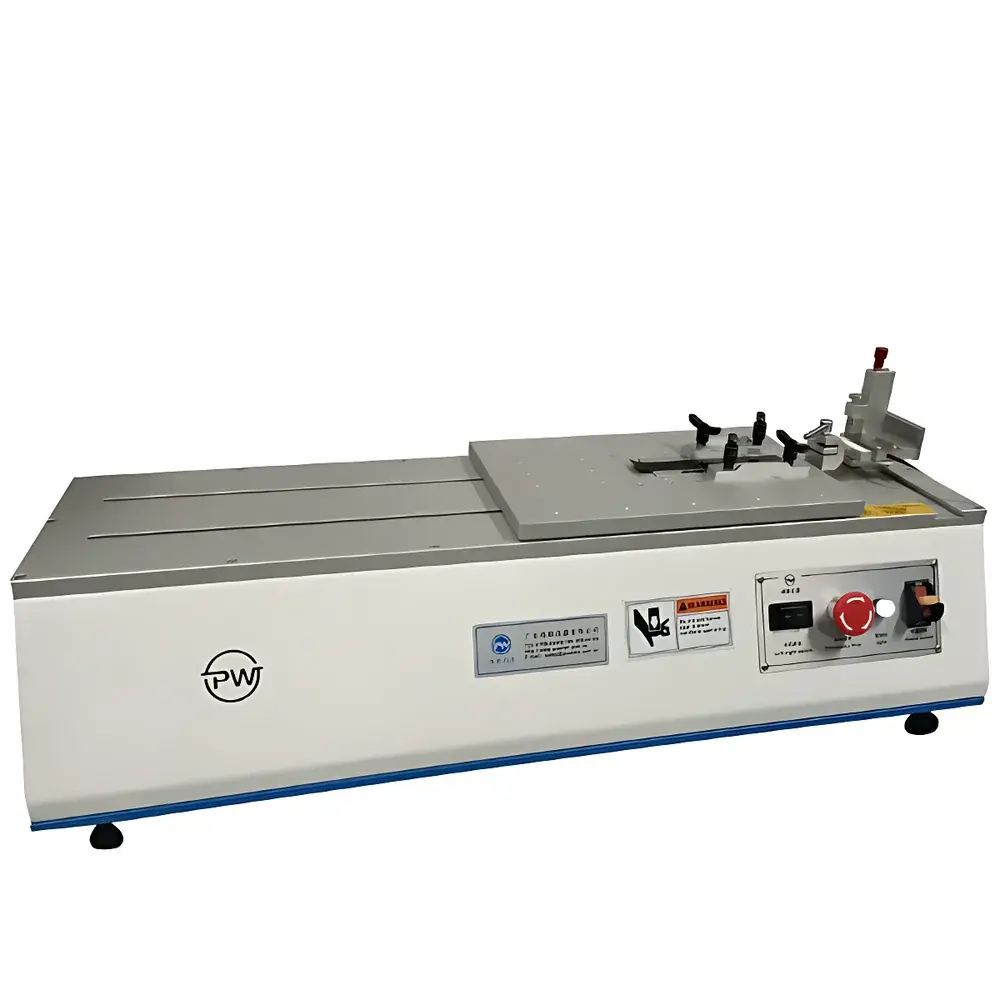
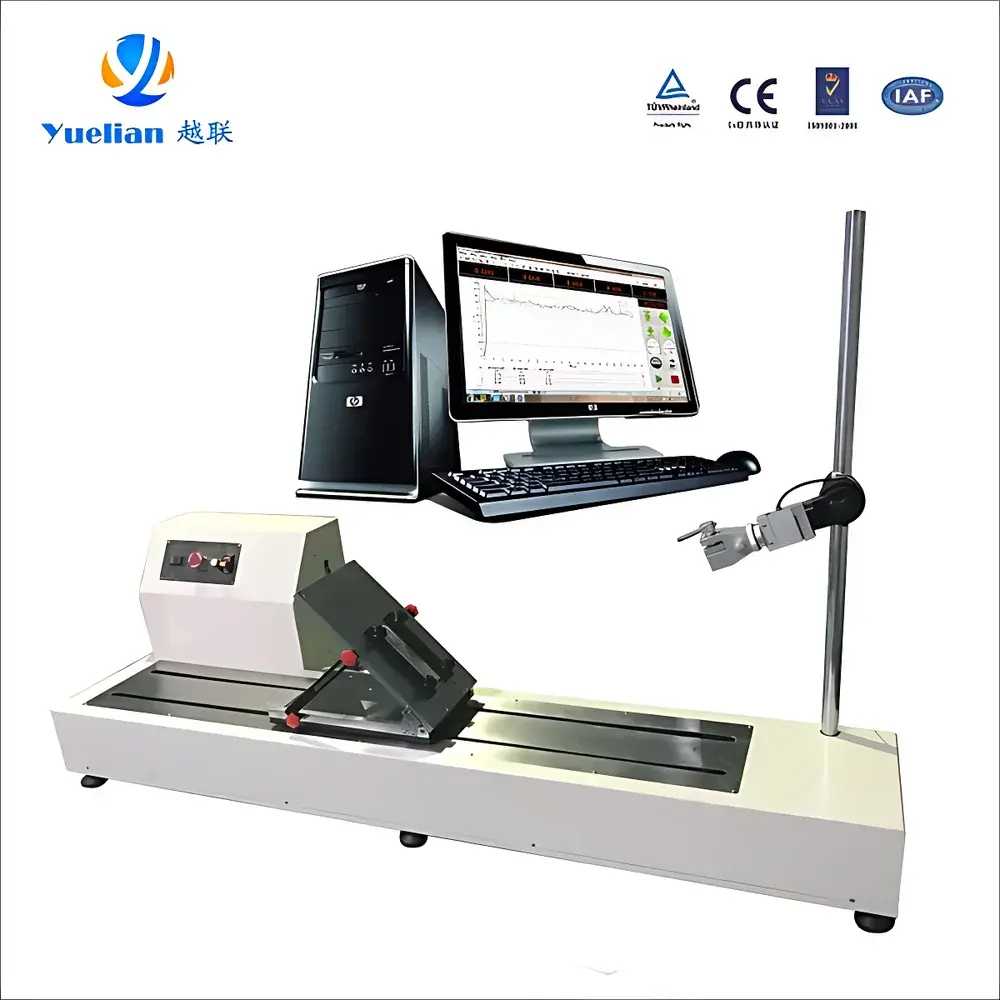
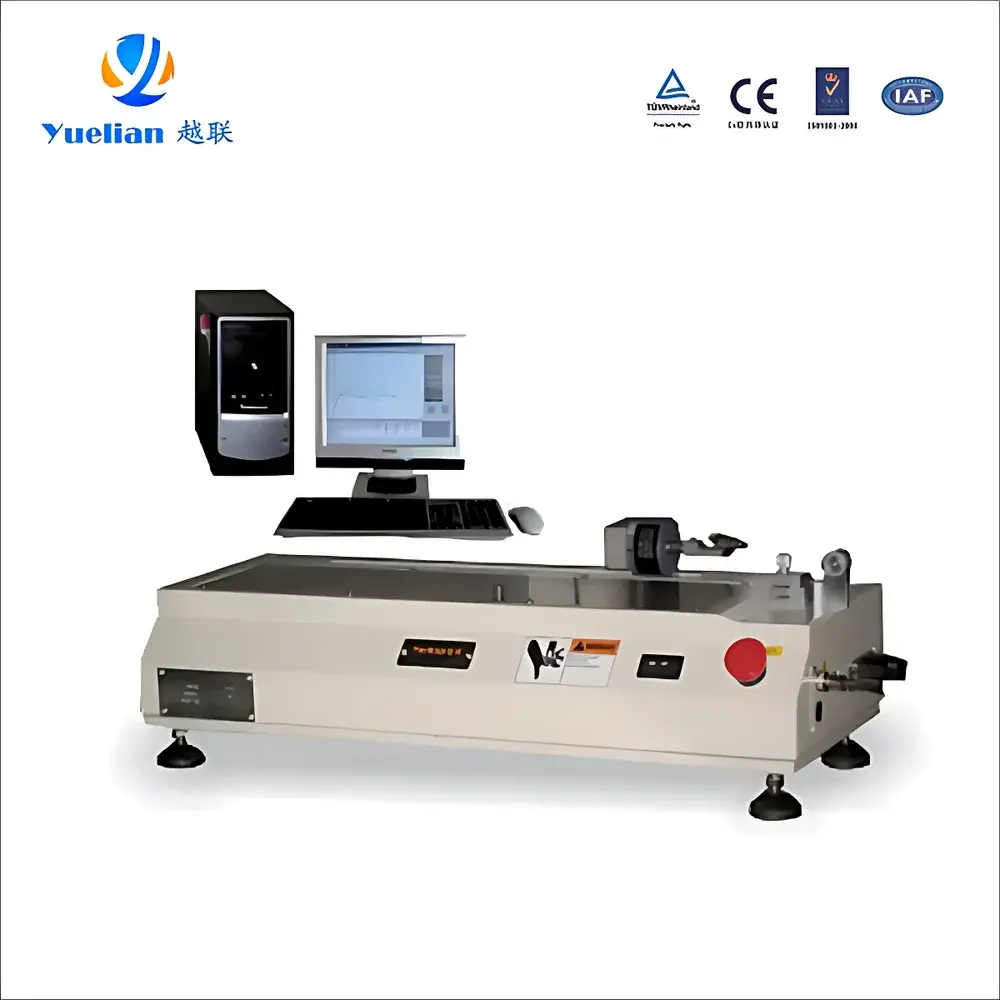
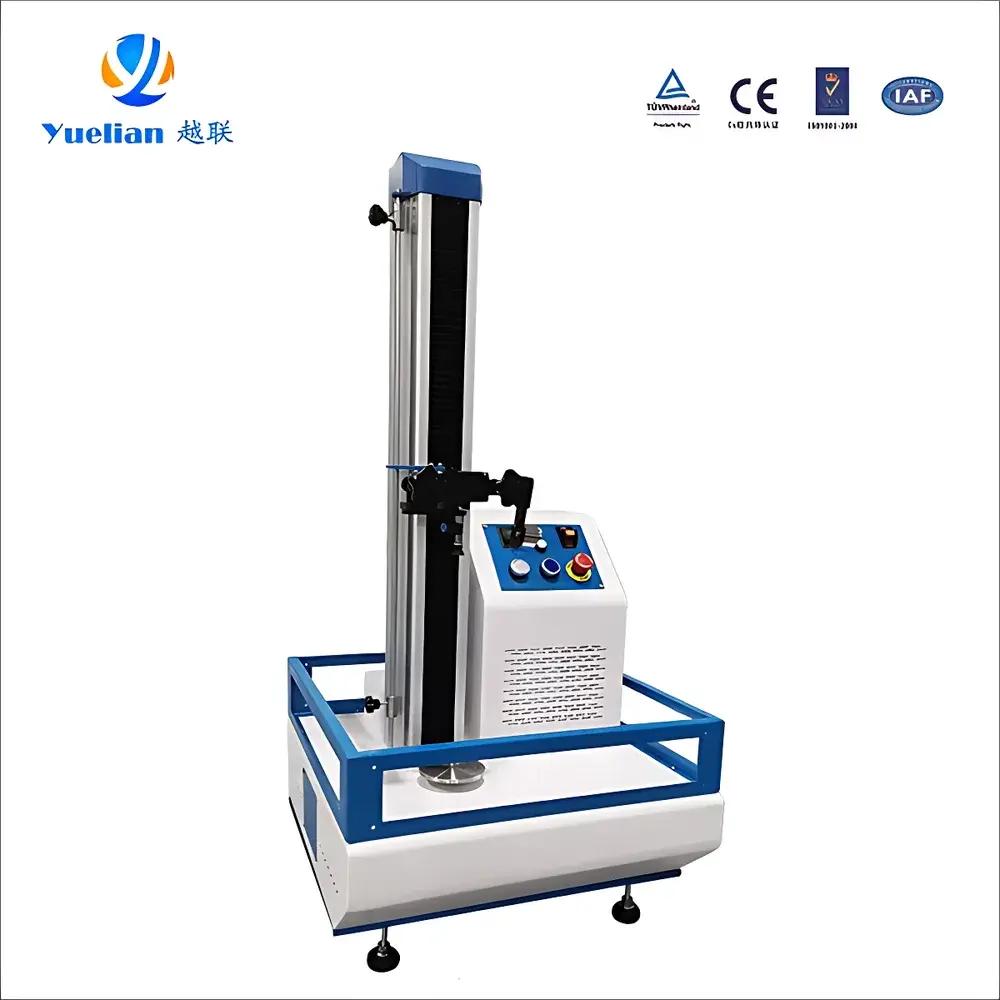
Ultra-High-Speed Peel Tester (60 m/min) – PW-H03M Universal Testing Machine
| Brand | PW |
|---|---|
| Origin | Guangdong, China |
| Manufacturer Type | Authorized Distributor |
| Country of Origin | China |
| Model | PW-H03M |
| Instrument Type | Electromechanical Universal Testing Machine |
| Force Capacity Options | 10 N / 20 N / 50 N / 100 N / 200 N (single selection) |
| Control System | Full PC-based control with proprietary software |
| Force Resolution | 1/1,000,000 full scale |
| Force Accuracy | ±0.1% FS |
| Displacement Resolution | 1/1,000,000 full stroke |
| Displacement Accuracy | ±0.1% FS |
| Sampling Rate | 1000 Hz |
| Effective Stroke | 450 mm |
| Speed Range | 0.01–30 m/min (standard), upgradable to 60 m/min (1,000,000 mm/min) upon configuration |
| Sample Width | ≥50 mm |
| Safety & Stop Modes | Overload stop, emergency stop button, automatic rupture detection, auto-return, dual-end travel limit protection |
| Drive System | High-precision servo motor with ball screw and linear guide transmission |
| Dimensions (L×W×H) | 850 × 270 × 560 mm |
| Net Weight | ~45 kg |
| Power Supply | 220 V AC, 50–60 Hz |
| Rated Power | 400 W |
| Included Accessories | USB/RS232 interface cable, control software license, standard fixture set |
| Optional Fixtures | 90°/180° peel fixtures (small/large), coefficient-of-friction fixture, unwind force fixture, stainless steel test plates, consumables |
Overview
The PW-H03M Ultra-High-Speed Peel Tester is an electromechanical universal testing machine engineered for dynamic interfacial adhesion characterization under industrially relevant high-velocity conditions. It operates on the principle of controlled tensile separation—applying precisely regulated axial force while maintaining constant peel angle (90° or 180°) and velocity—to quantify peel resistance of pressure-sensitive adhesives (PSAs), release liners, functional films, and laminated substrates. With a standard maximum speed of 30 m/min and configurable capability up to 60 m/min (1,000,000 mm/min), it meets stringent test protocols specified by global electronics OEMs—including Huawei, OPPO, Xiaomi, and vivo—for evaluating adhesive performance in high-throughput display module assembly, flexible circuit bonding, and protective film lamination processes. Its architecture integrates a high-bandwidth servo drive system, sub-micron displacement feedback, and real-time 1 kHz data acquisition to ensure repeatability and traceability required in R&D validation and production line QC environments.
Key Features
- Multi-mode mechanical testing platform supporting peel (90°, 180°, variable-angle), unwind force, coefficient of friction (COF), shear, tear, and tensile measurements via interchangeable ISO/ASTM-compliant fixtures.
- High-fidelity force transduction with 1/1,000,000 internal resolution and ±0.1% full-scale accuracy across five selectable load cell ranges (10–200 N), enabling precise quantification of low-force PSA delamination events.
- Real-time motion control with closed-loop servo positioning, achieving stable velocity regulation within ±0.2% deviation across the full 0.01–60 m/min range—even during rapid acceleration/deceleration transitions.
- Modular software architecture supporting customizable test sequences, multi-segment parameter definition (e.g., pre-load dwell → ramp → constant-speed peel → post-failure relaxation), and programmable pass/fail criteria per segment.
- Ruggedized mechanical design featuring hardened ball screws, preloaded linear guides, and vibration-damped base structure—optimized for continuous operation in factory-floor environments with minimal maintenance intervals.
Sample Compatibility & Compliance
The PW-H03M accommodates specimens ≥50 mm wide and ≤450 mm effective travel length, compatible with standard release liner rolls, PET/PE/PVC films, silicone-coated papers, acrylic and rubber-based PSAs, and thin-film composite laminates. Fixture geometry adheres to ASTM D903 (peel strength), ASTM D1898 (tape adhesion), ISO 8510-2 (peel resistance at defined angles), and GB/T 2792 (Chinese national standard for peel testing). Data integrity complies with GLP and GMP-aligned audit trail requirements: all test parameters, raw sensor outputs, operator IDs, timestamps, and calibration metadata are immutably logged and exportable in CSV/PDF formats. Optional 21 CFR Part 11-compliant software modules support electronic signatures and role-based access control for regulated manufacturing sites.
Software & Data Management
The embedded Windows-based control suite provides intuitive workflow navigation, real-time curve overlay (force vs. displacement/time), automated peak/valley detection, and statistical reporting (mean, SD, CV%, min/max) across batched tests. Users may define custom analysis windows—e.g., extracting average peel force over the central 80% of travel—or apply moving-average filters to suppress high-frequency noise without compromising temporal resolution. Raw datasets (1000 Hz) are stored in binary format with embedded metadata tags, ensuring compatibility with third-party analytics platforms (MATLAB, Python Pandas, JMP). Export options include ISO-standardized test reports with embedded calibration certificates, graphical overlays for comparative benchmarking, and XML-based data exchange for MES integration.
Applications
This instrument serves critical quality assurance functions across advanced materials supply chains: validating peel consistency of cover films used in foldable smartphone displays; assessing unwind torque stability of die-cut adhesive tapes prior to high-speed pick-and-place application; quantifying COF between separator films and cathode foils in lithium-ion battery electrode coating lines; and screening edge-lift resistance of ultra-thin polyimide flex circuits bonded with anisotropic conductive films (ACFs). Its speed scalability enables correlation studies between peel kinetics and viscoelastic relaxation time—supporting formulation development for next-generation low-residue, repositionable adhesives demanded by consumer electronics OEMs.
FAQ
What peel angles does the PW-H03M support?
It supports fixed 90° and 180° configurations as standard; variable-angle peel (e.g., 45°, 135°) is achievable using optional adjustable-angle fixtures compliant with ISO 8510-1.
Can the system meet automotive or medical device regulatory requirements?
Yes—when equipped with validated software and documented calibration records, it supports IATF 16949 process validation and ISO 13485-compliant adhesive testing protocols for Class I/II device packaging materials.
Is remote diagnostics or firmware update capability available?
The system includes Ethernet connectivity and secure remote desktop support for technical troubleshooting; firmware updates are delivered via encrypted USB media with version-controlled release notes.
How is traceability ensured for calibration and maintenance?
Each unit ships with NIST-traceable force and displacement calibration certificates; maintenance logs, sensor drift checks, and preventive service alerts are tracked within the software’s built-in asset management module.
What is the typical lead time for custom speed upgrades to 60 m/min?
Factory-configured 60 m/min variants require 6–8 weeks from order confirmation, including mechanical reinforcement of the drive train and extended validation per EN ISO 17025 requirements.



