
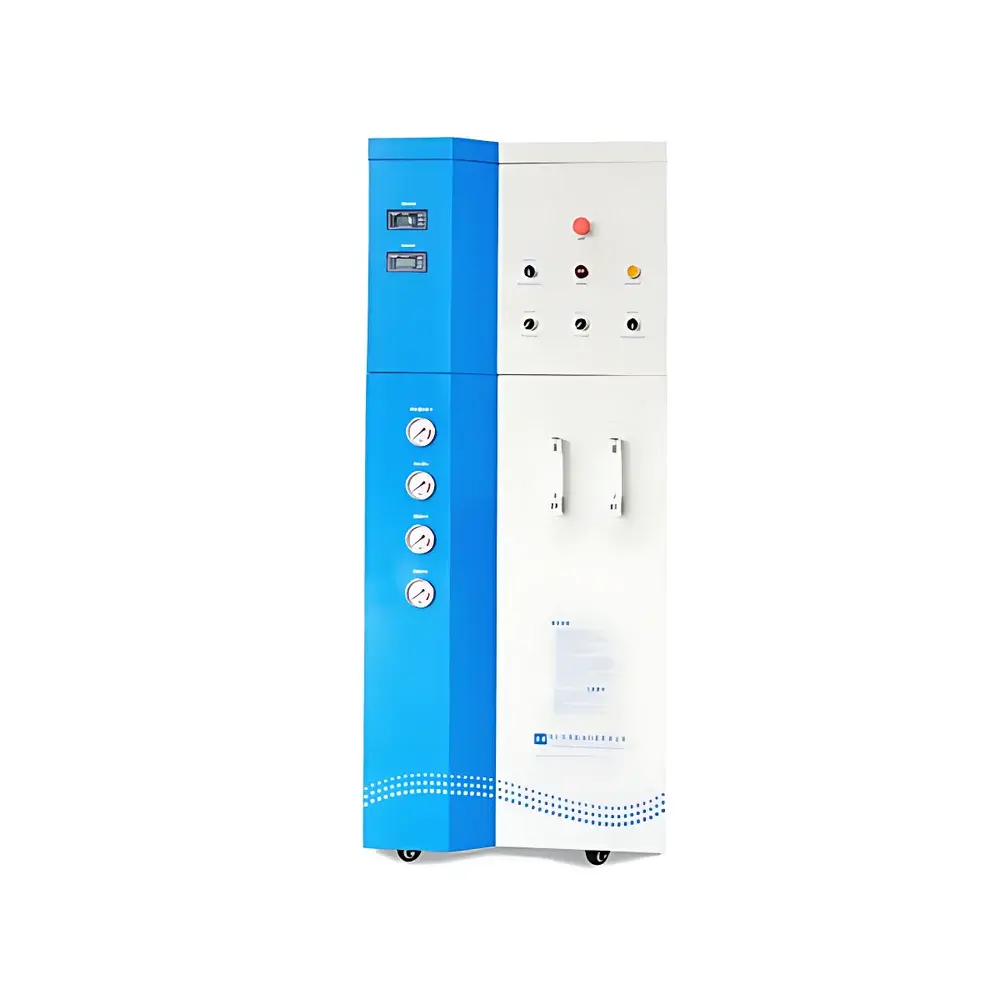
ULUPURE ULPTY Medical-Grade Integrated Ultra-Pure Water System
| Brand | ULUPURE |
|---|---|
| Origin | Sichuan, China |
| Manufacturer Type | Direct Manufacturer |
| Country of Origin | China |
| Model | ULPTY |
| Pricing | Upon Request |
| Water Grade | ASTM Type I / GB/T 6682–2008 Grade I |
| Heavy Metals & Soluble Silica | < 0.1 ppb |
| Particles (>0.1 µm) | < 1 particle/mL |
Overview
The ULUPURE ULPTY Medical-Grade Integrated Ultra-Pure Water System is a fully enclosed, cabinet-style water purification platform engineered specifically for clinical and diagnostic environments across hospitals and healthcare facilities. It employs a multi-stage purification architecture—comprising pre-filtration (multi-media + scale inhibition), reverse osmosis (RO), electrodeionization (EDI) or mixed-bed (MB) polishing, and optional ultrafiltration (UF) or UV oxidation—to convert municipal tap water or groundwater into Type I ultrapure water compliant with GB/T 6682–2008, ASTM D1193–2022, ISO 3696:1995, CLSI EP21-A, WS 507–2016, and WS 310.1–2016. Designed for space-constrained medical departments—including Central Sterile Supply Departments (CSSD), endoscopy units, dental clinics, operating theaters, and clinical laboratories—the ULPTY integrates all core components (feed pump, high-pressure RO pump, recirculation pump, storage tank interface, and distribution loop controls) within a single footprint. Its modular construction enables scalable output capacities (120–500 L/h at 25 °C), with performance calibrated to inlet water conditions per ISO 14644-1 cleanroom-grade particulate control and USP water quality guidance.
Key Features
- Microprocessor-controlled automation with liquid-level interlock logic, enabling full-cycle self-diagnosis at startup, low-inlet-pressure shutdown, overpressure alarm, phase-loss and overcurrent protection, and intelligent reservoir management (auto-stop at high level, auto-restart at mid-level).
- Dual-mode operation: fully automatic mode with real-time fault logging, plus manual override for emergency maintenance or validation procedures.
- Integrated antiscalant dosing module and graded multimedia filtration (anthracite/sand/activated carbon) to ensure stable RO membrane performance under variable municipal feedwater quality (TDS ≤ 500 ppm, free chlorine ≤ 0.05 mg/L, pressure 1.5–5 bar, temperature 5–45 °C).
- Constant-pressure delivery via digital PWM-controlled booster pump; all wetted parts fabricated from ASTM A240 304 stainless steel; RO membranes, solenoid valves, and fittings sourced from globally certified suppliers.
- Real-time online monitoring of feedwater conductivity, product water conductivity (≤15 µS/cm for purified water; ≤0.1 µS/cm for ultrapure water), and integrated particle counters (≥0.1 µm, <1 particle/mL).
Sample Compatibility & Compliance
The ULPTY system delivers water suitable for critical medical applications where ionic, organic, microbial, and particulate contamination must be minimized. Purified water meets requirements for automated washer-disinfectors (ISO 15883), endoscope reprocessing (AAMI ST91), and dental unit waterlines (ADA/OSAP guidelines). Ultrapure water output satisfies analytical needs in clinical chemistry analyzers, immunoassay platforms (e.g., chemiluminescence), reagent preparation, and molecular diagnostics. All system firmware supports audit trails, user access levels, and electronic signature capability aligned with FDA 21 CFR Part 11 principles. Hardware design conforms to IP54 enclosure rating and IEC 61000-6-2/6-4 EMC standards. Validation documentation packages—including DQ/IQ/OQ protocols—are available upon request for GLP/GMP-regulated environments.
Software & Data Management
The embedded HMI features a 7-inch TFT-LCD touchscreen with multilingual UI (English, Spanish, French, Arabic). System logs record timestamped events including conductivity excursions, pump runtime, filter replacement alerts, and alarm history—retained for ≥12 months. Data export is supported via USB 2.0 or optional RS485 Modbus RTU interface for integration into facility-wide BMS or LIMS. Calibration certificates for conductivity sensors are traceable to NIST standards. Firmware updates are performed locally without cloud dependency, preserving data sovereignty—a requirement under HIPAA-compliant infrastructure deployments.
Applications
- CSSD: Feed water for thermal washer-disinfectors, ultrasonic cleaners, and acidic electrolyzed water generators.
- Endoscopy: Final rinse water for flexible scopes per AAMI TIR34 recommendations.
- Operating Rooms & Dental Clinics: Irrigation and instrument reprocessing water meeting ISO 13485 biocompatibility thresholds.
- Clinical Laboratories: Source water for hematology analyzers, ELISA readers, PCR prep stations, and LC-MS mobile phase preparation.
- Pharmacy & IV Admixture Units: WFI-adjacent use in non-sterile compounding where endotoxin limits <0.25 EU/mL are not required but low silica and TOC are critical.
FAQ
What is the minimum inlet water pressure required for continuous operation?
A sustained feed pressure of ≥1.5 bar (150 kPa) is mandatory. Below this threshold, installation of a source water tank with gravity-fed supply or a dedicated booster pump is recommended.
How does ambient temperature affect system output?
RO membrane flux declines by ~3% per 1 °C drop below 25 °C. At temperatures <5 °C, RO production ceases entirely; pre-heating of feedwater may be necessary in cold-climate installations.
Is the system compatible with existing hospital water distribution networks?
Yes—ULPTY supports direct connection to stainless-steel or PEX-aluminum composite loops. Optional 0.22 µm final filters and UV reactors can be added for point-of-use compliance with ISO 14644-1 Class 5 particle limits.
Can the system be validated for ISO 13485 or GMP environments?
All ULPTY configurations include IQ/OQ documentation templates, calibration records, and material traceability dossiers. Third-party PQ support is available through ULUPURE’s global validation partners.
What maintenance intervals are recommended for consumables?
Pre-filters: every 3–6 months depending on feedwater quality. RO membrane: 2–3 years. Mixed-bed resin: 6–12 months. UV lamp: annually. Full service logs are tracked automatically within the HMI.



