
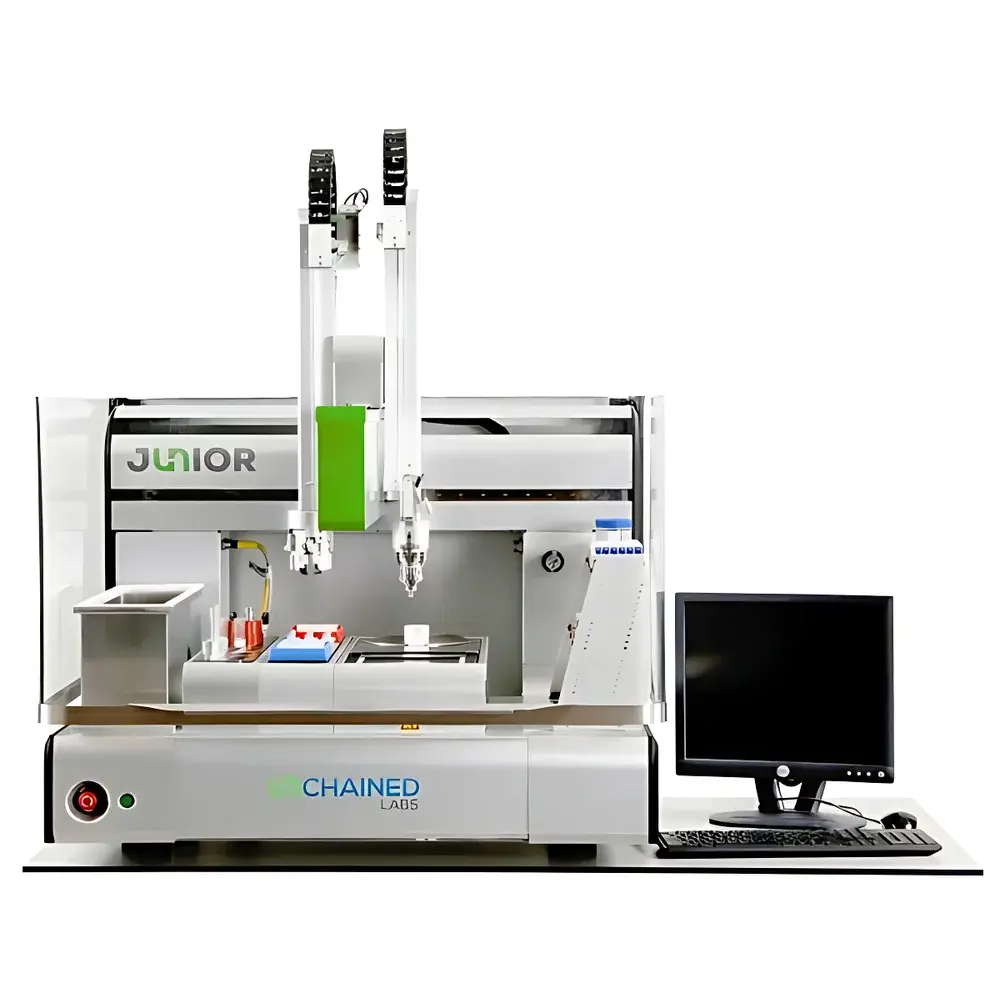
Unchained Labs Junior Automated High-Throughput Drug Sample Preparation System
| Brand | Unchained Labs |
|---|---|
| Origin | USA |
| Model | Junior |
| Heating Stage Temp Range | RT–180 °C |
| Cooling Stage Temp Range | –20–120 °C |
| Magnetic Stirring Speed | 0–750 rpm |
| Heated Filtration Unit Temp Range | RT–120 °C |
| Filter Pore Size | 0.7 µm glass microfiber (binder-free) |
Overview
The Unchained Labs Junior Automated High-Throughput Drug Sample Preparation System is an integrated, benchtop platform engineered for solid-form screening and solubility profiling of active pharmaceutical ingredients (APIs) under controlled thermal and mechanical conditions. Built upon a modular architecture, the Junior implements a closed-loop, temperature-regulated workflow that supports crystallization, slurry aging, hot filtration, and rapid solvent evaporation—all within a single instrument footprint. Its core operational principle relies on precise thermally coupled sample handling: saturated or supersaturated solutions are heated to maintain homogeneity during transfer and filtration, then cooled in situ to induce nucleation and phase separation. This eliminates manual intervention at critical transition points—such as hot filtration—and significantly reduces operator-induced variability, ensuring high reproducibility across hundreds of parallel experiments.
Key Features
- 384-well parallel processing capability enables comprehensive polymorph, salt, and cocrystal screening in a single run, supporting DoE-driven experimental design.
- Minimal API consumption: as little as 1 g per full solid-form screen, optimizing use of scarce or synthetically challenging compounds.
- Integrated heating-cooling-stirring station with independent control over temperature (–20 °C to 180 °C) and agitation (0–750 rpm), allowing simultaneous suspension preparation, precipitation induction, controlled cooling crystallization, and solvent evaporation.
- Heated filtration module maintains solution temperature up to 120 °C during vacuum-assisted filtration through binder-free 0.7 µm glass microfiber filters—preventing premature API crystallization or filter clogging.
- LEA (Logical Experimental Automation) software framework enables rule-based, formulation-centric experiment definition—automating parameter sequencing, condition mapping, and hardware actuation without scripting.
- Unified data dashboard synchronizes time-resolved birefringence imaging, PXRD patterns, Raman spectra, and third-party analytical outputs into a single navigable view for cross-modal correlation.
Sample Compatibility & Compliance
The Junior accommodates standard 96- and 384-well microplates (SBS format), vials (1.5–4 mL), and custom reaction vessels compatible with organic solvents, aqueous buffers, and mixed solvent systems. All wetted materials—including heating blocks, filtration manifolds, and fluid paths—are chemically resistant (e.g., PTFE, borosilicate glass, 316 stainless steel) and validated for low extractables. The system supports GLP-compliant operation through audit-trail-enabled LEA software, with full electronic records retention, user access controls, and timestamped event logging aligned with FDA 21 CFR Part 11 requirements. It is routinely deployed in early-phase development labs adhering to ICH Q5A, Q5D, and Q6A guidelines for solid-state characterization.
Software & Data Management
LEA software provides a browser-based interface for experiment authoring, real-time monitoring, and post-run analysis. Users define crystallization protocols using intuitive drag-and-drop modules—specifying thermal ramps, hold times, stir profiles, and filtration triggers. All instrument actions are logged with metadata (e.g., ambient humidity, plate barcode, calibration status). Raw image stacks, diffraction files (.raw, .xy), and spectral datasets (.spc, .csv) are automatically tagged, versioned, and stored in a structured repository. APIs enable integration with LIMS (e.g., LabVantage, STARLIMS) and ELN platforms (e.g., Benchling, Dotmatics) via RESTful endpoints and secure SFTP ingestion. Data exports comply with ISA-Tab and AnIML standards for regulatory submission readiness.
Applications
- Polymorph screening under varied supersaturation, solvent composition, and cooling rate conditions.
- Salt and cocrystal screening via liquid-assisted grinding (LAG) and slurry conversion studies.
- Solubility and intrinsic dissolution rate (IDR) determination across pH and temperature gradients.
- Stability-indicating crystallization assays for assessing phase transformation kinetics under stress conditions (e.g., humidity, thermal cycling).
- Supporting QbD initiatives by generating multivariate datasets linking process parameters to critical quality attributes (CQAs) such as particle size distribution, crystallinity, and hygroscopicity.
FAQ
Does the Junior support unattended overnight operation?
Yes—the system is designed for fully autonomous runs up to 72 hours, with integrated safety interlocks, temperature fault detection, and emergency shutdown protocols.
Can third-party analytical instruments be synchronized with Junior workflows?
Yes—LEA supports hardware-triggered acquisition via TTL pulses and software-triggered calls to vendor SDKs (e.g., Malvern Panalytical, Thermo Fisher, Horiba), enabling coordinated in-line or at-line measurement.
Is method validation documentation available for regulatory submissions?
Unchained Labs provides IQ/OQ documentation packages, including traceable calibration certificates, performance qualification protocols, and risk assessments compliant with ASTM E2500 and ISO/IEC 17025 frameworks.
What maintenance is required for the heated filtration module?
The 0.7 µm glass microfiber filters are single-use consumables; the manifold requires quarterly cleaning with ethanol and compressed air—no routine recalibration is needed.
How does Junior handle highly viscous or particulate-laden slurries during hot filtration?
The system employs programmable vacuum ramping and backflush cycles, combined with temperature-maintained filter housings, to sustain flow integrity without membrane rupture or channeling.



