
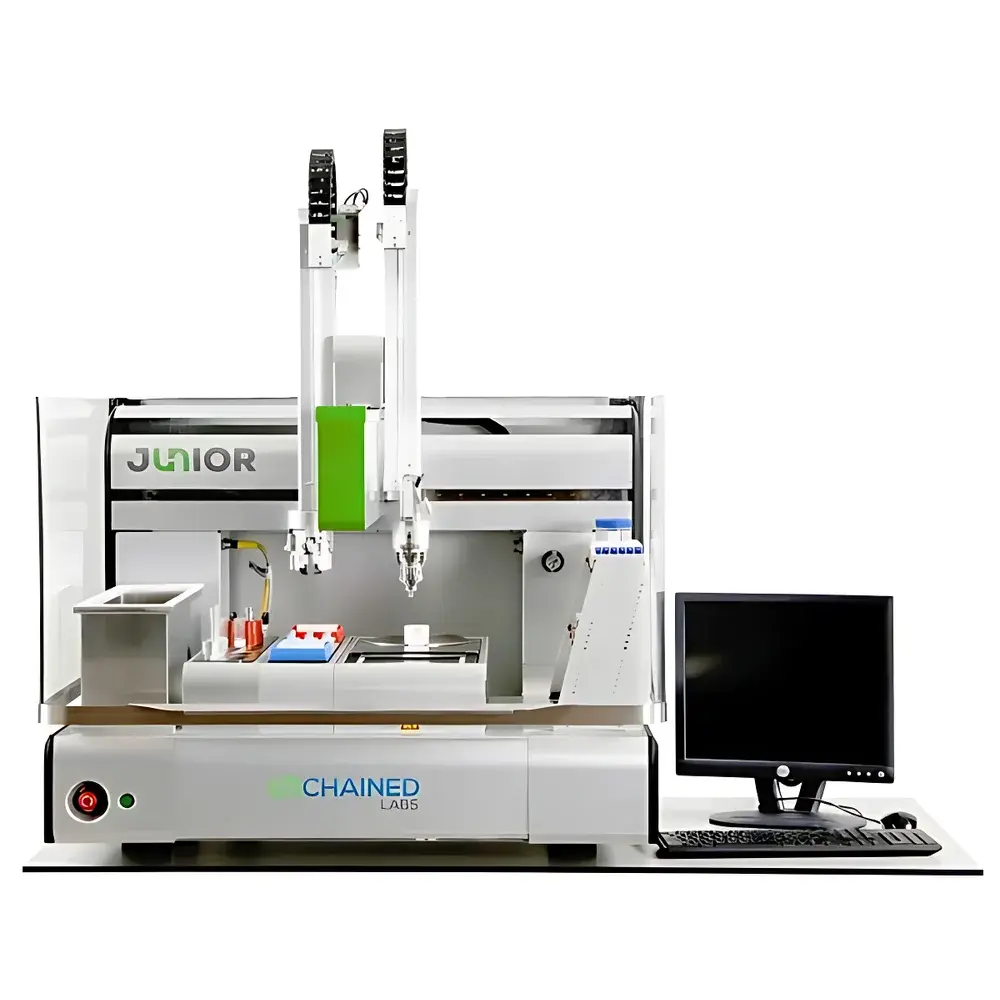
Unchained Labs Metals Impregnation System (MIPS)
| Brand | Unchained Labs |
|---|---|
| Origin | USA |
| Model | MIPS |
| Temperature Range | −20 °C to 180 °C |
| Temperature Control Accuracy | ±1 °C |
| Reaction Units | 24 / 48 / 96 wells |
| Reaction Volume Capacity | 0–125 mL |
| Liquid Dispensing | 4-channel variable-pitch pipettor (9 / 13 / 30 mm) |
| Viscosity Handling | 1–1000 cP |
| Solid Dispensing | Powderium™ hopper (10–100 mL), SV vial (4 mL) |
| Balance Range | 0.0001–1200 g |
| Imaging Resolution | 1032 × 779 pixels |
| Stirring Speed | up to 750 rpm |
| Vibration Frequency | 50/60 Hz |
| Cap Sealing Range | vials 2–250 mL, height 32–86 mm |
Overview
The Unchained Labs Metals Impregnation System (MIPS) is an automated, modular platform engineered for the reproducible, high-throughput preparation of supported heterogeneous catalysts via incipient wetness impregnation and related solution-based deposition techniques. Built on a foundation of precision fluidics, gravimetric solid dispensing, and thermally controlled reaction staging, MIPS implements a closed-loop synthesis workflow—from solid support conditioning and precursor solution formulation to pH-adjusted impregnation, controlled drying, and sealed vial storage. Its architecture supports parallel processing across 24, 48, or 96 independent reaction vessels, enabling laboratories to generate statistically meaningful catalyst libraries within days rather than weeks. The system operates on core principles of mass balance-driven stoichiometry, dynamic liquid–solid interaction control, and thermal history management—critical parameters in determining metal dispersion, surface coverage, and subsequent catalytic performance.
Key Features
- Integrated multi-modal dispensing: Four independent, adjustable-pitch liquid channels (9 mm, 13 mm, 30 mm spacing) enable simultaneous reagent addition to microtiter plates, vials, or custom arrays without cross-contamination.
- Gravimetric solid dosing with dual-hopper capability: Powderium™ reservoir (10–100 mL) handles free-flowing supports; SV vial (4 mL) accommodates fine, cohesive, or hygroscopic powders with sub-milligram repeatability.
- Viscosity-resilient liquid handling: Programmable piston-driven dispensers process solutions from 1 cP (aqueous) to 1000 cP (glycerol-based or polymer-containing precursors) with volumetric accuracy validated per ISO 8655-6.
- Thermally decoupled heating/cooling stages: Independent hot plate (RT–180 °C) and Peltier-cooled stage (−20 °C to 120 °C) allow sequential thermal treatments—including solvent evaporation, calcination pre-steps, and low-temperature stabilization—under inert or ambient atmosphere.
- High-intensity vertical vibration module: 50/60 Hz oscillation ensures uniform particle fluidization during impregnation, minimizing channeling and promoting homogeneous metal distribution across porous supports such as alumina, silica, carbon, or zeolites.
- Automated cap sealing station: Compatible with crimp, screw, and septum caps for vials ranging from 2 mL to 250 mL, supporting downstream compatibility with glovebox transfer, GC headspace analysis, or accelerated aging studies.
Sample Compatibility & Compliance
MIPS accommodates standard laboratory consumables including ANSI/SLAS-format microplates, 10–50 mL scintillation vials, and custom reactor tubes (8–60 mm diameter). All wetted components are chemically resistant to common catalyst precursors (e.g., nitrate, chloride, acetate salts) and organic solvents (ethanol, isopropanol, ethylene glycol). The system complies with CE marking requirements and meets electrical safety standards IEC 61010-1. For regulated environments, LEA software supports audit trails, electronic signatures, and user-access tiering aligned with FDA 21 CFR Part 11 and GLP/GMP documentation workflows. Data integrity is preserved through timestamped metadata capture for every dispense event, weight measurement, temperature setpoint, and vibration cycle.
Software & Data Management
The LEA (Laboratory Execution Architecture) software provides a unified interface for experimental design, method deployment, real-time monitoring, and structured data export. Users define synthesis protocols using hierarchical templates—specifying support mass, metal loading target, precursor concentration, solvent composition, and thermal ramp profiles. LEA auto-calculates required volumes and masses based on stoichiometric equivalence and measured bulk density. All instrument actions are logged with full traceability: balance readings (0.1 mg resolution), temperature deviations (<±0.5 °C), dispensing timestamps, and camera-captured process snapshots (1032 × 779 px). Export formats include CSV, JSON, and ISA-Tab for integration with ELN systems (e.g., LabArchives, Benchling) or statistical modeling platforms (Python/Pandas, JMP).
Applications
- Rapid screening of metal–support combinations (e.g., Pt/TiO₂, Ni/SiO₂, Co/Al₂O₃) for hydrogenation, oxidation, or reforming reactions.
- Optimization of impregnation parameters—including pH, aging time, drying rate, and calcination ramp—to control crystallite size and oxidation state.
- Preparation of catalyst libraries for evaluation in high-throughput flow reactors (e.g., Unchained Labs’ LUNA or commercial microreactors).
- Reproducible synthesis of reference materials for XRD, XPS, TEM, and BET characterization workflows.
- Method development for scale-up translation: Correlating small-scale MIPS outputs with pilot-scale fixed-bed or slurry-phase performance data.
FAQ
What types of solid supports are compatible with MIPS?
Standard porous oxides (γ-Al₂O₃, SiO₂, TiO₂, CeO₂), activated carbon, zeolites (e.g., ZSM-5, Beta), and mixed-metal oxides—provided particle size falls within 10–200 µm and bulk density is ≥0.2 g/mL.
Can MIPS handle air-sensitive precursors?
Yes—when integrated with optional inert-gas purged enclosures or glovebox docking stations; all liquid and solid modules support nitrogen/argon blanketing during dispensing and impregnation.
Is method validation support available?
Unchained Labs provides IQ/OQ documentation templates, calibration certificates for balance and temperature sensors, and protocol-specific verification reports upon request.
How does MIPS ensure batch-to-batch reproducibility?
Through real-time gravimetric feedback loops, closed-loop temperature regulation, and vibration-synchronized impregnation timing—reducing inter-unit CV to <3% for metal loading across 96-well runs.
What maintenance intervals are recommended?
Liquid dispensing manifolds require cleaning every 200 cycles; solid hoppers should be inspected after each support type change; annual recalibration of balance and thermal sensors is advised per ISO/IEC 17025 guidelines.



