
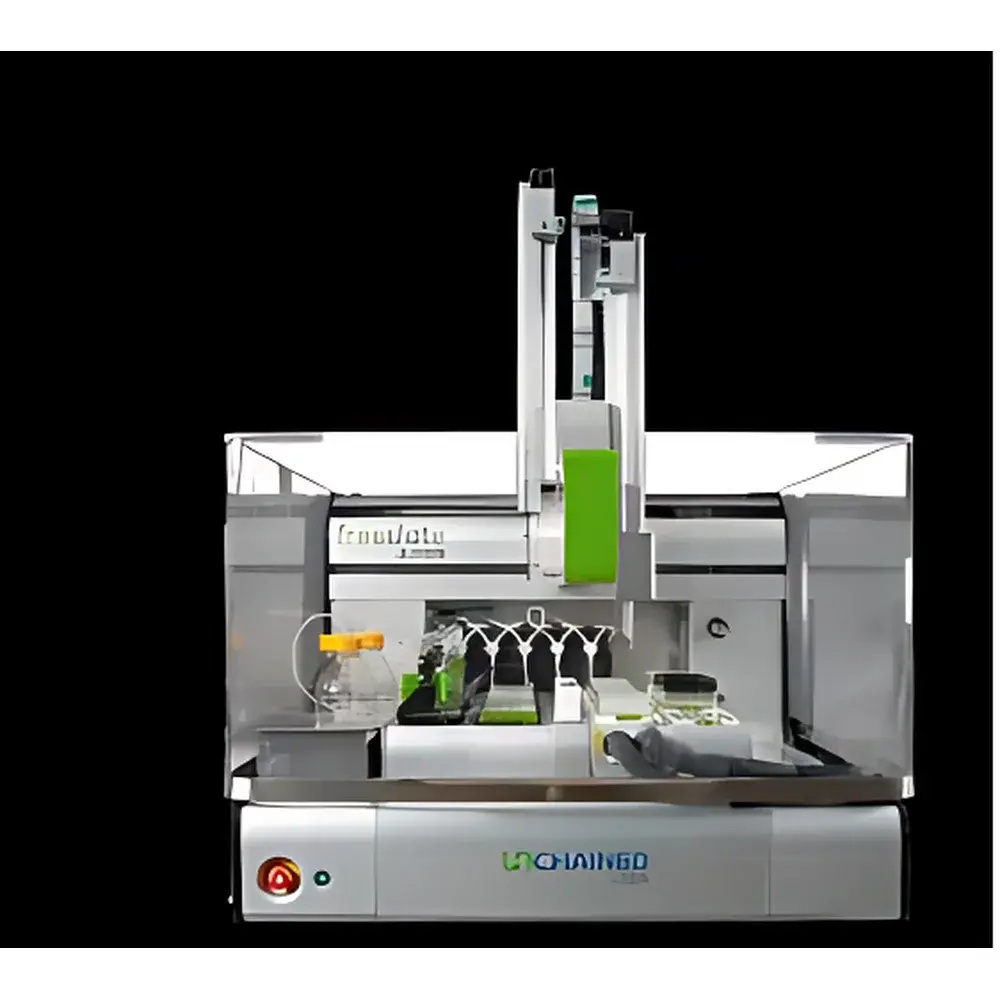
Unchained Labs OSR Optimization Sampling Reactor
| Brand | Unchained Labs |
|---|---|
| Origin | USA |
| Model | OSR (Optimization Sampling Reactor) |
| Reactor Type | High-Throughput Parallel Flow Reactor |
| Vessel Material | 316 Stainless Steel |
| Operating Pressure Range | Ambient to 400 PSI |
| Temperature Range | 20 °C to 200 °C |
| Individual Vessel Volume | 7–25 mL |
| Number of Parallel Stations | 8 |
| Vacuum Capability | Up to 400 PSI (gauge, positive pressure mode) |
| Control Architecture | Integrated LEA Software Platform |
| Compliance | Designed for GLP-compliant workflows with audit-trail-enabled data capture |
Overview
The Unchained Labs OSR Optimization Sampling Reactor is an engineered high-throughput parallel flow reactor system designed for systematic catalyst screening, reaction condition optimization, and kinetic profiling under controlled temperature and pressure. Based on continuous-flow microreactor architecture with independent thermal management per station, the OSR implements a Couette-type or segmented plug-flow configuration—depending on internal hardware configuration—to ensure reproducible residence time distribution and minimize axial dispersion. It operates within a rigorously sealed stainless-steel manifold, enabling precise pressurization up to 400 PSI (gauge) while maintaining leak-tight integrity across all eight parallel channels. The system is not a batch autoclave but rather a modular, continuously sampled reaction platform where real-time process control and automated sampling are integral to experimental design—not post-hoc add-ons.
Key Features
- Eight independently temperature-controlled reaction stations, each with dedicated PID-controlled heating/cooling zones (20 °C–200 °C, ±0.5 °C stability)
- Integrated pressure regulation via back-pressure regulators (BPRs), supporting both constant-pressure and ramped-pressure protocols from ambient to 400 PSI
- Automated, non-invasive sampling using pneumatically actuated syringe-based micro-samplers—each draw is volume-calibrated and introduces <0.5% transient perturbation to bulk concentration
- Real-time synchronization of temperature, pressure, flow rate, and sampling events via the LEA (Laboratory Execution Architecture) software environment
- Modular vessel design with standard Swagelok®-compatible 1/4″ NPT ports, facilitating rapid reconfiguration for liquid-phase hydrogenation, oxidation, cross-coupling, or enzymatic reactions
- Stainless steel (316 SS) wetted parts conforming to ASTM A276 and ASME BPE standards for corrosion resistance and cleanability
Sample Compatibility & Compliance
The OSR accommodates homogeneous and heterogeneous catalytic systems—including supported metal nanoparticles, immobilized enzymes, and organometallic complexes—in solvent matrices ranging from water and alcohols to chlorinated hydrocarbons and supercritical CO₂-compatible mixtures. Each reactor supports solid catalyst loading up to 100 mg without channel blockage, validated per ISO 11276 for particulate suspension stability in microflow environments. The system complies with mechanical integrity requirements outlined in ASME BPVC Section VIII, Division 1, and includes certified pressure relief mechanisms. Data acquisition meets FDA 21 CFR Part 11 criteria through LEA’s role-based access control, electronic signatures, and immutable audit trails—enabling direct use in GMP-regulated process development labs.
Software & Data Management
LEA serves as the unified interface for experiment definition, device orchestration, and analytical integration. Users define multivariable DoE (Design of Experiments) templates—including temperature ramps, pressure steps, and staggered sampling schedules—via drag-and-drop workflow builders. All sensor telemetry (RTD, strain-gauge pressure transducers, mass flow controllers) is timestamped at 100 Hz and stored in HDF5 format with embedded metadata (e.g., calibration certificates, operator ID, environmental log). Export options include CSV, MATLAB .mat, and direct linkage to third-party cheminformatics platforms (e.g., KNIME, Spotfire) via REST API. Raw data files are cryptographically hashed upon generation and retained with versioned provenance tracking.
Applications
- Catalyst structure–activity relationship (SAR) mapping across combinatorial ligand/metal/support libraries
- Thermal and pressure sensitivity analysis for exothermic nitration or epoxidation processes
- Residence time distribution (RTD) studies for scale-up correlation between microfluidic and pilot-plant reactors
- Accelerated stability testing of pharmaceutical intermediates under oxidative stress conditions
- Enzyme immobilization efficiency evaluation via real-time turnover number (TON) monitoring
- Reaction calorimetry proxy estimation via dynamic temperature–power correlation modeling
FAQ
Can the OSR be integrated with in-line analytics such as FTIR or UV-Vis?
Yes—standard optical flow cells (2 mm pathlength, sapphire windows) are available as OEM accessories; spectral data streams synchronize natively with LEA timestamps.
Is remote operation supported for unattended overnight runs?
All OSR units ship with TLS-secured remote desktop access and watchdog-triggered SMS/email alerts for pressure excursion or thermal fault events.
What maintenance intervals are recommended for pneumatic sampling modules?
Syringe seals require replacement every 500 cycles; full module recalibration is advised quarterly or after any system-level firmware update.
Does the OSR support gas–liquid mass transfer quantification?
When paired with calibrated mass flow controllers and dissolved oxygen probes, it enables kLa determination per ASTM D2395-17 methodology.
Are validation documents (IQ/OQ/PQ protocols) provided?
Unchained Labs supplies configurable IQ/OQ templates aligned with ISO/IEC 17025; PQ execution support is available through certified field application engineers.



