
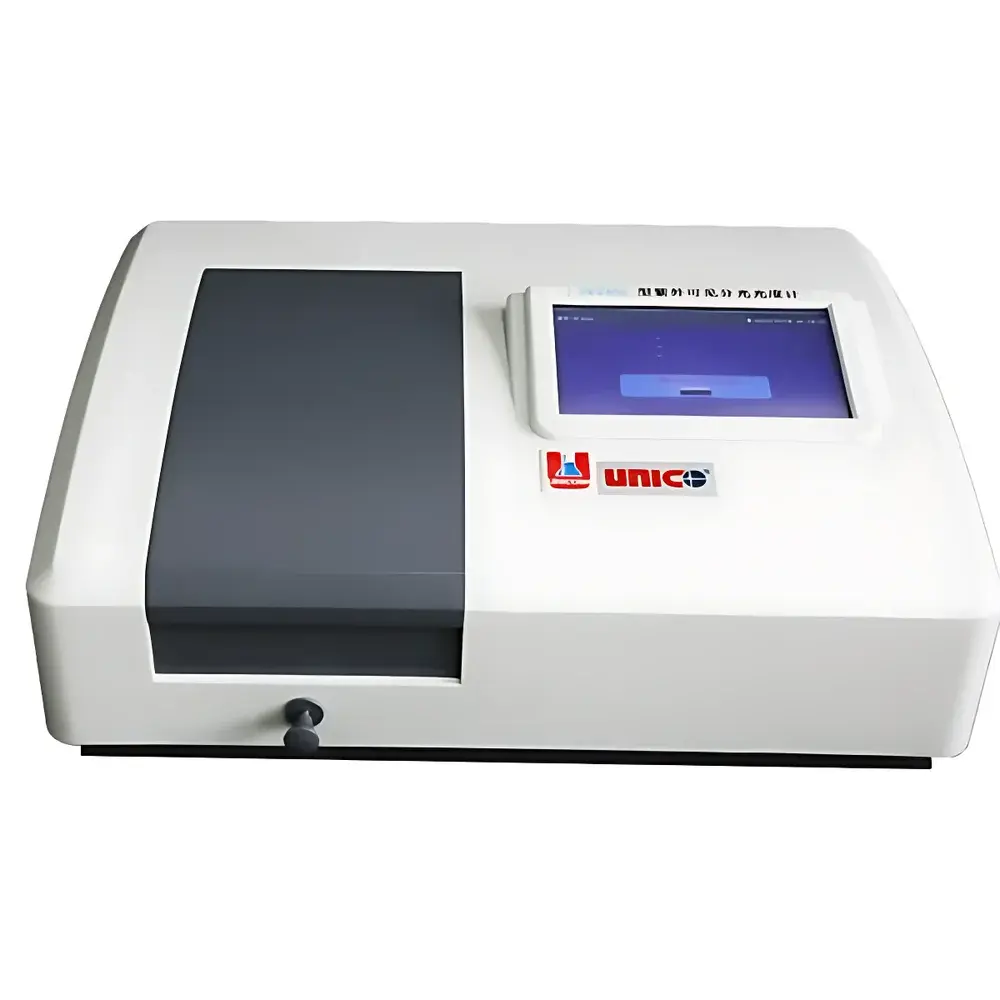
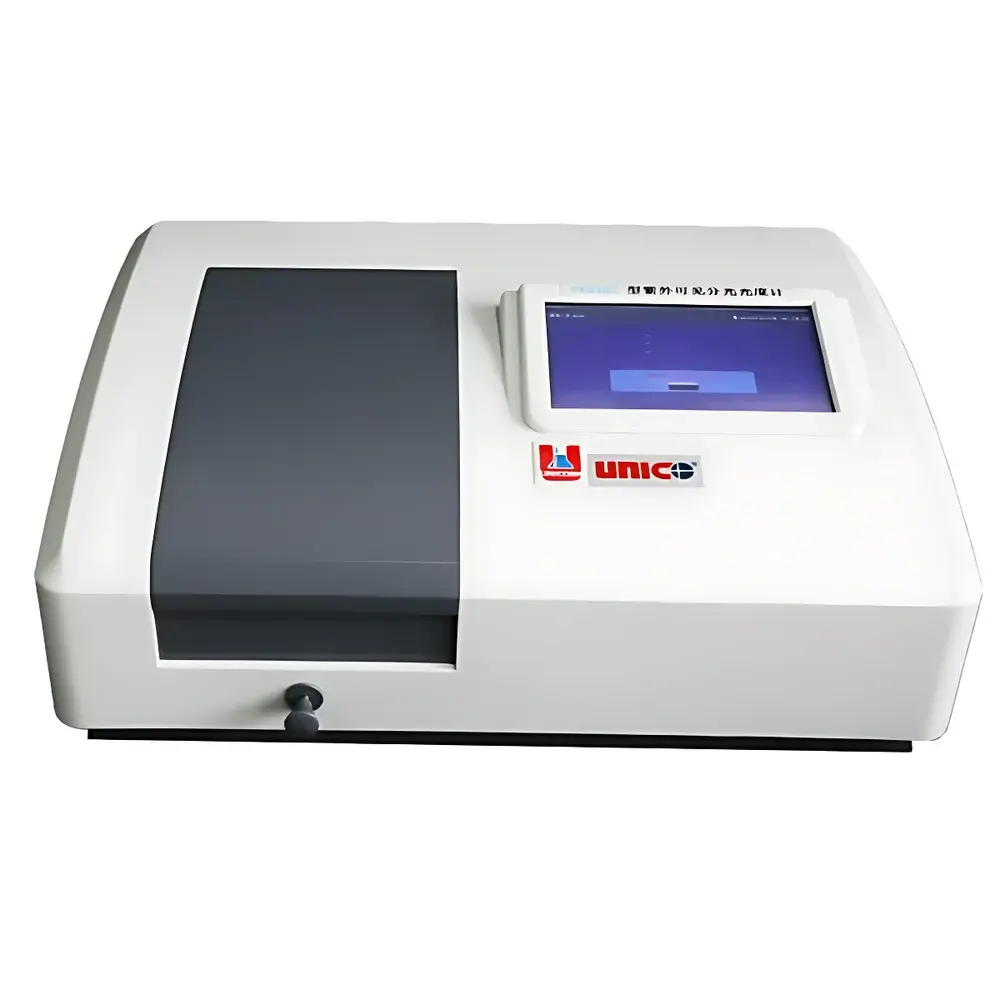
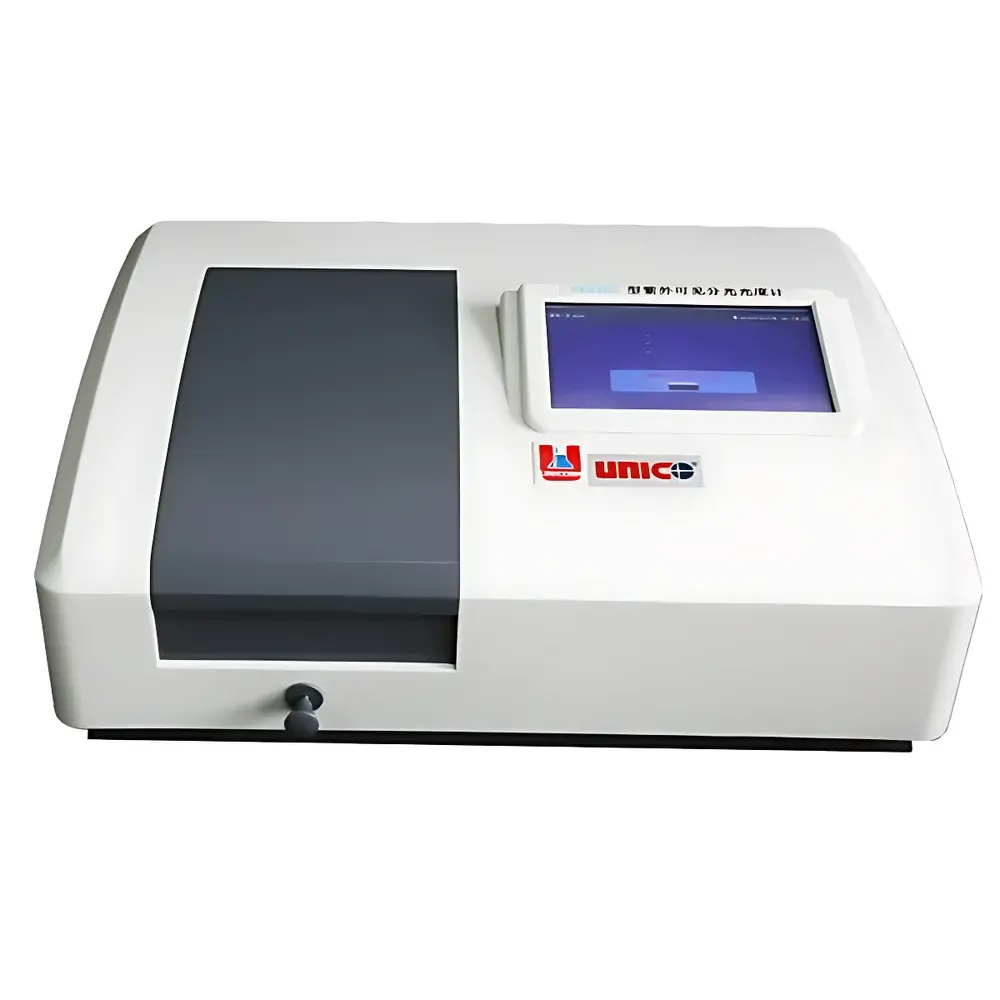
UniCo UV-2365 Ultraviolet-Visible Spectrophotometer
| Brand | UniCo |
|---|---|
| Origin | Shanghai, China |
| Instrument Type | Single-Beam |
| Detector | Photodiode Array (PDA) |
| Wavelength Range | 190–1100 nm |
| Spectral Bandwidth | 1.8 nm |
| Wavelength Accuracy | ±0.3 nm |
| Wavelength Repeatability | ≤0.2 nm |
| Stray Light | ≤0.05% T |
| Display | 7-inch high-resolution color touchscreen |
| Data Interface | USB storage, Bluetooth printing & mobile app integration |
| Scan Speed | Up to 3000 nm/min (high mode) |
| Scan Interval Options | 0.1, 0.2, 0.5, 1, 2, 5 nm |
| Kinetic Sampling Interval | 0.5 s minimum |
| Kinetic Duration | Up to 9 hours |
| Calibration Modes | Zero-order, first-order (with/without intercept), second-order, third-order polynomial regression |
| Standard Curve Methods | Single-wavelength, dual-wavelength (isosbestic point), three-point calibration |
| File Capacity | 100 measurement records per test type |
| Compliance | Designed for routine QC and R&D use in GLP-aligned laboratories |
Overview
The UniCo UV-2365 is a single-beam ultraviolet-visible spectrophotometer engineered for precision, reliability, and operational flexibility in routine analytical laboratories. It operates on the fundamental principle of Beer–Lambert law-based absorbance measurement, utilizing a stable deuterium/tungsten-halogen light source and a high-sensitivity photodiode array (PDA) detector to quantify analyte concentration across the full UV-Vis spectrum (190–1100 nm). Its 1.8 nm spectral bandwidth ensures adequate resolution for most pharmaceutical, environmental, and biochemical applications—balancing signal-to-noise ratio with spectral fidelity. The instrument’s optical design minimizes thermal drift and mechanical hysteresis, contributing to long-term baseline stability and reproducibility under standard laboratory conditions (20–25 °C, <65% RH).
Key Features
- 7-inch capacitive color touchscreen interface enabling direct visualization of spectra, kinetic traces, and calibration curves—no external PC required for basic operation.
- Integrated Bluetooth 4.2 module supporting wireless data export to compatible printers and mobile devices; paired with a dedicated iOS/Android application for remote monitoring and file synchronization.
- Multi-mode scanning capability: user-defined wavelength range, variable scan intervals (0.1–5 nm), and selectable scan speeds (low/medium/high), with automatic peak/valley detection and derivative analysis.
- Comprehensive kinetic module supporting time-resolved measurements at 0.5-second minimum sampling intervals, programmable delay start, and up to 9-hour continuous acquisition.
- Advanced data processing engine supporting zero-, first-, second-, and third-order polynomial regression; dual-wavelength analysis at isosbestic points; and three-point calibration for non-linear response correction.
- Local data management via USB flash drive: stores spectra, kinetics, multi-wavelength results, and calibration parameters in standardized CSV and XML formats compliant with LIMS ingestion protocols.
Sample Compatibility & Compliance
The UV-2365 accommodates standard 10-mm pathlength quartz or glass cuvettes (including semi-micro and micro-volume variants with optional adapters). It supports liquid-phase analysis of aqueous, organic, and mixed-solvent systems—commonly applied to quantification of nucleic acids, proteins, pharmaceutical actives, catalysts, and environmental pollutants (e.g., nitrate, phosphate, COD indicators). While not certified for GMP production environments, its software architecture supports audit-ready workflows: all measurement events—including method parameters, operator ID, timestamp, and raw absorbance values—are logged locally with immutable timestamps. The system aligns with general requirements of ISO/IEC 17025 for testing laboratories and provides traceable calibration verification per ASTM E275 and USP guidelines.
Software & Data Management
Firmware v3.2+ includes embedded data handling tools compliant with FDA 21 CFR Part 11 principles: electronic signatures are supported via password-protected user roles (Operator, Supervisor, Administrator); all method changes and result modifications generate timestamped audit trails. Raw spectral data is exported in vendor-neutral formats (CSV, ASCII, XML) compatible with third-party analysis platforms such as OriginLab, MATLAB, and Python-based spectroscopic libraries (e.g., scikit-spectra, PySpectra). The mobile application enables secure cloud backup (via encrypted HTTPS channels), QR-code-assisted instrument pairing, and real-time push notifications for completed assays or error conditions.
Applications
- Pharmaceutical QC: assay of active pharmaceutical ingredients (APIs), excipient compatibility studies, dissolution profile analysis.
- Environmental testing: determination of heavy metals (via complexometric colorimetry), nutrient concentrations (NO₃⁻, PO₄³⁻), and organic contaminant screening (e.g., phenols, PAHs).
- Life sciences: DNA/RNA quantification (A260/A280 ratios), protein concentration (Bradford/Lowry/Biuret assays), enzyme kinetics (NADH/NADPH monitoring at 340 nm).
- Industrial R&D: pigment formulation validation, polymer degradation assessment, catalyst activity profiling under controlled irradiation.
- Academic research: teaching labs requiring intuitive interface and robust spectral acquisition for undergraduate spectroscopy curricula.
FAQ
Does the UV-2365 support GLP-compliant data archiving?
Yes—audit trail logging, user access control, and immutable record generation meet foundational GLP documentation requirements for non-GMP research and quality control environments.
Can the instrument be integrated into a centralized LIMS?
Yes—CSV and XML exports are structured for automated ingestion; optional RS-232 or Ethernet modules (sold separately) enable direct serial communication with LIMS middleware.
What cuvette materials are recommended for UV-range measurements below 220 nm?
High-purity fused silica cuvettes with polished optical surfaces are required for reliable transmission at 190–220 nm; standard quartz cuvettes must be verified for UV-grade transmission specifications.
Is wavelength calibration traceable to NIST standards?
The factory calibration uses holmium oxide and didymium filters traceable to NIST SRM 2034 and SRM 2035; users may perform periodic verification using certified reference materials.
How is photometric accuracy validated during routine operation?
Users can run internal validation routines using neutral density filters or potassium dichromate solutions per ISO 6060 and ASTM E380 protocols; results are automatically compared against tolerance thresholds and logged.




