
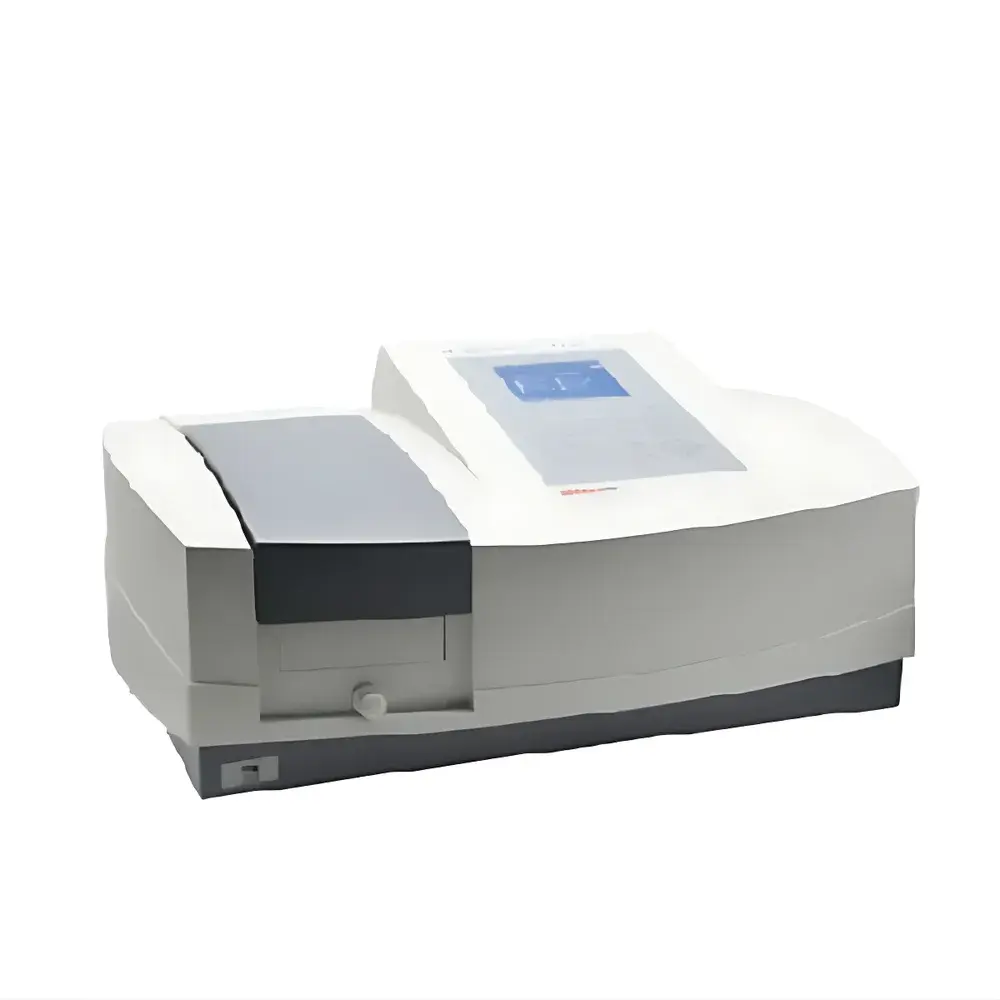
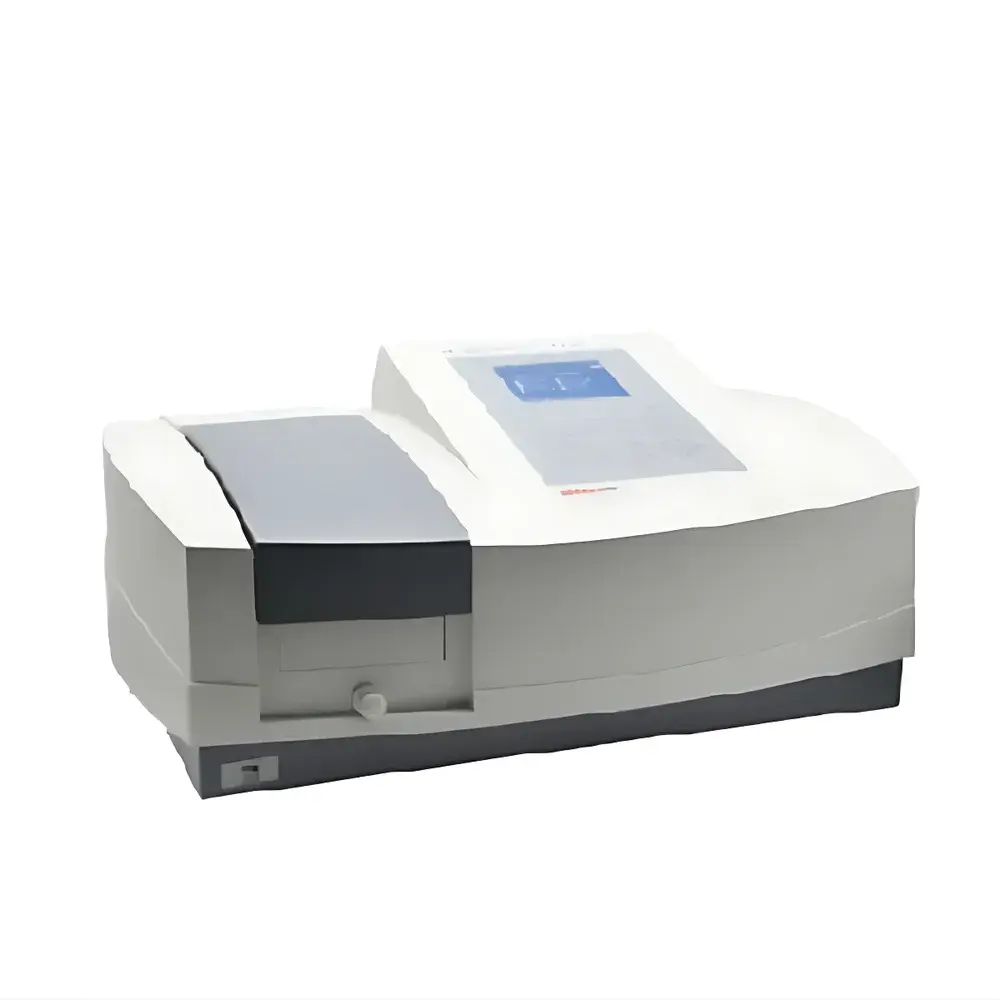
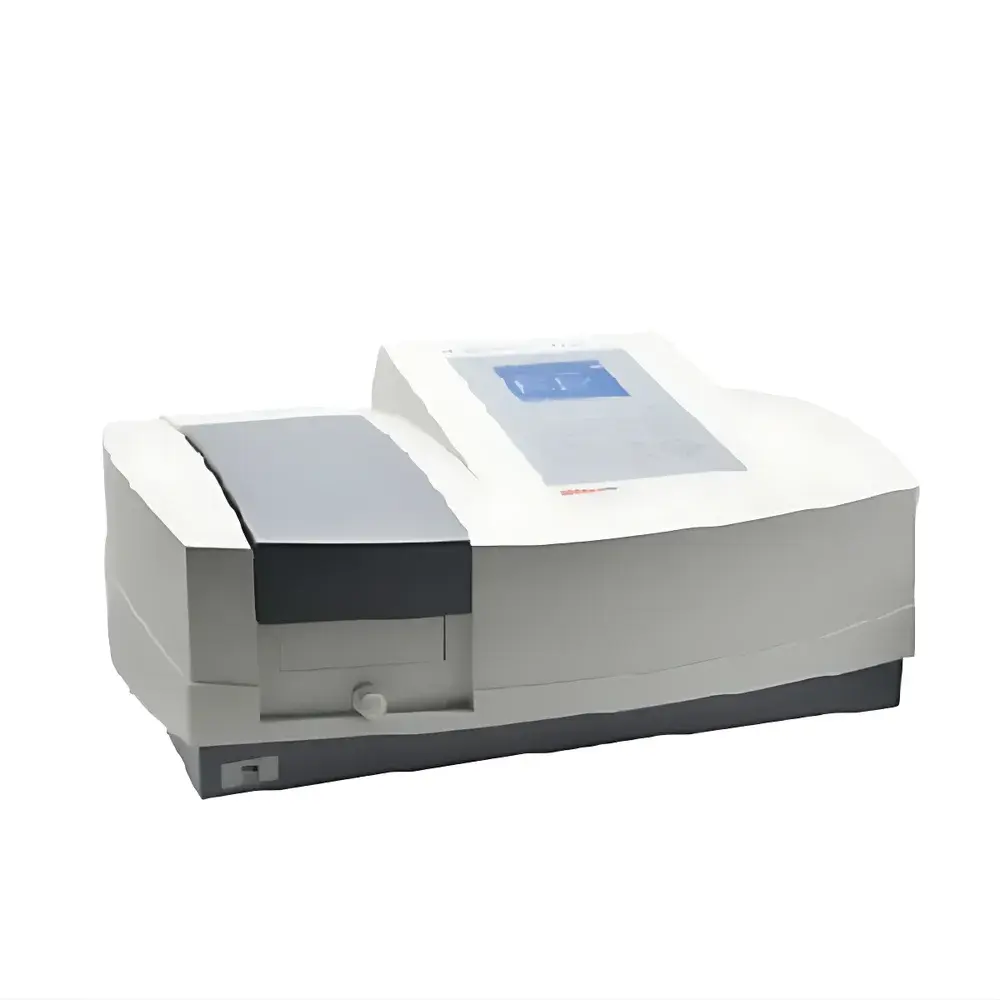
UniCo UV-3802S Advanced Variable-Slit Double-Beam Ultraviolet-Visible Spectrophotometer
| Brand | UniCo |
|---|---|
| Origin | Shanghai, China |
| Model | UV-3802S |
| Optical System | Pseudo-Double-Beam |
| Detector Type | Silicon Photocell |
| Wavelength Range | 190–1100 nm |
| Wavelength Accuracy | ±0.3 nm |
| Wavelength Repeatability | ≤0.2 nm |
| Spectral Bandwidth | 0.5 / 1 / 2 / 4 nm (selectable) |
| Stray Light | ≤0.05% T |
| Photometric Accuracy | ±0.004 Abs (0–0.5 Abs), ±0.004 Abs (0.5–1.0 Abs), ±0.5% T |
| Photometric Repeatability | ±0.001 Abs (0–0.5 Abs), ±0.002 Abs (0.5–1.0 Abs), ±0.2% T |
| Baseline Drift | ±0.002 A/h (at 500 nm, after warm-up) |
| Display | 320 × 240 graphical LCD |
| Data Interface | USB port |
| Dimensions (W × D × H) | 625 × 405 × 280 mm |
| Weight | 24 kg |
Overview
The UniCo UV-3802S is a high-performance, variable-slit pseudo-double-beam ultraviolet-visible (UV-Vis) spectrophotometer engineered for precision absorbance, transmittance, and concentration measurements across the full spectral range of 190–1100 nm. Its optical architecture employs a 1200-line/mm holographic grating and a stable silicon photocell detector, enabling reliable quantification in research laboratories, quality control environments, and educational institutions. Unlike true double-beam systems that split light continuously via a mechanical chopper, the UV-3802S utilizes a time-shared reference–sample measurement protocol—where the beam alternates rapidly between reference and sample paths—delivering improved photometric stability while minimizing mechanical complexity and long-term alignment drift. This design ensures robust baseline linearity (±0.002 A) and low thermal drift (±0.002 A/h at 500 nm post-warm-up), critical for extended kinetic assays or multi-point calibration workflows.
Key Features
- Four selectable spectral bandwidths (0.5, 1, 2, and 4 nm) to balance resolution and signal-to-noise ratio according to sample matrix and regulatory requirements.
- Precision wavelength accuracy of ±0.3 nm and repeatability ≤0.2 nm—validated against NIST-traceable holmium oxide and didymium filters—ensuring compliance with ISO 9001 and ASTM E275-22 standards for spectrophotometer verification.
- Graphical 320 × 240 LCD display with intuitive touch-sensitive keypad navigation, eliminating membrane-switch wear and supporting real-time spectral visualization during scanning.
- Integrated USB interface for direct data export to FAT32-formatted USB drives—no proprietary drivers required—and native support for CSV and ASCII formats compatible with LIMS, Excel, and third-party analysis platforms.
- Onboard quantitative analysis modes including fixed-wavelength measurement, multi-wavelength analysis, kinetics (time-scan), standard curve generation (linear, quadratic, cubic), and dedicated nucleic acid/protein calculation protocols (A260/A280 ratios, extinction coefficients).
Sample Compatibility & Compliance
The UV-3802S accommodates standard 10-mm pathlength cuvettes—including supplied quartz (for UV < 220 nm) and optical glass cells—enabling routine analysis of aqueous buffers, organic solvents, enzyme solutions, and purified biomolecules. Its optical path geometry complies with ISO 6223:2021 (spectrophotometers for pharmaceutical applications) and supports GLP-compliant documentation when used with UniCo’s optional PC software, which logs user ID, timestamp, method parameters, and raw absorbance values with audit-trail capability. While not FDA 21 CFR Part 11–certified out-of-the-box, the system meets foundational data integrity criteria (ALCOA+ principles) when deployed with controlled access, electronic signatures, and version-controlled method files.
Software & Data Management
The included UniCo Advanced Spectroscopy Software (v3.x) provides comprehensive instrument control, spectral processing (baseline correction, peak integration, derivative analysis), and report generation compliant with ISO/IEC 17025 documentation templates. Raw data files retain full metadata—including slit width, scan speed, integration time, and lamp status—and support batch processing for QC release testing. The software enforces method locking and user-level permission tiers (Operator, Supervisor, Administrator), facilitating SOP adherence in regulated environments. All exported datasets include embedded calibration history and instrument identification tags for traceability.
Applications
The UV-3802S serves as a core analytical tool in diverse settings: quantification of DNA/RNA (via A260), protein concentration (A280 or Bradford/Lowry assays), enzymatic reaction monitoring (e.g., NADH oxidation at 340 nm), colorimetric endpoint assays (e.g., phosphate, nitrate, heavy metals), dissolution testing per USP , and excipient purity screening in pharmaceutical development. Its wide dynamic range (–0.3 to 3.0 A; 0–200% T) and low stray light (<0.05% T at 220 nm) ensure accurate measurements even for highly absorbing or turbid samples—critical for formulation stability studies and environmental water analysis.
FAQ
What distinguishes “pseudo-double-beam” from true double-beam operation?
Pseudo-double-beam instruments sequentially measure reference and sample beams using a single optical path and rapid electronic switching—reducing cost and maintenance while retaining most stability benefits of dual-path designs.
Can the UV-3802S perform GMP-compliant testing?
Yes—when paired with validated UniCo software, defined SOPs, and documented calibration records, it fulfills key elements of EU Annex 11 and FDA guidance on computerized system validation.
Is quartz cuvette mandatory for UV-range measurements?
Yes—standard glass cuvettes absorb below ~340 nm; quartz is required for reliable quantification at 190–220 nm (e.g., peptide bonds, aromatic amino acids).
How is wavelength accuracy verified during routine qualification?
Using certified reference materials such as holmium oxide solution (sharp peaks at 241.5, 279.4, 287.5, 333.7 nm) and didymium filter (528.7, 573.0, 586.1, 640.8 nm), per ASTM E275-22 Section 8.
Does the system support external printer output?
No native parallel/serial printer interface is provided; reports are generated and exported digitally via USB or PC software for secure archival and review.





