
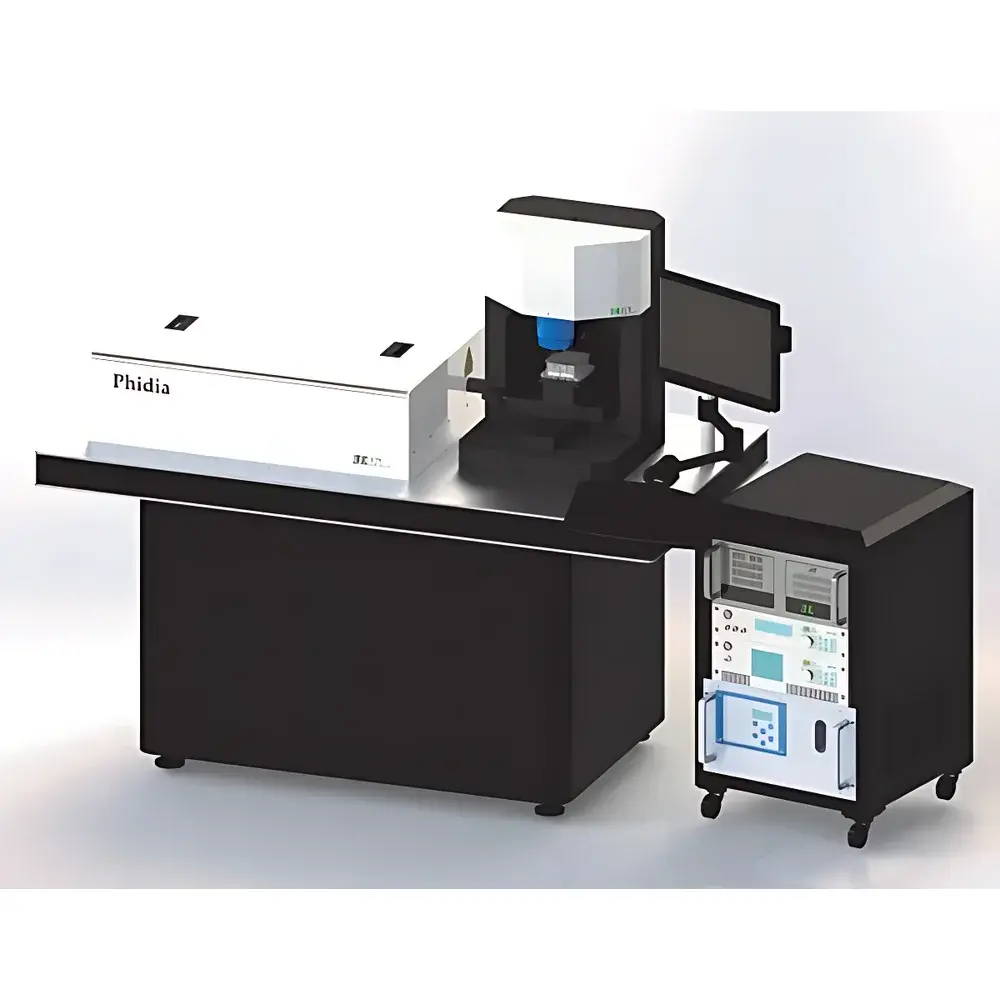
UpTek Solutions Corp. Phidia-10-FS/HFS Femtosecond Micromachining System
| Brand | UpTek |
|---|---|
| Origin | Germany |
| Manufacturer Type | Authorized Distributor |
| Product Category | Imported |
| Model | Phidia-10-FS/HFS |
| Core Component | Solid-State Femtosecond Laser System |
Overview
The UpTek Solutions Corp. Phidia-10-FS/HFS Femtosecond Micromachining System is a high-precision, industrial-grade platform engineered for non-thermal, sub-micron material processing using ultrashort pulse laser ablation. Based on the fundamental principle of multiphoton absorption and plasma-mediated energy deposition, this system delivers deterministic material removal with minimal heat-affected zones (HAZ), enabling true cold ablation across transparent dielectrics, metals, ceramics, polymers, and thin-film conductive layers such as ITO. The core laser source — the Phidia series — generates chirped-pulse amplified (CPA) femtosecond pulses with tunable pulse durations from 40 fs to 120 fs and pulse energies scalable up to 2 mJ, ensuring consistent process thresholds across heterogeneous material stacks. Integrated with the Spearay-series precision motion and beam delivery architecture, the system achieves long-term positional repeatability better than ±100 nm over multi-hour operation cycles — a requirement for GLP-compliant microfabrication workflows and ISO 13485-aligned medical device prototyping.
Key Features
- Industrial-strength solid-state femtosecond laser source (Phidia-10-FS/HFS) with active thermal stabilization and sealed-beam path architecture for >20,000 hours MTBF
- Modular laser processing head design supporting interchangeable focusing optics (NA 0.1–0.65), vacuum chuck interfaces, and in-situ process monitoring ports
- Granite-based龙门 (gantry) structural frame with linear air-bearing stages and Heidenhain encoders, delivering <±150 nm bidirectional positioning accuracy over 300 × 300 mm travel range
- Open-control architecture compliant with EtherCAT and RS-422 protocols, enabling integration with third-party ultrafast lasers (e.g., Coherent Monaco, Light Conversion Pharos, or Amplitude Satsuma)
- Passive and active vibration isolation compatible with ISO 23828 Class 2 cleanroom environments and standard laboratory floor installations
Sample Compatibility & Compliance
The Phidia-10-FS/HFS accommodates substrates ranging from 10 mm × 10 mm wafers to 600 mm × 400 mm display panels, including fused silica, sapphire, BK7, silicon, stainless steel 316L, alumina, polyimide, PET, and multilayer ITO/glass composites. All optical and mechanical subsystems conform to CE Machinery Directive 2006/42/EC, IEC 60825-1:2014 (Class 4 laser safety), and EN 61326-1:2013 (EMC for laboratory equipment). Process documentation supports FDA 21 CFR Part 11 audit trails when paired with UpTek’s optional TraceLog software module — including electronic signatures, version-controlled recipe management, and immutable raw-data archiving.
Software & Data Management
Control and workflow orchestration are executed via UpTek’s proprietary FemtoControl Suite v4.2 — a Windows 10/11-native application built on Qt and integrated with Python 3.9 scripting APIs. The suite provides real-time beam diagnostics (pulse energy, M², pointing stability), layer-by-layer depth profiling, and automated focus calibration using confocal chromatic sensors. Raw scan data (XYZ coordinates, pulse count, fluence maps) are exported in HDF5 format for post-processing in MATLAB, Python (NumPy/SciPy), or commercial CAE tools. Optional cloud synchronization enables secure remote monitoring and multi-site recipe validation per ISO/IEC 17025 requirements.
Applications
- Maskless direct-write fabrication of microfluidic channel networks in PMMA and glass substrates
- High-aspect-ratio drilling of fuel injector nozzles in hardened steel (diameters 5–50 µm, aspect ratios >20:1)
- Edge deletion and busbar isolation in photovoltaic PERC and TOPCon solar cells
- Surface texturing of ophthalmic lenses for anti-reflective and hydrophobic functionalization
- Micro-structuring of biodegradable polymer stents with feature sizes down to 300 nm
- Repair and trimming of thin-film resistor arrays in aerospace-grade hybrid circuits
FAQ
What is the maximum average power supported by the Phidia-10-FS/HFS system?
The system operates with an average power range of 10–50 W depending on repetition rate (1 kHz–2 MHz) and pulse energy configuration; optimal throughput is achieved at 20–30 W for most transparent material ablation tasks.
Can the system be upgraded to support burst-mode or shaped-pulse operation?
Yes — via firmware update and optional AOPDF (acousto-optic programmable dispersive filter) add-on, enabling temporal pulse shaping and burst sequencing with inter-pulse delays from 1 ns to 10 µs.
Is vacuum or inert-gas purging available for reactive material processing?
Standard configurations include N₂ purge ports on the processing chamber; vacuum-compatible variants (10⁻³ mbar base pressure) are available under custom order P/N PHIDIA-VAC-10FS.
Does UpTek provide application-specific process development support?
Yes — all systems ship with a 10-day on-site process optimization package, including DOE-based parameter mapping for target materials and geometry specifications.



