
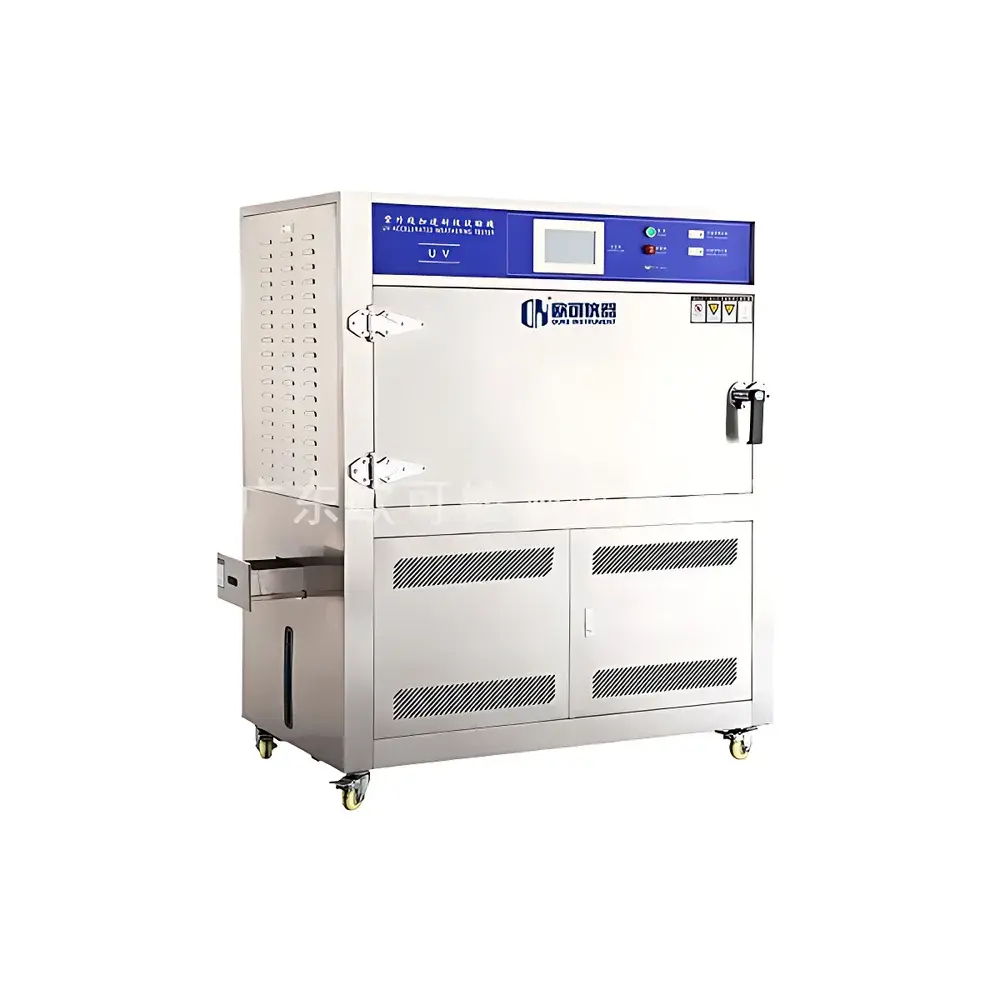
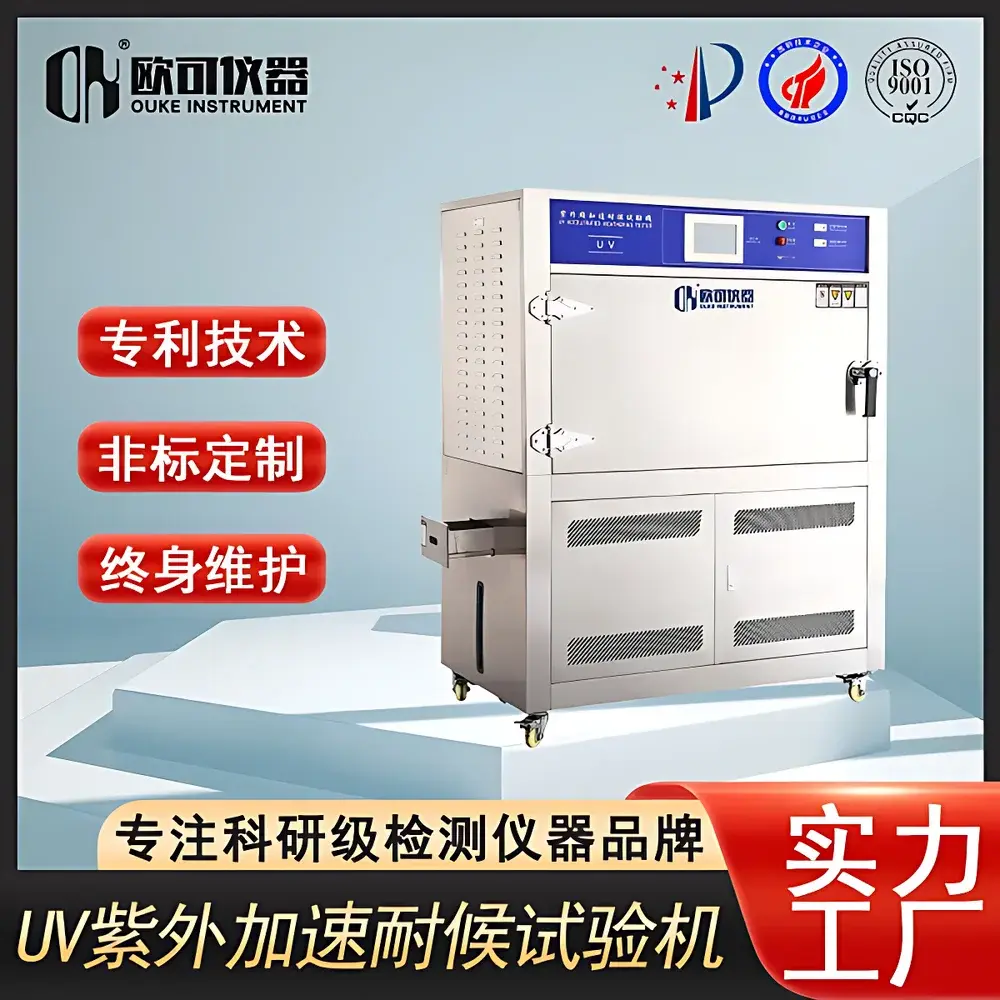
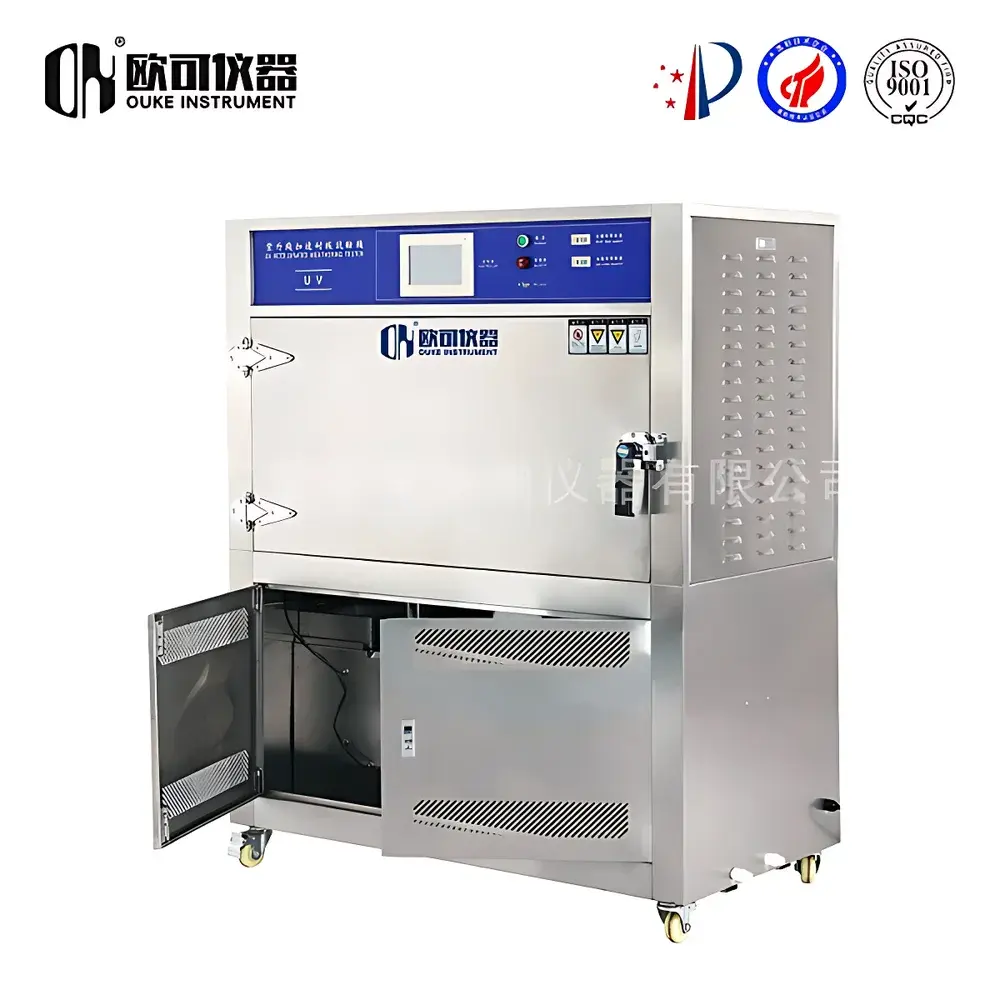
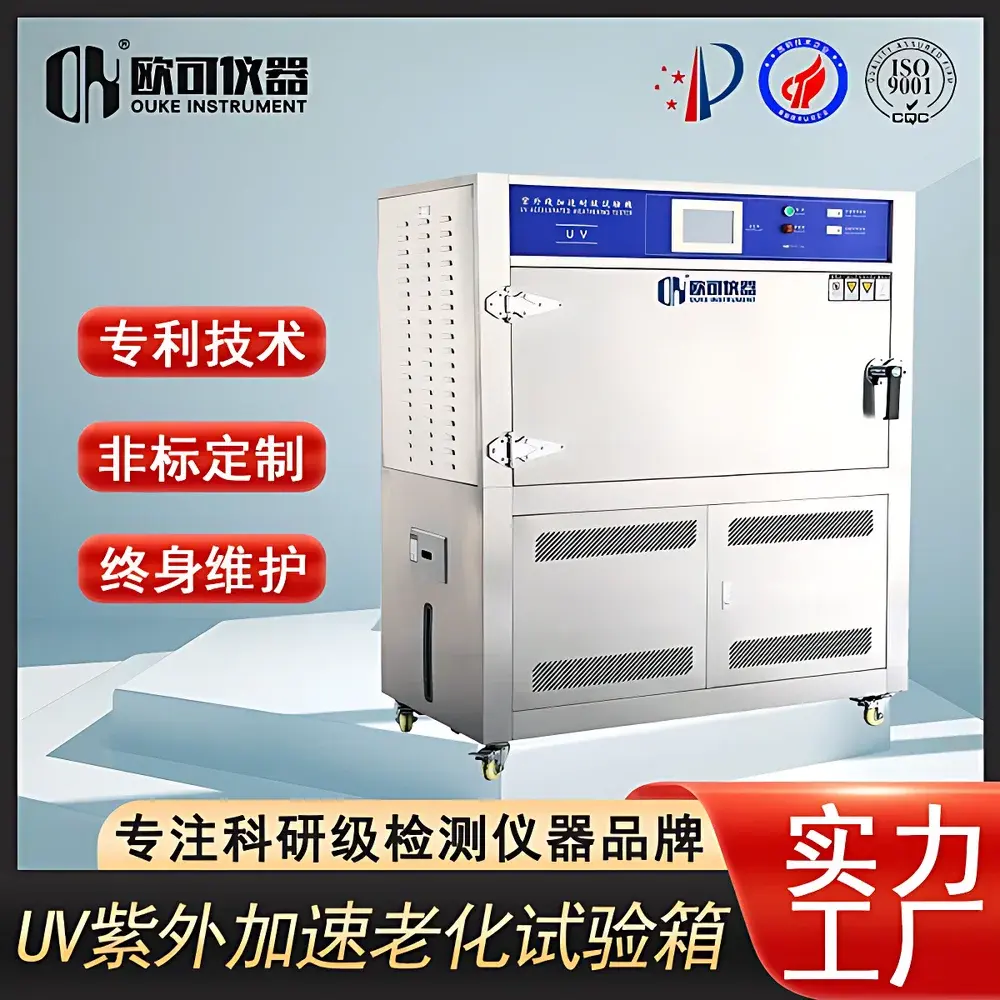
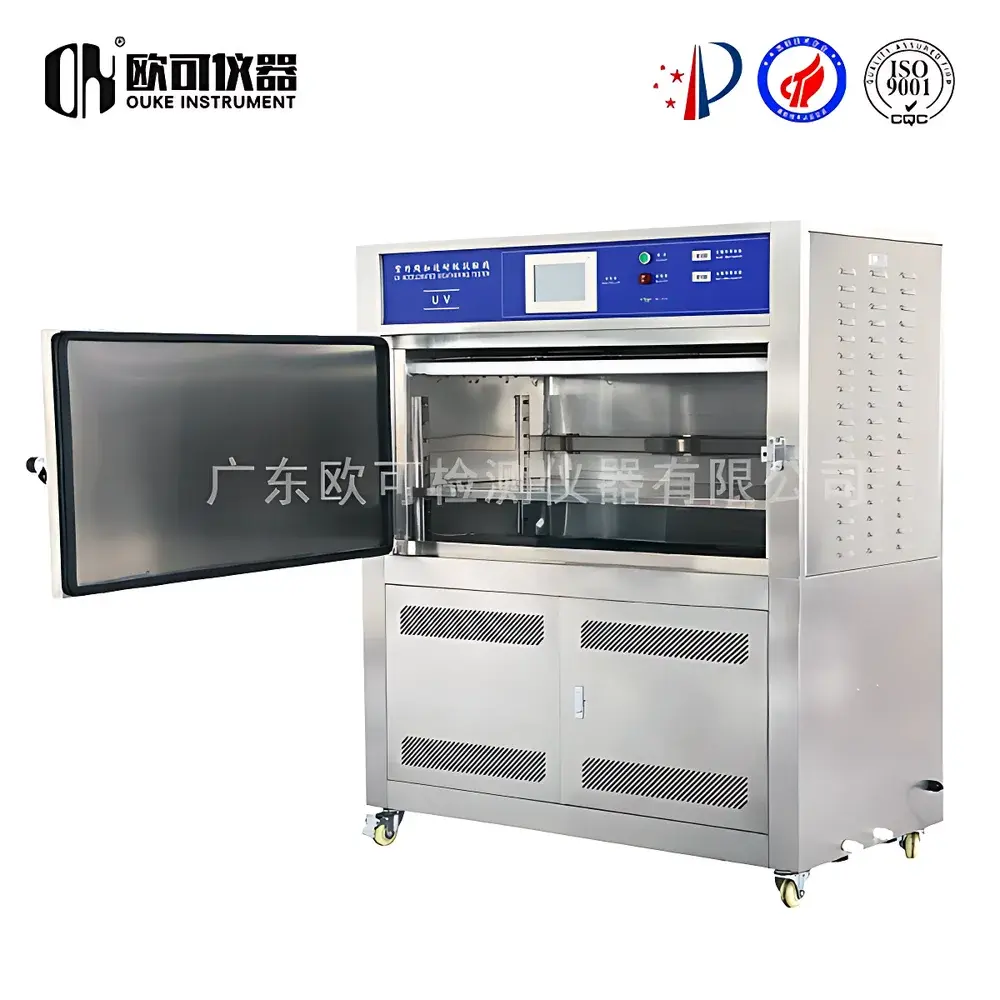
OK UV-290.00..0.. UV Aging Test Chamber
| Brand | OK Instruments |
|---|---|
| Origin | Guangdong, China |
| Manufacturer Type | Direct Manufacturer |
| Model | OK-UV-290.00..0.. |
| Humidity Range | ≥95% RH (in-chamber actual value) |
| Lamp Power | 40 W per tube |
| Irradiance Range | 0.72 W/m² |
| Exposure Time | 1–9999 h (adjustable) |
| Illumination Temperature Range | RT to 70 °C |
| UV Wavelength Range | 280–400 nm |
| Chamber Dimensions (L×W×H) | 1170 × 400 × 400 mm |
Overview
The OK UV-290.00..0.. UV Aging Test Chamber is a purpose-engineered environmental test system designed to accelerate material degradation under controlled ultraviolet (UV) radiation, thermal cycling, and moisture exposure. It operates on the principle of fluorescent UV lamp-based accelerated weathering—specifically replicating the most photochemically active portion of terrestrial solar irradiance (280–400 nm)—to induce and quantify photodegradation mechanisms such as polymer chain scission, chromophore bleaching, surface oxidation, and hydrolytic embrittlement. Unlike full-spectrum xenon arc systems, this chamber focuses on UV-dominated failure pathways, making it especially effective for evaluating materials whose degradation is primarily driven by short-wavelength UV photons—e.g., acrylics, polyesters, alkyd resins, and UV-curable coatings. The system integrates calibrated UVA/UVB spectral output, precise black-panel temperature control, condensation humidity simulation, and optional water spray functionality to replicate diurnal cycles of irradiation, dew formation, and rain-induced thermal shock—all within a compact, laboratory-scale enclosure.
Key Features
- Fluorescent UV lamp array with standardized 280–400 nm spectral output, compatible with industry-relevant lamp types including UVA-340 (sunlight-spectrum match) and UVB-313 (high-acceleration, short-wave emphasis)
- Precise irradiance control at 0.72 W/m² (typically measured at 340 nm), maintained via electronic ballast regulation and periodic recalibration traceable to NIST-traceable reference sensors
- Black-panel temperature range from ambient to 70 °C, monitored and regulated independently of chamber air temperature to reflect real-world surface heating effects
- Condensation humidity system generating ≥95% RH via heated water reservoir and controlled thermal gradient across specimen backs—mimicking nocturnal dew formation without direct water contact
- Programmable exposure cycles supporting multi-step protocols: UV irradiation, dark condensation, and optional water spray phases—all independently timed and sequenced
- Robust stainless-steel interior construction with quartz UV-transmissive viewing window, corrosion-resistant hardware, and over-temperature/over-humidity safety interlocks
- Microprocessor-based controller with password-protected parameter settings, real-time data logging, and USB export capability for audit-ready test records
Sample Compatibility & Compliance
The OK UV-290.00..0.. accommodates flat specimens up to 1170 mm × 400 mm × 50 mm (L×W×T), suitable for coated panels, plastic sheets, textile swatches, elastomer strips, and adhesive bond coupons. Specimen mounting fixtures allow for adjustable tilt angles (0°–20°) to optimize irradiance uniformity and simulate real-world exposure geometry. The system is engineered to support testing in accordance with internationally recognized standards including ASTM G154 (Standard Practice for Operating Fluorescent Ultraviolet (UV) Lamp Apparatus for Exposure of Nonmetallic Materials), ASTM D4329 (Standard Practice for Fluorescent UV Exposure of Plastics), ASTM D4587 (Standard Practice for Fluorescent UV-Condensation Exposures of Paint and Related Coatings), ISO 4892-3 (Plastics — Methods of Exposure to Laboratory Light Sources — Part 3: Fluorescent UV Lamps), and GB/T 14522 (Chinese national standard for mechanical properties of plastics after UV exposure). All operational parameters—including irradiance, temperature setpoints, cycle durations, and humidity profiles—are fully configurable to meet method-specific requirements and GLP-compliant validation protocols.
Software & Data Management
The integrated control interface supports user-defined test profiles with up to 99 programmable steps per cycle. Real-time monitoring includes irradiance intensity (W/m²), black-panel temperature (°C), chamber humidity (%RH), elapsed exposure time (h), and lamp operating hours. Data are logged at user-selectable intervals (1–60 min) and stored internally for ≥30 days. Export is supported via USB flash drive in CSV format for downstream analysis in Excel or statistical software. While the base unit does not include FDA 21 CFR Part 11-compliant electronic signatures or audit trail functionality, optional firmware upgrades and external data acquisition modules can be deployed to satisfy GMP/GLP documentation requirements in regulated industries such as automotive Tier-1 supplier qualification or medical device packaging validation.
Applications
- Coatings & Inks: Evaluation of gloss retention, chalking, cracking, blistering, and color shift in automotive OEM finishes, architectural paints, and industrial powder coatings
- Polymers & Elastomers: Accelerated assessment of tensile strength loss, elongation reduction, surface microcracking, and yellowing in ABS, PC, PP, EPDM, and TPE compounds
- Textiles & Leather: Quantification of colorfastness (ΔE*), tensile degradation, and fiber pilling resistance in outdoor awnings, automotive interiors, and technical apparel
- Photovoltaic Materials: Durability screening of EVA encapsulants, backsheet laminates (e.g., PET-based fluoropolymer films), and edge sealants under UV/humidity stress
- Adhesives & Sealants: Monitoring of lap-shear strength decay, cohesive failure mode transitions, and interfacial delamination kinetics after cyclic UV-moisture exposure
FAQ
What lamp types are compatible with the OK UV-290.00..0..?
UVA-340 and UVB-313 fluorescent tubes (40 W, T8 or T5 configuration) are supported; lamp replacement intervals follow manufacturer guidelines (typically 1,600–2,000 h for UVA-340, 500–1,000 h for UVB-313).
Is irradiance calibration included with purchase?
The system ships with factory-set irradiance calibration; however, users must perform periodic verification using a NIST-traceable UV radiometer—recommended every 100 h of operation or per ASTM G151 Annex A3.
Can the chamber operate continuously for 9999 hours?
Yes—the timer supports uninterrupted runs up to 9999 h; continuous operation requires stable utility supply, ambient room temperature ≤25 °C, and routine maintenance (e.g., water refills, lamp inspection, condensate drain cleaning).
Does it comply with automotive OEM specifications (e.g., GMW14124, Ford CETP)?
The base configuration meets core UV exposure parameters in these standards; full compliance may require optional accessories (e.g., calibrated black-panel thermometers, spectral irradiance mapping reports) and third-party validation.
How is temperature uniformity validated inside the test chamber?
Per ASTM G151 Section 7.3.2, temperature uniformity is assessed using ≥9 calibrated thermocouples placed across the specimen plane; typical deviation is ±2.5 °C at setpoint, verified during installation qualification (IQ) and periodic performance qualification (PQ).



