
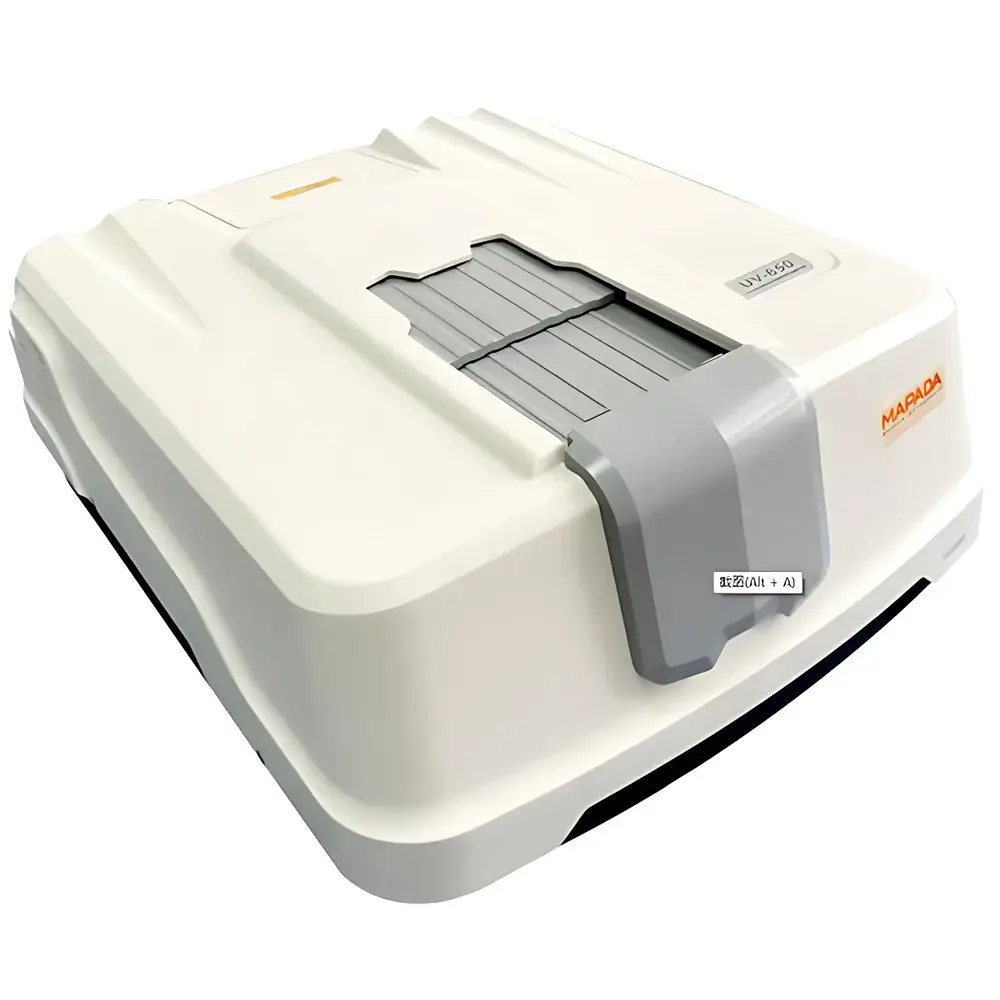
UV-690 Dual-Monochromator UV-Vis Spectrophotometer with Photomultiplier Tube Detector
| Origin | Shanghai, China |
|---|---|
| Manufacturer Type | Authorized Distributor |
| Regional Origin | Domestic (China) |
| Model | UV-690 |
| Instrument Architecture | Double-Beam |
| Detector Type | Photomultiplier Tube (PMT) |
| Wavelength Range | 190–900 nm |
| Wavelength Accuracy | ±0.3 nm |
| Spectral Bandwidth | 2 nm |
| Stray Light | ≤0.01% T |
| Linear Dynamic Range | Up to 5.0 Absorbance Units (A) |
| Power Supply | 100–240 V AC, 50/60 Hz, 160 W |
| Standard Sample Holder | 10-mm Single-Cell Rack |
| Light Sources | Deuterium Lamp (UV), Tungsten-Halogen Lamp (Vis–NIR) |
Overview
The UV-690 is a high-performance dual-monochromator ultraviolet–visible (UV-Vis) spectrophotometer engineered for precision quantitative and qualitative analysis in regulated and research-intensive laboratory environments. Unlike CCD-based instruments optimized for speed and multi-wavelength acquisition, the UV-690 employs a photomultiplier tube (PMT) detector — a vacuum-tube transducer renowned for exceptional signal-to-noise ratio, wide dynamic range, and superior sensitivity in low-light conditions. Its double-beam optical architecture continuously compares sample and reference beam intensities in real time, effectively compensating for source drift, lamp aging, and environmental fluctuations. The instrument operates across a broad spectral range of 190–900 nm, covering deep UV through near-infrared, enabling applications from nucleic acid quantification at 260 nm to transition metal complex analysis beyond 800 nm. The dual-monochromator design — featuring two sequential dispersion elements — achieves ultra-low stray light (<0.01% T), critical for measuring highly absorbing samples (e.g., concentrated dyes, biological extracts, or catalyst solutions) without deviation from Beer–Lambert linearity up to 5.0 A.
Key Features
- Dual-monochromator optical system delivering <0.01% T stray light — essential for high-absorbance measurements and extended linear dynamic range
- Photomultiplier tube (PMT) detector with high quantum efficiency in UV and visible regions, supporting detection limits down to sub-nanomolar concentrations
- Double-beam configuration with real-time reference correction, ensuring measurement stability over extended acquisition periods
- Wavelength accuracy of ±0.3 nm across full 190–900 nm range, verified against NIST-traceable holmium oxide and didymium filters
- Spectral bandwidth fixed at 2 nm — optimized for resolution of closely spaced absorption maxima while maintaining sufficient radiant throughput
- Integrated deuterium (190–350 nm) and tungsten-halogen (350–900 nm) lamps with automatic source switching and intensity balancing
- Compliant optical path design accommodating standard 10-mm rectangular quartz or fused-silica cuvettes; optional accessories include Peltier-controlled cells and fiber-optic probes
Sample Compatibility & Compliance
The UV-690 supports liquid, solution-phase samples in standard 10-mm pathlength cuvettes. Its high dynamic range (0–5.0 A) eliminates the need for serial dilution of viscous or highly concentrated samples — a key advantage over diode-array or CCD-based systems limited to ~2.5 A. The instrument meets fundamental performance criteria outlined in ISO 6425 (spectrophotometer verification), ASTM E275 (describing UV-Vis measurement practices), and USP (Spectrophotometry and Light-Scattering). Audit trail functionality, user-level access control (administrator/operator/guest), and electronic signature support align with FDA 21 CFR Part 11 requirements for regulated pharmaceutical and clinical laboratories operating under GLP or GMP frameworks.
Software & Data Management
The UV-690 is operated via dedicated PC-based software compliant with Windows 10/11 (64-bit). The interface provides method-driven workflows including photometric mode, wavelength scanning, kinetic assays, multi-component analysis, and DNA/protein quantitation using built-in extinction coefficients. All data files are saved in proprietary but exportable formats (.uvd, .csv, .pdf), with metadata embedding instrument ID, operator login, timestamp, calibration history, and parameter settings. Audit trail logs record every user action — method creation, spectrum acquisition, result modification, and report generation — with immutable timestamps and user attribution. Software validation documentation (IQ/OQ protocols) and electronic signature templates are available upon request for compliance-driven deployments.
Applications
- Quantitative analysis of pharmaceutical actives and impurities per ICH Q2(R2) guidelines
- Enzyme kinetics monitoring via continuous absorbance tracking at defined wavelengths (e.g., NADH at 340 nm)
- Quality control of dyes, pigments, and optical brighteners requiring high-absorbance linearity
- Characterization of nanomaterials (e.g., gold nanoparticles) via surface plasmon resonance band profiling
- Validation of cleaning procedures in biopharmaceutical manufacturing using residual protein assays
- Educational use in analytical chemistry curricula emphasizing fundamental spectroscopic principles and instrument calibration
FAQ
What is the primary advantage of using a PMT over a CCD detector in UV-Vis spectrophotometry?
PMTs offer significantly higher gain and lower dark current than CCDs, enabling superior sensitivity at low light levels and extended linear response up to 5.0 A — ideal for undiluted, high-concentration samples.
Does the UV-690 support regulatory compliance for pharmaceutical QC labs?
Yes — it includes configurable user roles, full audit trail logging, electronic signatures, and calibration traceability aligned with FDA 21 CFR Part 11 and EU Annex 11 expectations.
Can the instrument perform kinetic measurements?
Yes — time-resolved absorbance monitoring is supported at user-defined intervals, with data exportable for post-acquisition rate constant calculation.
Is lamp alignment or monochromator calibration required by the end user?
No — both deuterium and tungsten lamps feature automatic positioning and intensity optimization; wavelength calibration is performed using internal reference standards during startup and can be manually re-verified.
What cuvette materials are compatible with the full 190–900 nm range?
Quartz (fused silica) cuvettes are required for measurements below 350 nm; standard optical glass cuvettes may be used above 350 nm, though quartz is recommended for consistency across the entire range.





