
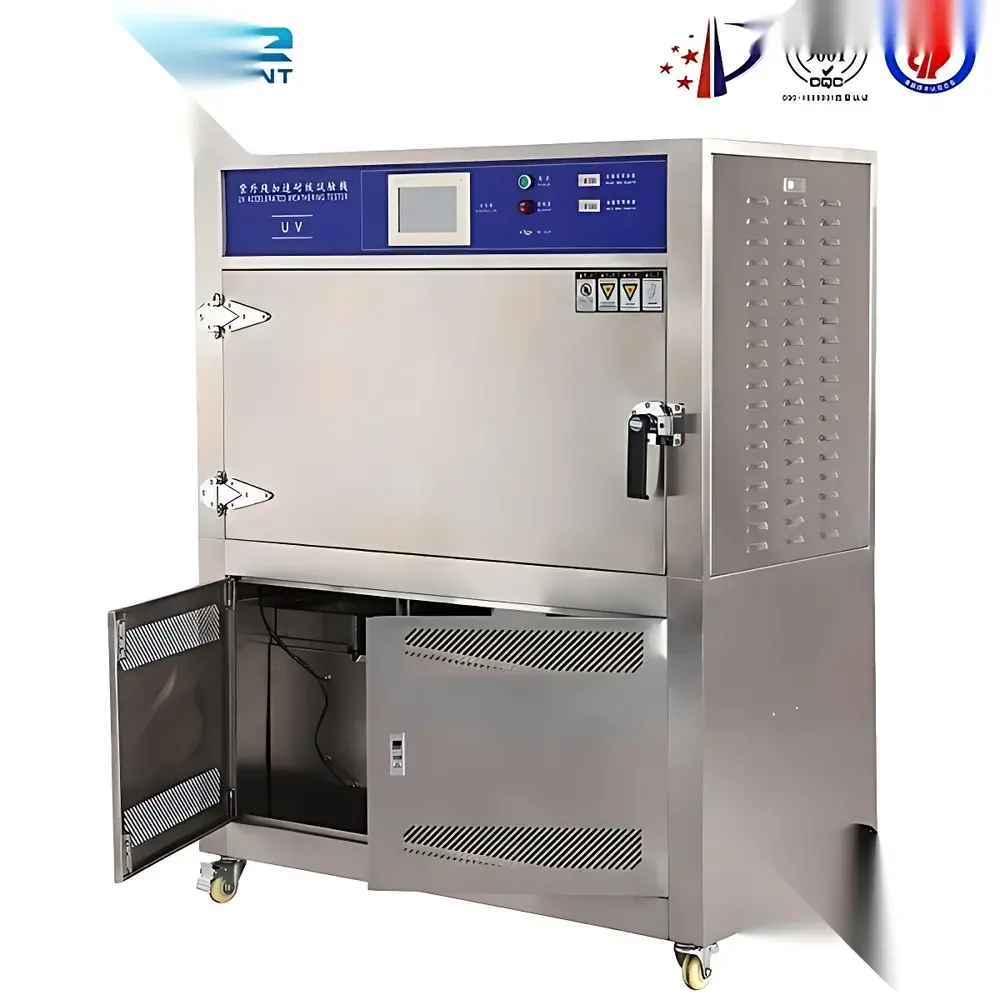
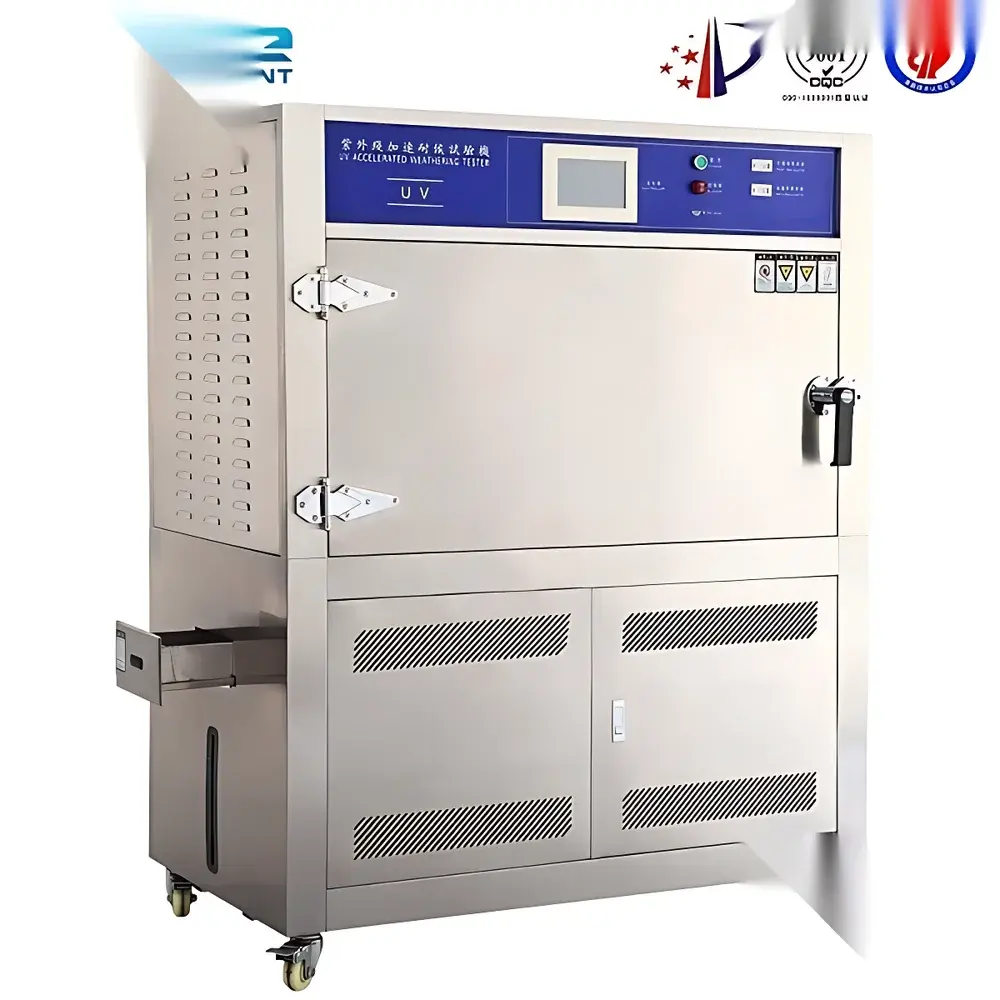
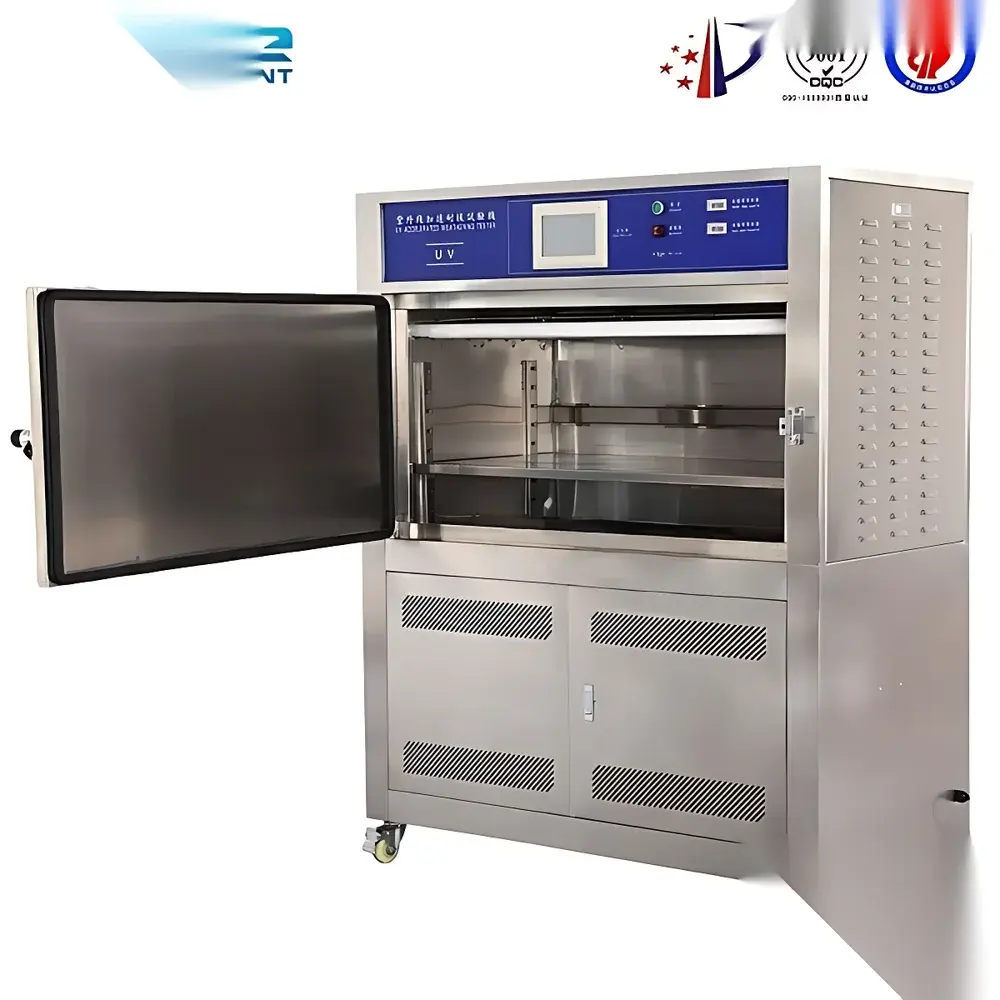
UV Accelerated Weathering Test Chamber OK-UV-290
| Brand | Other Brands |
|---|---|
| Origin | Imported |
| Manufacturer Type | General Distributor |
| Price | USD 3,200 (FOB) |
| Internal Chamber Dimensions (W×H×D) | 114 × 40 × 40 cm |
| External Dimensions (W×H×D) | 135 × 140 × 65 cm |
| Temperature Range | Ambient to 70 °C |
| Humidity Range | ≥95% RH |
| Temperature Control Accuracy | ≤ ±0.5 °C |
| Temperature Uniformity | ≤ ±2 °C or ≤ ±3% |
| UV Lamp Type | Fluorescent UV Lamps (UVA-340 or UVB-313 equivalent) |
| UV Wavelength Range | 280–400 nm |
| Lamp Service Life | Approx. 2,000 hours |
| Exposure Time Setting Range | 0–999 h |
| Chamber Material | SUS#304 Stainless Steel (Interior & Exterior) |
| Heating System | U-shaped Titanium Alloy High-Speed Heating Elements |
| Safety Features | Interlocked UV lamp cutoff upon door opening, Overtemperature Protection, Low-Water Level Cut-off |
| Power Supply | AC 220 ±5 V, 50 ±0.5 Hz |
Overview
The OK-UV-290 UV Accelerated Weathering Test Chamber is an engineered environmental simulation system designed to replicate the photochemical and hygrothermal degradation mechanisms induced by natural sunlight, moisture, and thermal cycling. It operates on the principle of controlled ultraviolet radiation exposure—primarily in the UVA (315–400 nm) and UVB (280–315 nm) spectral bands—combined with condensation and optional water spray cycles to accelerate material aging under repeatable laboratory conditions. Unlike full-spectrum xenon arc testers, this chamber utilizes fluorescent UV lamps calibrated to match critical solar irradiance profiles defined in ASTM G154 and ISO 4892-3, enabling high-throughput screening of polymer stability, coating durability, and pigment resistance without requiring complex optical filtering or high-power cooling infrastructure. Its architecture supports both irradiance-controlled and time-based exposure protocols, making it suitable for routine quality control as well as comparative accelerated life testing in regulated R&D environments.
Key Features
- Fluorescent UV lamp array compliant with ASTM G154 Class I and II spectral requirements, offering selectable UVA-340 (sunlight simulation) or UVB-313 (harsh accelerated aging) output configurations
- Integrated condensation cycle via heated water reservoir and controlled chamber wall temperature differential, replicating dew formation at 100% RH during dark periods
- Precise PID-controlled temperature regulation from ambient to 70 °C with ≤ ±0.5 °C accuracy and ≤ ±2 °C uniformity across the test volume
- SUS#304 stainless steel construction—both interior and exterior—for long-term corrosion resistance and ease of cleaning in aggressive UV/humidity environments
- Interlocked safety system: automatic UV lamp deactivation upon door opening, plus independent overtemperature and low-water-level protection circuits
- Front-accessible lamp replacement design with standardized G13 base sockets; average lamp service life rated at 2,000 hours under nominal operating conditions
- Programmable exposure timer (0–999 hours) with non-volatile memory retention and power-fail recovery functionality
Sample Compatibility & Compliance
The OK-UV-290 accommodates flat-panel specimens up to 100 × 50 cm (custom fixtures available), with adjustable sample racks supporting multi-angle mounting for directional exposure assessment. It meets core international standards for UV exposure testing including ASTM G153 (for enclosed carbon-arc apparatus), ASTM G154 (fluorescent UV-condensation apparatus), ASTM D4329 (plastics), ASTM D4587 (coatings), ASTM D4799 (wood products), SAE J2020 (automotive exterior materials), and ISO 4892-3 (methods for plastics—fluorescent UV lamp exposure). While not inherently 21 CFR Part 11 compliant, its operational logs and exposure records can be integrated into GLP/GMP-aligned documentation workflows when paired with external audit-trail-enabled data acquisition systems.
Software & Data Management
The chamber operates via a dedicated microprocessor-based controller with LED display and tactile keypad interface. No embedded PC or proprietary software is included; however, analog voltage outputs (0–5 V DC) for temperature and irradiance monitoring are provided for integration with third-party SCADA or LIMS platforms. Optional RS-485 Modbus RTU communication enables remote parameter setting, real-time status polling, and event logging—including lamp-on duration, temperature deviation alarms, and condensation cycle completion timestamps. All operational parameters are retained in EEPROM memory with battery-backed retention exceeding 10 years.
Applications
This test chamber is routinely deployed in QC laboratories and materials development groups across industries where photostability and weather resistance are mission-critical. Key use cases include: evaluating UV resistance of automotive clearcoats and interior trim polymers per SAE J2020; assessing gloss retention and chalking behavior in architectural coatings per ASTM D4587; validating shelf-life stability of medical device packaging films; screening adhesive bond integrity under cyclic UV/moisture stress; qualifying outdoor signage substrates for ISO 4892-3 compliance; and supporting regulatory submissions for cosmetic packaging under ICH Q1B photostability guidelines. Its reproducible irradiance profile supports inter-laboratory correlation studies when operated within standardized lamp calibration and maintenance protocols.
FAQ
What UV lamp types are supported, and how often must they be replaced?
The chamber accepts standard G13-base fluorescent UV lamps—UVA-340 for realistic sunlight simulation or UVB-313 for aggressive acceleration. Lamps should be replaced after 2,000 hours of cumulative operation or sooner if irradiance output falls below 90% of initial calibration value.
Is condensation the only moisture mechanism available?
Yes—the standard configuration provides only condensation-based humidity cycling. Water spray functionality is not included but may be added via third-party retrofit kits meeting IPX5-rated ingress protection specifications.
Can the chamber operate continuously for extended durations (e.g., >500 h)?
Yes, provided routine maintenance is performed—including weekly visual inspection of lamp integrity, monthly cleaning of condensate drain lines, and quarterly verification of temperature sensor calibration using NIST-traceable reference probes.
Does the unit comply with CE or UL safety directives?
The chamber conforms to IEC 61000-6-3 (EMC emission) and IEC 61000-6-2 (immunity) standards. CE marking is available upon request with EU Representative designation and DoC preparation; UL 61010-1 certification requires factory-installed modifications and additional evaluation.
How is irradiance monitored and calibrated?
Irradiance is not measured in situ by the base unit. Users must employ a traceable UV radiometer (e.g., calibrated to NIST SRM 2241) at the specimen plane during qualification and periodic verification—typically every 100 hours of lamp operation or per internal QA schedule.



