
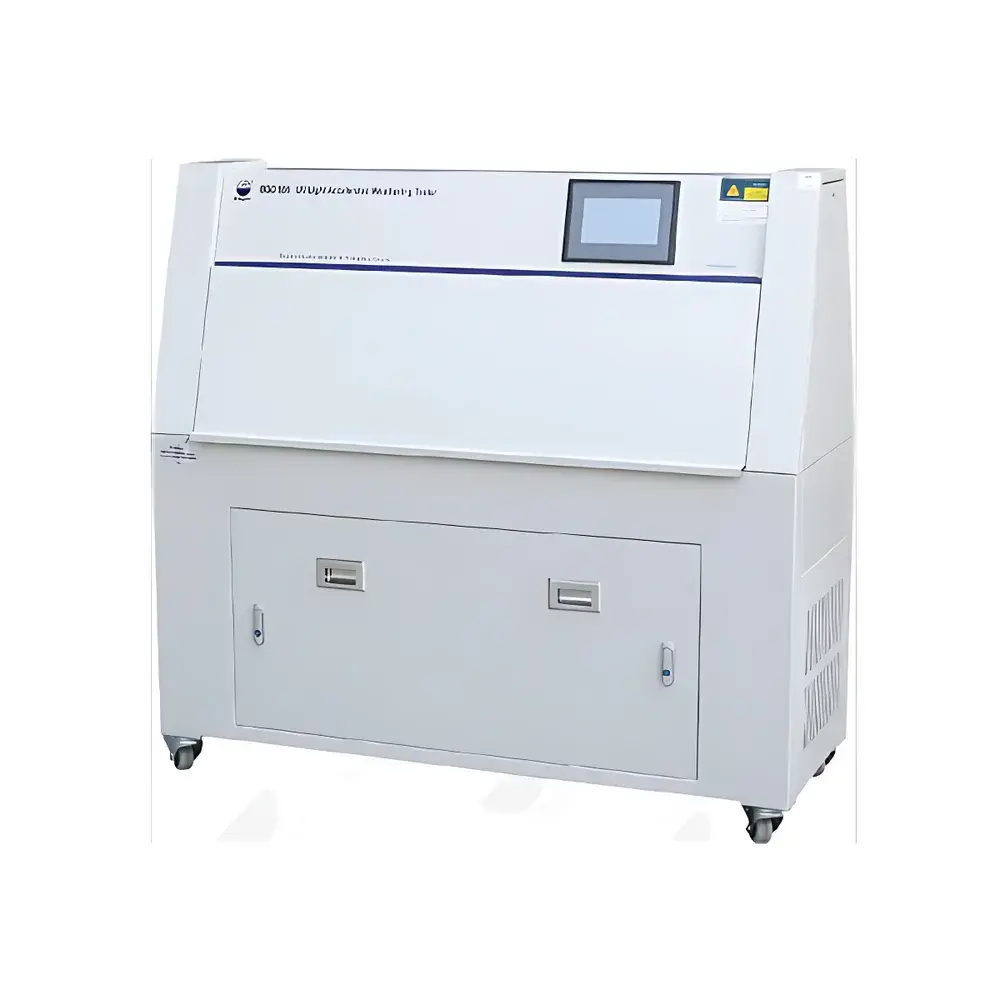
UV Aging Test Chamber BJ-BDG859 by GBPI
| Brand | GBPI |
|---|---|
| Model | BJ-BDG859 |
| Origin | Guangdong, China |
| Manufacturer Type | Direct Manufacturer |
| Country of Origin | China |
| Price | USD 17,800 (FOB Guangdong) |
Overview
The GBPI BJ-BDG859 UV Aging Test Chamber is an engineered laboratory-grade environmental test system designed for accelerated weathering evaluation of polymeric materials under controlled ultraviolet (UV) irradiation, temperature, and humidity cycling. It operates on the principle of fluorescent UV lamp-based exposure—specifically conforming to ISO 16474-3, ISO 4892-3, ASTM D4587, ASTM G154, and GB/T 16422.3—wherein standardized UVA-340 or UVB-313 fluorescent lamps replicate the short-wavelength UV component of terrestrial sunlight (290–400 nm). The chamber integrates programmable condensation cycles (100% RH, 40–60 °C) and optional water spray functionality to simulate dew formation and rain erosion. Unlike xenon arc or carbon arc systems, fluorescent UV technology provides high spectral stability over extended operational life, enabling reproducible degradation kinetics across multiple test runs. This architecture ensures traceable correlation between lab-scale exposure and real-world outdoor service life—particularly critical for QC/QA in coatings, automotive trim, architectural sealants, and wood finishes.
Key Features
- Four independently calibrated UV irradiance sensors (UVA-340 or UVB-313 spectral response) mounted on a rotating sample carousel for spatial uniformity verification
- Closed-loop irradiance control system maintaining ±3% deviation from setpoint throughout lamp lifetime (up to 6,000 hours)
- Patented domestically developed electronic ballast with adaptive power compensation—extending lamp service life while preserving spectral output integrity
- Programmable multi-step test profiles: simultaneous UV irradiation + condensation; UV + water spray; dark condensation only; or hybrid cycles per ASTM D5894
- Stainless steel 316L interior chamber with quartz UV-transmissive viewing window and corrosion-resistant sample racks
- Integrated black panel thermometer (BPT) and air temperature sensor compliant with ISO 16474-1 calibration requirements
Sample Compatibility & Compliance
The BJ-BDG859 accommodates flat-panel specimens up to 150 mm × 300 mm × 20 mm (W × L × H), including coated metal substrates, plastic injection-molded parts, laminated composites, and textile-backed films. All test protocols align with regulatory frameworks governing product durability claims: ISO 16474 series for paint and varnish qualification; ASTM D4329 and D5894 for polymer stabilization validation; GB/T 14522 and GB/T 23987 for Chinese national certification of architectural coatings and furniture finishes; and SAE J2020 for automotive exterior material approval. Data generated meets GLP documentation standards—including timestamped irradiance logs, temperature/humidity event records, and lamp hour counters—supporting FDA 21 CFR Part 11-compliant audit trails when integrated with validated LIMS platforms.
Software & Data Management
Equipped with GBPI’s proprietary WinUV v3.2 control software, the system supports real-time monitoring via Ethernet or RS-485 interface. Users define custom exposure sequences using drag-and-drop cycle builders, assign pass/fail criteria based on ΔE*ab color shift or gloss retention thresholds, and export raw sensor data in CSV/Excel format. Software includes built-in compliance reporting modules preconfigured for ISO, ASTM, and GB standard templates—automatically generating test certificates with embedded metadata (lamp batch ID, calibration date, operator signature). Firmware supports firmware-over-the-air (FOTA) updates and maintains full backward compatibility with historical test method libraries.
Applications
This chamber serves as a primary qualification tool in R&D and production QA labs for evaluating photochemical degradation mechanisms—including chain scission, crosslinking, chalking, gloss loss, and yellowing—in solvent-borne and waterborne coatings (e.g., marine hull paints, UV-curable wood finishes, coil-coated aluminum); thermoplastic elastomers used in automotive grilles and bumpers; silicone-based construction sealants; and PVC-based window profiles. Its ability to isolate UV-driven damage pathways—decoupled from thermal oxidation or infrared heating effects—makes it indispensable for formulating UV absorbers, HALS stabilizers, and pigment dispersion systems. Industrial users routinely deploy it for supplier qualification audits, shelf-life modeling, and failure root cause analysis following field return investigations.
FAQ
What UV lamp types are supported?
UVA-340 (peak 340 nm, simulates solar UV below 365 nm) and UVB-313 (peak 313 nm, aggressive acceleration for screening) lamps—both supplied as original equipment manufacturer (OEM) units with traceable spectral certification.
Is irradiance calibration traceable to NIST or equivalent national standards?
Yes—each irradiance sensor is factory-calibrated against a NIST-traceable reference spectroradiometer, with calibration certificate provided per unit. Annual recalibration is recommended per ISO/IEC 17025 guidelines.
Can the chamber operate unattended for extended cycles?
Fully autonomous operation is supported for up to 1,000 hours with automatic lamp power compensation, condensate drainage monitoring, and fault-triggered email/SMS alerts via optional IoT gateway module.
Does the system comply with FDA 21 CFR Part 11 for electronic records?
When deployed with WinUV v3.2 in validated configuration (including user access controls, electronic signatures, and audit trail archiving), it satisfies predicate rule requirements for regulated pharmaceutical and medical device coating testing.
What maintenance intervals are required?
Lamp replacement every 6,000 hours (or per spectral output decay ≥15%), sensor recalibration annually, and stainless-steel chamber cleaning with deionized water after each test series to prevent residue buildup.



